4RFY | pdb_00004rfy

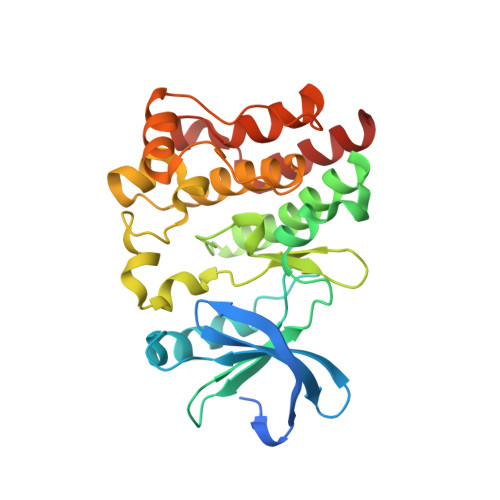
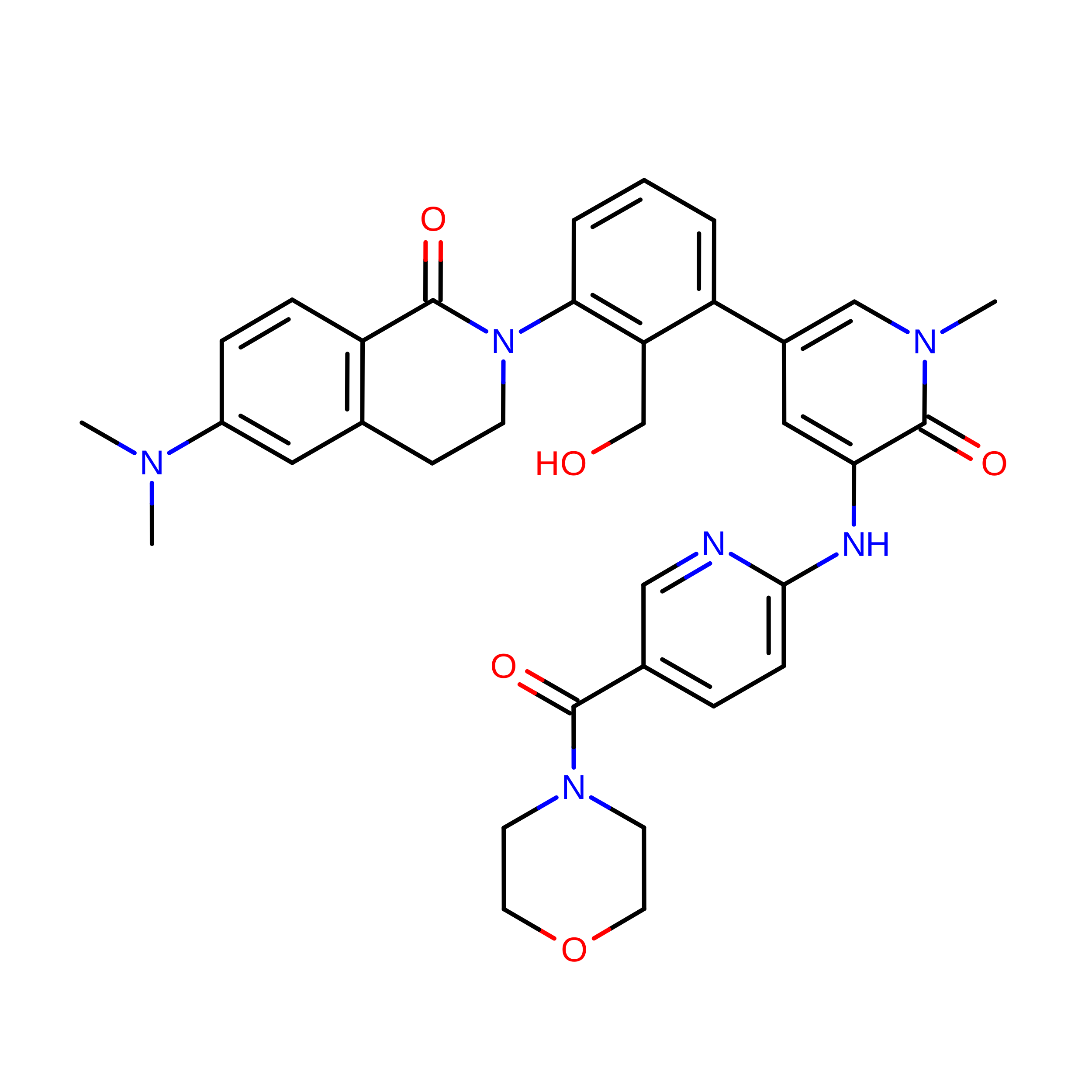
Crystal structure of BTK kinase domain complexed with 6-(dimethylamino)-2-[2-(hydroxymethyl)-3-[1-methyl-5-[[5-(morpholine-4-carbonyl)-2-pyridyl]amino]-6-oxo-3-pyridyl]phenyl]-3,4-dihydroisoquinolin-1-one


Experimental Data Snapshot

  • Method: X-RAY DIFFRACTION
  • Resolution: 1.70 Å
  • R-Value Free: 
    0.219 (Depositor), 0.237 (DCC) 
  • R-Value Work: 
    0.182 (Depositor) 
  • R-Value Observed: 
    0.184 (Depositor) 

Starting Model: experimental
View more details

wwPDB Validation 3D Report Full Report

Validation slider image for 4RFY

Ligand Structure Quality Assessment 


This is version 1.3 of the entry. See complete history

Literature

Finding the perfect spot for fluorine: Improving potency up to 40-fold during a rational fluorine scan of a Bruton's Tyrosine Kinase (BTK) inhibitor scaffold.

Lou, Y.Sweeney, Z.K.Kuglstatter, A.Davis, D.Goldstein, D.M.Han, X.Hong, J.Kocer, B.Kondru, R.K.Litman, R.McIntosh, J.Sarma, K.Suh, J.Taygerly, J.Owens, T.D.

(2015) Bioorg Med Chem Lett 25: 367-371

  • DOI: https://doi.org/10.1016/j.bmcl.2014.11.030
  • Primary Citation Related Structures: 
    4RFY, 4RFZ, 4RG0

  • PubMed Abstract: 

    A rational fluorine scan based on co-crystal structures was explored to increase the potency of a series of selective BTK inhibitors. While fluorine substitution on a saturated bicyclic ring system yields no apparent benefit, the same operation on an unsaturated bicyclic ring can increase HWB activity by up to 40-fold. Comparison of co-crystal structures of parent molecules and fluorinated counterparts revealed the importance of placing fluorine at the optimal position to achieve favorable interactions with protein side chains.


  • Organizational Affiliation
    • Hoffmann-La Roche Inc., pRED, Pharma Research & Early Development, Small Molecule Research, Discovery Chemistry, 3431 Hillview Ave, Palo Alto, CA 94304, United States. Electronic address: ylou@nurix-inc.com.

Macromolecule Content 

  • Total Structure Weight: 33.29 kDa 
  • Atom Count: 2,447 
  • Modeled Residue Count: 263 
  • Deposited Residue Count: 283 
  • Unique protein chains: 1

Macromolecules

Find similar proteins by:|  3D Structure
Entity ID: 1
MoleculeChains  Sequence LengthOrganismDetailsImage
Tyrosine-protein kinase BTK283Homo sapiensMutation(s): 4 
Gene Names: BTKAGMX1ATKBPK
EC: 2.7.10.2
UniProt & NIH Common Fund Data Resources
Find proteins for Q06187 (Homo sapiens)
Explore Q06187 
Go to UniProtKB:  Q06187
PHAROS:  Q06187
GTEx:  ENSG00000010671 
Entity Groups
Sequence Clusters30% Identity50% Identity70% Identity90% Identity95% Identity100% Identity
UniProt GroupQ06187
Sequence Annotations
Expand
Reference Sequence

Small Molecules

Ligands 2 Unique
IDChains Name / Formula / InChI Key2D Diagram3D Interactions
3OU

Query on 3OU


Download:Ideal Coordinates CCD File
B [auth A]6-(dimethylamino)-2-[2-(hydroxymethyl)-3-(1-methyl-5-{[5-(morpholin-4-ylcarbonyl)pyridin-2-yl]amino}-6-oxo-1,6-dihydropyridin-3-yl)phenyl]-3,4-dihydroisoquinolin-1(2H)-one
C34 H36 N6 O5
SJBGHIGDLWCJIO-UHFFFAOYSA-N
DMS

Query on DMS


Download:Ideal Coordinates CCD File
C [auth A],
D [auth A]
DIMETHYL SULFOXIDE
C2 H6 O S
IAZDPXIOMUYVGZ-UHFFFAOYSA-N

Experimental Data & Validation

Experimental Data

  • Method: X-RAY DIFFRACTION
  • Resolution: 1.70 Å
  • R-Value Free:  0.219 (Depositor), 0.237 (DCC) 
  • R-Value Work:  0.182 (Depositor) 
  • R-Value Observed: 0.184 (Depositor) 
Space Group: P 21 21 2
Unit Cell:
Length ( Å )Angle ( ˚ )
a = 71.805α = 90
b = 107.123β = 90
c = 38.305γ = 90
Software Package:
Software NamePurpose
REFMACrefinement
CNSrefinement
ADSCdata collection
DENZOdata reduction
SCALEPACKdata scaling
CNSphasing

Structure Validation

View Full Validation Report


Ligand Structure Quality Assessment 


Entry History 

Deposition Data

Revision History  (Full details and data files)

  • Version 1.0: 2014-12-24
    Type: Initial release
  • Version 1.1: 2015-01-14
    Changes: Database references
  • Version 1.2: 2019-07-17
    Changes: Data collection, Refinement description
  • Version 1.3: 2023-09-20
    Changes: Data collection, Database references, Derived calculations, Refinement description