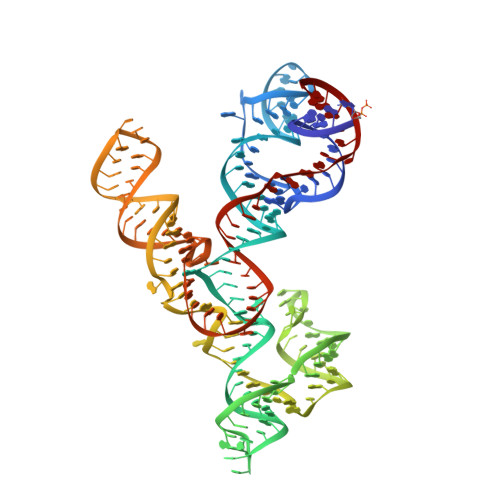
4R4V | pdb_00004r4v

Crystal structure of the VS ribozyme - G638A mutant


Experimental Data Snapshot

  • Method: X-RAY DIFFRACTION
  • Resolution: 3.07 Å
  • R-Value Free: 
    0.204 (Depositor), 0.221 (DCC) 
  • R-Value Work: 
    0.179 (Depositor), 0.204 (DCC) 
  • R-Value Observed: 
    0.180 (Depositor) 

wwPDB Validation 3D Report Full Report

Validation slider image for 4R4V

This is version 2.1 of the entry. See complete history

Literature

Crystal structure of the Varkud satellite ribozyme.

Suslov, N.B.DasGupta, S.Huang, H.Fuller, J.R.Lilley, D.M.Rice, P.A.Piccirilli, J.A.

(2015) Nat Chem Biol 11: 840-846

  • DOI: https://doi.org/10.1038/nchembio.1929
  • Primary Citation Related Structures: 
    4R4P, 4R4V

  • PubMed Abstract: 

    The Varkud satellite (VS) ribozyme mediates rolling-circle replication of a plasmid found in the Neurospora mitochondrion. We report crystal structures of this ribozyme from Neurospora intermedia at 3.1 Å resolution, which revealed an intertwined dimer formed by an exchange of substrate helices. In each protomer, an arrangement of three-way helical junctions organizes seven helices into a global fold that creates a docking site for the substrate helix of the other protomer, resulting in the formation of two active sites in trans. This mode of RNA-RNA association resembles the process of domain swapping in proteins and has implications for RNA regulation and evolution. Within each active site, adenine and guanine nucleobases abut the scissile phosphate, poised to serve direct roles in catalysis. Similarities to the active sites of the hairpin and hammerhead ribozymes highlight the functional importance of active-site features, underscore the ability of RNA to access functional architectures from distant regions of sequence space, and suggest convergent evolution.


  • Organizational Affiliation
    • Department of Biochemistry and Molecular Biology, The University of Chicago, Chicago, Illinois, USA.

Macromolecule Content 

  • Total Structure Weight: 60.58 kDa 
  • Atom Count: 3,848 
  • Modeled Residue Count: 186 
  • Deposited Residue Count: 186 
  • Unique nucleic acid chains: 1

Macromolecules

Find similar nucleic acids by:  (by identity cutoff) 
Entity ID: 1
MoleculeChains LengthOrganismImage
VS ribozyme RNA186Neurospora
Sequence Annotations
Expand
Reference Sequence

Small Molecules

Ligands 2 Unique
IDChains Name / Formula / InChI Key2D Diagram3D Interactions
K

Query on K


Download:Ideal Coordinates CCD File
C [auth A],
E [auth A],
J [auth A],
K [auth A],
L [auth A]
POTASSIUM ION
K
NPYPAHLBTDXSSS-UHFFFAOYSA-N
MG

Query on MG


Download:Ideal Coordinates CCD File
B [auth A]
D [auth A]
F [auth A]
G [auth A]
H [auth A]
B [auth A],
D [auth A],
F [auth A],
G [auth A],
H [auth A],
I [auth A],
M [auth A],
N [auth A],
O [auth A]
MAGNESIUM ION
Mg
JLVVSXFLKOJNIY-UHFFFAOYSA-N

Experimental Data & Validation

Experimental Data

  • Method: X-RAY DIFFRACTION
  • Resolution: 3.07 Å
  • R-Value Free:  0.204 (Depositor), 0.221 (DCC) 
  • R-Value Work:  0.179 (Depositor), 0.204 (DCC) 
  • R-Value Observed: 0.180 (Depositor) 
Space Group: P 43 21 2
Unit Cell:
Length ( Å )Angle ( ˚ )
a = 102.229α = 90
b = 102.229β = 90
c = 215.02γ = 90
Software Package:
Software NamePurpose
HKL-2000data collection
HKL-2000data reduction
HKL-2000data scaling
PHENIXrefinement
SHELXSphasing

Structure Validation

View Full Validation Report


Entry History 

Deposition Data

Revision History  (Full details and data files)

  • Version 1.0: 2015-09-30
    Type: Initial release
  • Version 1.1: 2015-11-04
    Changes: Database references
  • Version 2.0: 2022-06-08
    Changes: Advisory, Atomic model, Data collection, Database references, Derived calculations
  • Version 2.1: 2024-02-28
    Changes: Data collection