4Q9J | pdb_00004q9j

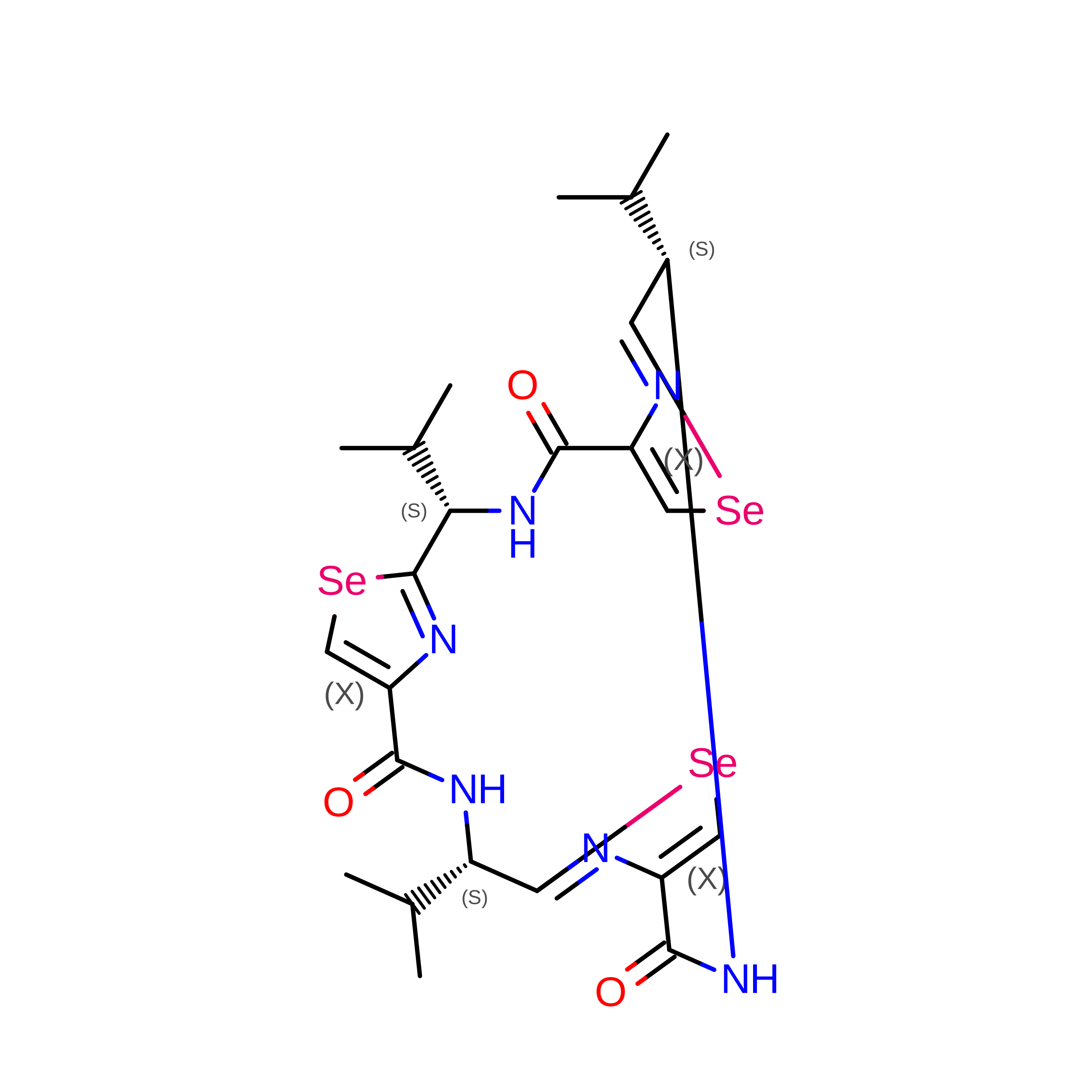
P-glycoprotein cocrystallised with QZ-Val


Experimental Data Snapshot

  • Method: X-RAY DIFFRACTION
  • Resolution: 3.60 Å
  • R-Value Free: 
    0.282 (Depositor), 0.303 (DCC) 
  • R-Value Work: 
    0.261 (Depositor), 0.286 (DCC) 
  • R-Value Observed: 
    0.262 (Depositor) 

wwPDB Validation 3D Report Full Report

Validation slider image for 4Q9J

This is version 3.0 of the entry. See complete history

Literature

Snapshots of ligand entry, malleable binding and induced helical movement in P-glycoprotein.

Szewczyk, P.Tao, H.McGrath, A.P.Villaluz, M.Rees, S.D.Lee, S.C.Doshi, R.Urbatsch, I.L.Zhang, Q.Chang, G.

(2015) Acta Crystallogr D Biol Crystallogr 71: 732-741

  • DOI: https://doi.org/10.1107/S1399004715000978
  • Primary Citation Related Structures: 
    4Q9H, 4Q9I, 4Q9J, 4Q9K, 4Q9L

  • PubMed Abstract: 

    P-glycoprotein (P-gp) is a transporter of great clinical and pharmacological significance. Several structural studies of P-gp and its homologs have provided insights into its transport cycle, but questions remain regarding how P-gp recognizes diverse substrates and how substrate binding is coupled to ATP hydrolysis. Here, four new P-gp co-crystal structures with a series of rationally designed ligands are presented. It is observed that the binding of certain ligands, including an ATP-hydrolysis stimulator, produces a large conformational change in the fourth transmembrane helix, which is positioned to potentially transmit a signal to the nucleotide-binding domains. A new ligand-binding site on the surface of P-gp facing the inner leaflet of the membrane is also described, providing vital insights regarding the entry mechanism of hydrophobic drugs and lipids into P-gp. These results represent significant advances in the understanding of how P-gp and related transporters bind and export a plethora of metabolites, antibiotics and clinically approved and pipeline drugs.


  • Organizational Affiliation
    • Division of Biological Sciences, University of California at San Diego, La Jolla, CA 92023, USA.

Macromolecule Content 

  • Total Structure Weight: 144.2 kDa 
  • Atom Count: 9,315 
  • Modeled Residue Count: 1,205 
  • Deposited Residue Count: 1,302 
  • Unique protein chains: 2

Macromolecules

Find similar proteins by:|  3D Structure
Entity ID: 1
MoleculeChains  Sequence LengthOrganismDetailsImage
Multidrug resistance protein 1A1,284Mus musculusMutation(s): 0 
Gene Names: Abcb1aAbcb4Mdr1aMdr3Pgy-3Pgy3
EC: 3.6.3.44 (PDB Primary Data), 7.6.2.1 (UniProt), 7.6.2.2 (UniProt)
Membrane Entity: Yes 
UniProt
Find proteins for P21447 (Mus musculus)
Explore P21447 
Go to UniProtKB:  P21447
Entity Groups
Sequence Clusters30% Identity50% Identity70% Identity90% Identity95% Identity100% Identity
UniProt GroupP21447
Sequence Annotations
Expand
Reference Sequence
Find similar proteins by:  Sequence   |   3D Structure  
Entity ID: 2
MoleculeChains  Sequence LengthOrganismDetailsImage
N-{[5-AMINO-1-(5-O-PHOSPHONO-BETA-D-ARABINOFURANOSYL)-1H-IMIDAZOL-4-YL]CARBONYL}-L-ASPARTIC ACIDB [auth C],
C [auth D],
D [auth B]
6N/AMutation(s): 0 

Small Molecules

Modified Residues  1 Unique
IDChains TypeFormula2D DiagramParent
30F
Query on 30F
B [auth C],
C [auth D],
D [auth B]
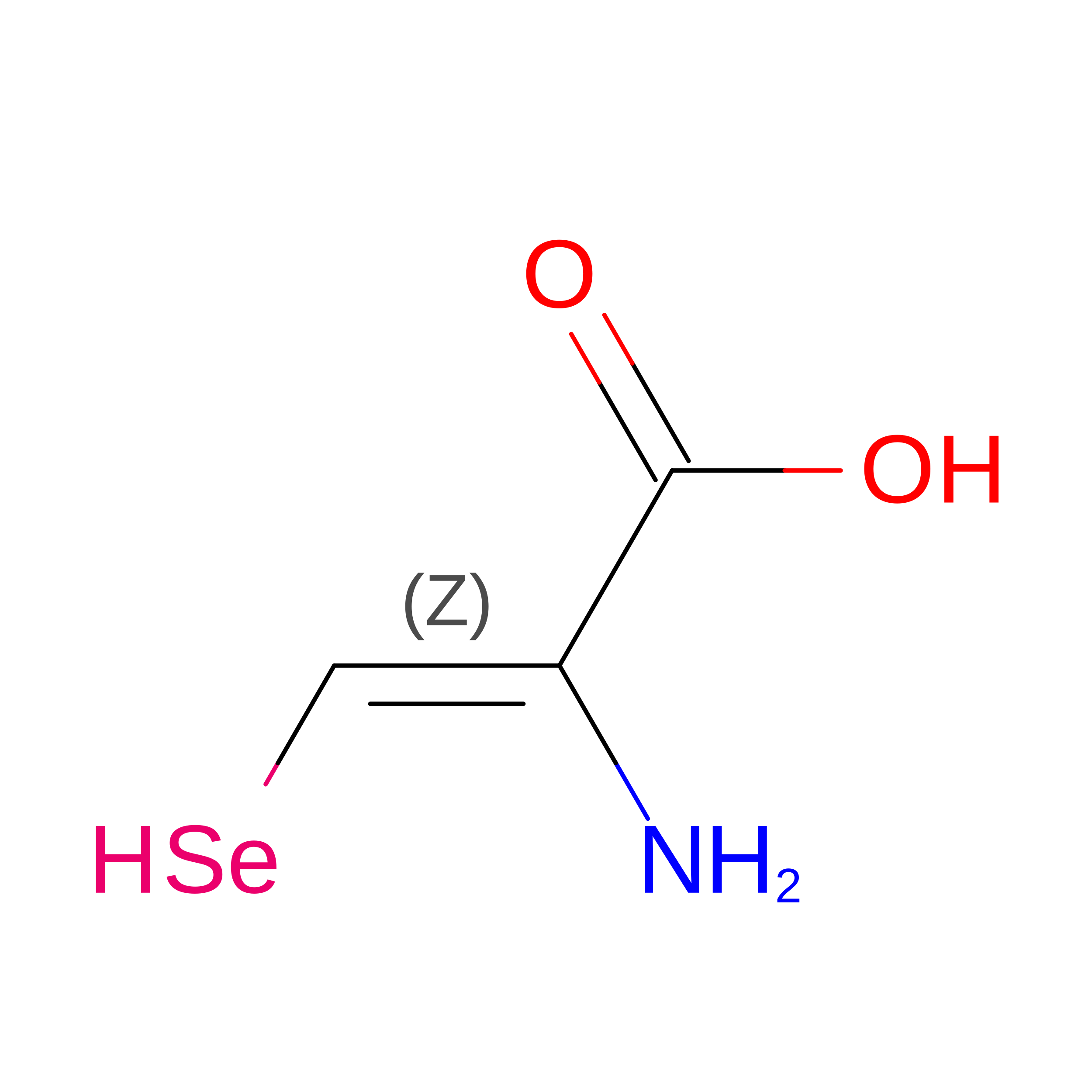
PEPTIDE LINKINGC3 H5 N O2 SeSEC

Experimental Data & Validation

Experimental Data

  • Method: X-RAY DIFFRACTION
  • Resolution: 3.60 Å
  • R-Value Free:  0.282 (Depositor), 0.303 (DCC) 
  • R-Value Work:  0.261 (Depositor), 0.286 (DCC) 
  • R-Value Observed: 0.262 (Depositor) 
Space Group: P 21 21 21
Unit Cell:
Length ( Å )Angle ( ˚ )
a = 88.74α = 90
b = 138.66β = 90
c = 189.99γ = 90
Software Package:
Software NamePurpose
SCALAdata scaling
PHENIXrefinement
PDB_EXTRACTdata extraction

Structure Validation

View Full Validation Report


Entry History 

Deposition Data

Revision History  (Full details and data files)

  • Version 1.0: 2015-03-04
    Type: Initial release
  • Version 1.1: 2015-03-18
    Changes: Database references
  • Version 2.0: 2023-11-15
    Changes: Atomic model, Data collection, Database references, Derived calculations
  • Version 3.0: 2024-07-10
    Changes: Polymer sequence