4OOG | pdb_00004oog

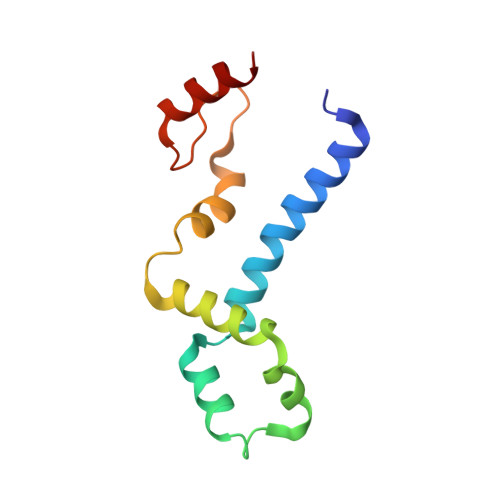
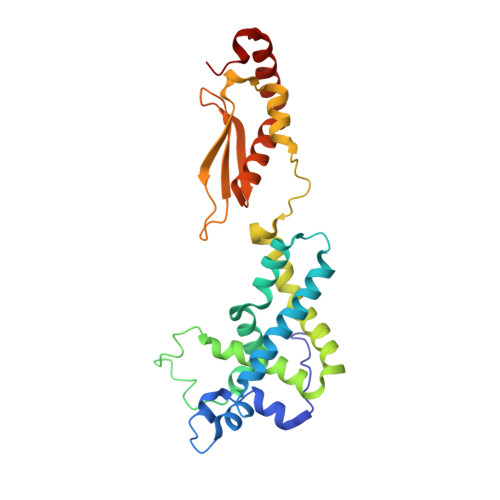
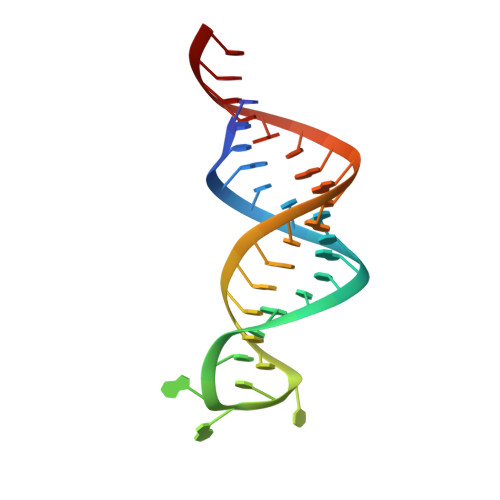
Crystal structure of yeast RNase III (Rnt1p) complexed with the product of dsRNA processing


Experimental Data Snapshot

  • Method: X-RAY DIFFRACTION
  • Resolution: 2.50 Å
  • R-Value Free: 
    0.239 (Depositor), 0.239 (DCC) 
  • R-Value Work: 
    0.216 (Depositor), 0.217 (DCC) 
  • R-Value Observed: 
    0.217 (Depositor) 

Starting Models: experimental
View more details

wwPDB Validation 3D Report Full Report

Validation slider image for 4OOG

This is version 1.3 of the entry. See complete history

Literature

Structure of a Eukaryotic RNase III Postcleavage Complex Reveals a Double-Ruler Mechanism for Substrate Selection.

Liang, Y.H.Lavoie, M.Comeau, M.A.Abou Elela, S.Ji, X.

(2014) Mol Cell 54: 431-444

  • DOI: https://doi.org/10.1016/j.molcel.2014.03.006
  • Primary Citation Related Structures: 
    4OOG

  • PubMed Abstract: 

    Ribonuclease III (RNase III) enzymes are a family of double-stranded RNA (dsRNA)-specific endoribonucleases required for RNA maturation and gene regulation. Prokaryotic RNase III enzymes have been well characterized, but how eukaryotic RNase IIIs work is less clear. Here, we describe the structure of the Saccharomyces cerevisiae RNase III (Rnt1p) postcleavage complex and explain why Rnt1p binds to RNA stems capped with an NGNN tetraloop. The structure shows specific interactions between a structural motif located at the end of the Rnt1p dsRNA-binding domain (dsRBD) and the guanine nucleotide in the second position of the loop. Strikingly, structural and biochemical analyses indicate that the dsRBD and N-terminal domains (NTDs) of Rnt1p function as two rulers that measure the distance between the tetraloop and the cleavage site. These findings provide a framework for understanding eukaryotic RNase IIIs.


  • Organizational Affiliation
    • Biomolecular Structure Section, Macromolecular Crystallography Laboratory, National Cancer Institute, Frederick, MD 21702, USA.

Macromolecule Content 

  • Total Structure Weight: 66.55 kDa 
  • Atom Count: 4,754 
  • Modeled Residue Count: 514 
  • Deposited Residue Count: 515 
  • Unique protein chains: 2
  • Unique nucleic acid chains: 1

Macromolecules


Find similar proteins by:|  3D Structure
Entity ID: 1
MoleculeChains  Sequence LengthOrganismDetailsImage
Ribonuclease 3
A, B
110Saccharomyces cerevisiae S288CMutation(s): 0 
Gene Names: RNT1YM9408.01CYM9959.21YMR239C
EC: 3.1.26.3
UniProt
Find proteins for Q02555 (Saccharomyces cerevisiae (strain ATCC 204508 / S288c))
Explore Q02555 
Go to UniProtKB:  Q02555
Entity Groups
Sequence Clusters30% Identity50% Identity70% Identity90% Identity95% Identity100% Identity
UniProt GroupQ02555
Sequence Annotations
Expand
Reference Sequence
Find similar proteins by:|  3D Structure
Entity ID: 2
MoleculeChains  Sequence LengthOrganismDetailsImage
Ribonuclease 3261Saccharomyces cerevisiae S288CMutation(s): 0 
Gene Names: RNT1YM9408.01CYM9959.21YMR239C
EC: 3.1.26.3
UniProt
Find proteins for Q02555 (Saccharomyces cerevisiae (strain ATCC 204508 / S288c))
Explore Q02555 
Go to UniProtKB:  Q02555
Entity Groups
Sequence Clusters30% Identity50% Identity70% Identity90% Identity95% Identity100% Identity
UniProt GroupQ02555
Sequence Annotations
Expand
Reference Sequence
Find similar nucleic acids by:  (by identity cutoff) 
Entity ID: 3
MoleculeChains LengthOrganismImage
34-mer RNA34N/A
Sequence Annotations
Expand
Reference Sequence

Experimental Data & Validation

Experimental Data

  • Method: X-RAY DIFFRACTION
  • Resolution: 2.50 Å
  • R-Value Free:  0.239 (Depositor), 0.239 (DCC) 
  • R-Value Work:  0.216 (Depositor), 0.217 (DCC) 
  • R-Value Observed: 0.217 (Depositor) 
Space Group: C 2 2 21
Unit Cell:
Length ( Å )Angle ( ˚ )
a = 157.972α = 90
b = 183.804β = 90
c = 61.289γ = 90
Software Package:
Software NamePurpose
XSCALEdata scaling
PHENIXrefinement
PDB_EXTRACTdata extraction
SERGUIdata collection
XDSdata reduction
PHENIXphasing

Structure Validation

View Full Validation Report


Entry History 

Deposition Data

Revision History  (Full details and data files)

  • Version 1.0: 2014-04-16
    Type: Initial release
  • Version 1.1: 2014-05-28
    Changes: Database references
  • Version 1.2: 2023-08-30
    Changes: Data collection, Database references, Derived calculations, Structure summary
  • Version 1.3: 2023-09-20
    Changes: Refinement description