4NWM | pdb_00004nwm

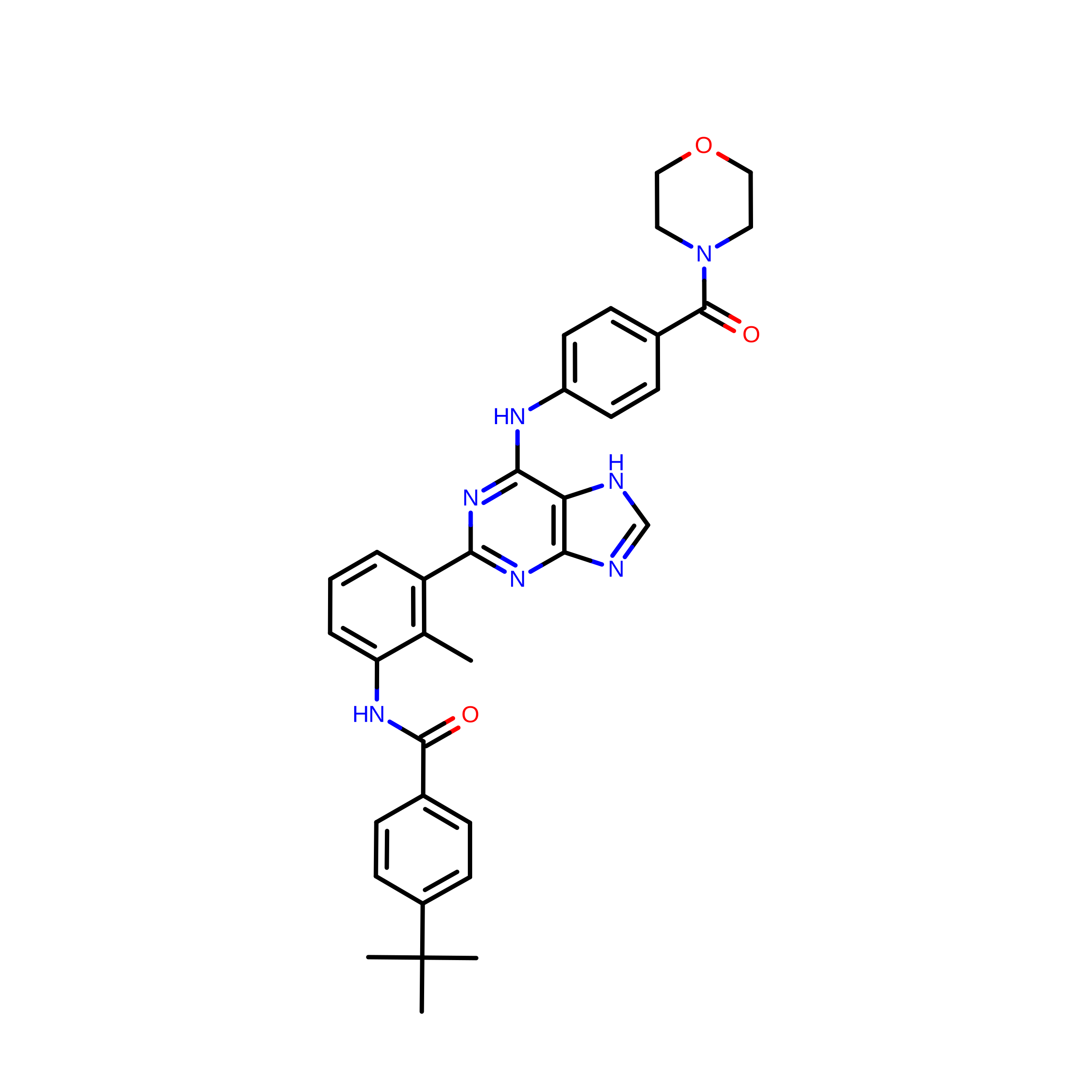
Crystal structure of Bruton agammaglobulinemia tyrosine kinase complexed with BMS-809959 aka 4-tert-butyl-n-[2-me thyl-3-(6-{[4-(morpholine-4-carbonyl)phenyl]amino}-9h- purin-2-yl)phenyl]benzamide


Experimental Data Snapshot

  • Method: X-RAY DIFFRACTION
  • Resolution: 2.03 Å
  • R-Value Free: 
    0.234 (Depositor), 0.231 (DCC) 
  • R-Value Work: 
    0.195 (Depositor) 
  • R-Value Observed: 
    0.197 (Depositor) 

wwPDB Validation 3D Report Full Report

Validation slider image for 4NWM

Ligand Structure Quality Assessment 


This is version 1.3 of the entry. See complete history

Literature

Purine derivatives as potent Bruton's tyrosine kinase (BTK) inhibitors for autoimmune diseases.

Shi, Q.Tebben, A.Dyckman, A.J.Li, H.Liu, C.Lin, J.Spergel, S.Burke, J.R.McIntyre, K.W.Olini, G.C.Strnad, J.Surti, N.Muckelbauer, J.K.Chang, C.An, Y.Cheng, L.Ruan, Q.Leftheris, K.Carter, P.H.Tino, J.De Lucca, G.V.

(2014) Bioorg Med Chem Lett 24: 2206-2211

  • DOI: https://doi.org/10.1016/j.bmcl.2014.02.075
  • Primary Citation Related Structures: 
    4NWM

  • PubMed Abstract: 

    Investigation of various heterocyclic core isosteres of imidazopyrazines 1 & 2 yielded purine derivatives 3 & 8 as potent and selective BTK inhibitors. Subsequent SAR studies of the purine series led to the discovery of 20 as a leading compound. Compound 20 is very selective when screened against a panel of 400 kinases and is a potent inhibitor in cellular assays of human B cell function including B-Cell proliferation and CD86 cell surface expression and exhibited in vivo efficacy in a mouse PCA model. Its X-ray co-crystal structure with BTK shows that the high selectivity is gained from filling a BTK specific lipophilic pocket. However, physical and ADME properties leading to low oral exposure hindered further development.


  • Organizational Affiliation
    • Bristol-Myers Squibb Research and Development, P.O. Box 4000, Princeton, NJ 08543-4000, United States. Electronic address: qing.shi@bms.com.

Macromolecule Content 

  • Total Structure Weight: 62.86 kDa 
  • Atom Count: 4,339 
  • Modeled Residue Count: 524 
  • Deposited Residue Count: 526 
  • Unique protein chains: 1

Macromolecules

Find similar proteins by:|  3D Structure
Entity ID: 1
MoleculeChains  Sequence LengthOrganismDetailsImage
Tyrosine-protein kinase BTK
A, B
263Homo sapiensMutation(s): 0 
Gene Names: BTKAGMX1ATKBPK
EC: 2.7.10.2
UniProt & NIH Common Fund Data Resources
Find proteins for Q06187 (Homo sapiens)
Explore Q06187 
Go to UniProtKB:  Q06187
PHAROS:  Q06187
GTEx:  ENSG00000010671 
Entity Groups
Sequence Clusters30% Identity50% Identity70% Identity90% Identity95% Identity100% Identity
UniProt GroupQ06187
Sequence Annotations
Expand
Reference Sequence

Small Molecules

Ligands 1 Unique
IDChains Name / Formula / InChI Key2D Diagram3D Interactions
2P5

Query on 2P5


Download:Ideal Coordinates CCD File
C [auth A],
D [auth B]
4-tert-butyl-N-[2-methyl-3-(6-{[4-(morpholin-4-ylcarbonyl)phenyl]amino}-7H-purin-2-yl)phenyl]benzamide
C34 H35 N7 O3
IGXJXMLDIIGDNE-UHFFFAOYSA-N
Modified Residues  1 Unique
IDChains TypeFormula2D DiagramParent
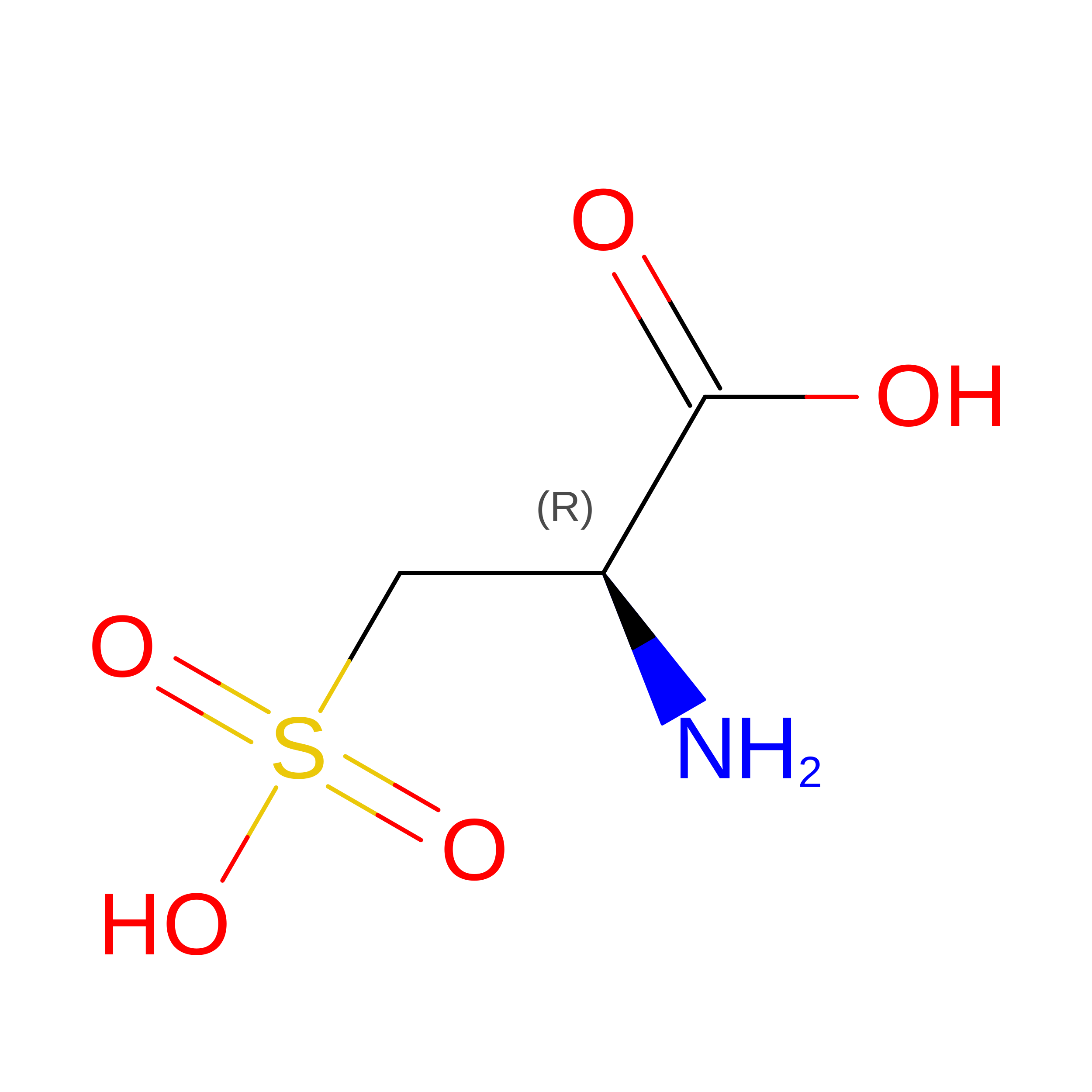
OCS
Query on OCS
A, B
L-PEPTIDE LINKINGC3 H7 N O5 SCYS

Experimental Data & Validation

Experimental Data

  • Method: X-RAY DIFFRACTION
  • Resolution: 2.03 Å
  • R-Value Free:  0.234 (Depositor), 0.231 (DCC) 
  • R-Value Work:  0.195 (Depositor) 
  • R-Value Observed: 0.197 (Depositor) 
Space Group: P 21 21 21
Unit Cell:
Length ( Å )Angle ( ˚ )
a = 44.918α = 90
b = 86.505β = 90
c = 135.126γ = 90
Software Package:
Software NamePurpose
SCALEPACKdata scaling
MOLREPphasing
BUSTER-TNTrefinement
PDB_EXTRACTdata extraction
DENZOdata reduction
BUSTERrefinement

Structure Validation

View Full Validation Report


Ligand Structure Quality Assessment 


Entry History 

Deposition Data

Revision History  (Full details and data files)

  • Version 1.0: 2014-04-02
    Type: Initial release
  • Version 1.1: 2014-10-08
    Changes: Database references
  • Version 1.2: 2017-11-22
    Changes: Advisory, Refinement description
  • Version 1.3: 2025-03-26
    Changes: Advisory, Data collection, Database references, Derived calculations, Structure summary