4NTG | pdb_00004ntg

Crystal structure of D60A mutant of Arabidopsis ACD11 (accelerated-cell-death 11) complexed with C12 ceramide-1-phosphate (d18:1/12:0) at 2.55 Angstrom resolution


Experimental Data Snapshot

  • Method: X-RAY DIFFRACTION
  • Resolution: 2.55 Å
  • R-Value Free: 
    0.236 (Depositor), 0.238 (DCC) 
  • R-Value Work: 
    0.181 (Depositor), 0.185 (DCC) 
  • R-Value Observed: 
    0.187 (Depositor) 

Starting Model: experimental
View more details

wwPDB Validation 3D Report Full Report

Validation slider image for 4NTG

Ligand Structure Quality Assessment 


This is version 1.2 of the entry. See complete history

Literature

Arabidopsis Accelerated Cell Death 11, ACD11, Is a Ceramide-1-Phosphate Transfer Protein and Intermediary Regulator of Phytoceramide Levels.

Simanshu, D.K.Zhai, X.Munch, D.Hofius, D.Markham, J.E.Bielawski, J.Bielawska, A.Malinina, L.Molotkovsky, J.G.Mundy, J.W.Patel, D.J.Brown, R.E.

(2014) Cell Rep 6: 388-399

  • DOI: https://doi.org/10.1016/j.celrep.2013.12.023
  • Primary Citation Related Structures: 
    4NT1, 4NT2, 4NTG, 4NTI, 4NTO

  • PubMed Abstract: 

    The accelerated cell death 11 (acd11) mutant of Arabidopsis provides a genetic model for studying immune response activation and localized cellular suicide that halt pathogen spread during infection in plants. Here, we elucidate ACD11 structure and function and show that acd11 disruption dramatically alters the in vivo balance of sphingolipid mediators that regulate eukaryotic-programmed cell death. In acd11 mutants, normally low ceramide-1-phosphate (C1P) levels become elevated, but the relatively abundant cell death inducer phytoceramide rises acutely. ACD11 exhibits selective intermembrane transfer of C1P and phyto-C1P. Crystal structures establish C1P binding via a surface-localized, phosphate headgroup recognition center connected to an interior hydrophobic pocket that adaptively ensheaths lipid chains via a cleft-like gating mechanism. Point mutation mapping confirms functional involvement of binding site residues. A π helix (π bulge) near the lipid binding cleft distinguishes apo-ACD11 from other GLTP folds. The global two-layer, α-helically dominated, "sandwich" topology displaying C1P-selective binding identifies ACD11 as the plant prototype of a GLTP fold subfamily.


  • Organizational Affiliation
    • Structural Biology Program, Memorial Sloan-Kettering Cancer Center, New York, NY 10065, USA.

Macromolecule Content 

  • Total Structure Weight: 46.63 kDa 
  • Atom Count: 3,222 
  • Modeled Residue Count: 400 
  • Deposited Residue Count: 414 
  • Unique protein chains: 1

Macromolecules

Find similar proteins by:|  3D Structure
Entity ID: 1
MoleculeChains  Sequence LengthOrganismDetailsImage
accelerated-cell-death 11
A, B
207Arabidopsis thalianaMutation(s): 1 
Gene Names: ACD11AT2G34690
UniProt
Find proteins for O64587 (Arabidopsis thaliana)
Explore O64587 
Go to UniProtKB:  O64587
Entity Groups
Sequence Clusters30% Identity50% Identity70% Identity90% Identity95% Identity100% Identity
UniProt GroupO64587
Sequence Annotations
Expand
Reference Sequence

Small Molecules

Ligands 1 Unique
IDChains Name / Formula / InChI Key2D Diagram3D Interactions
1PZ

Query on 1PZ


Download:Ideal Coordinates CCD File
C [auth A],
D [auth B]
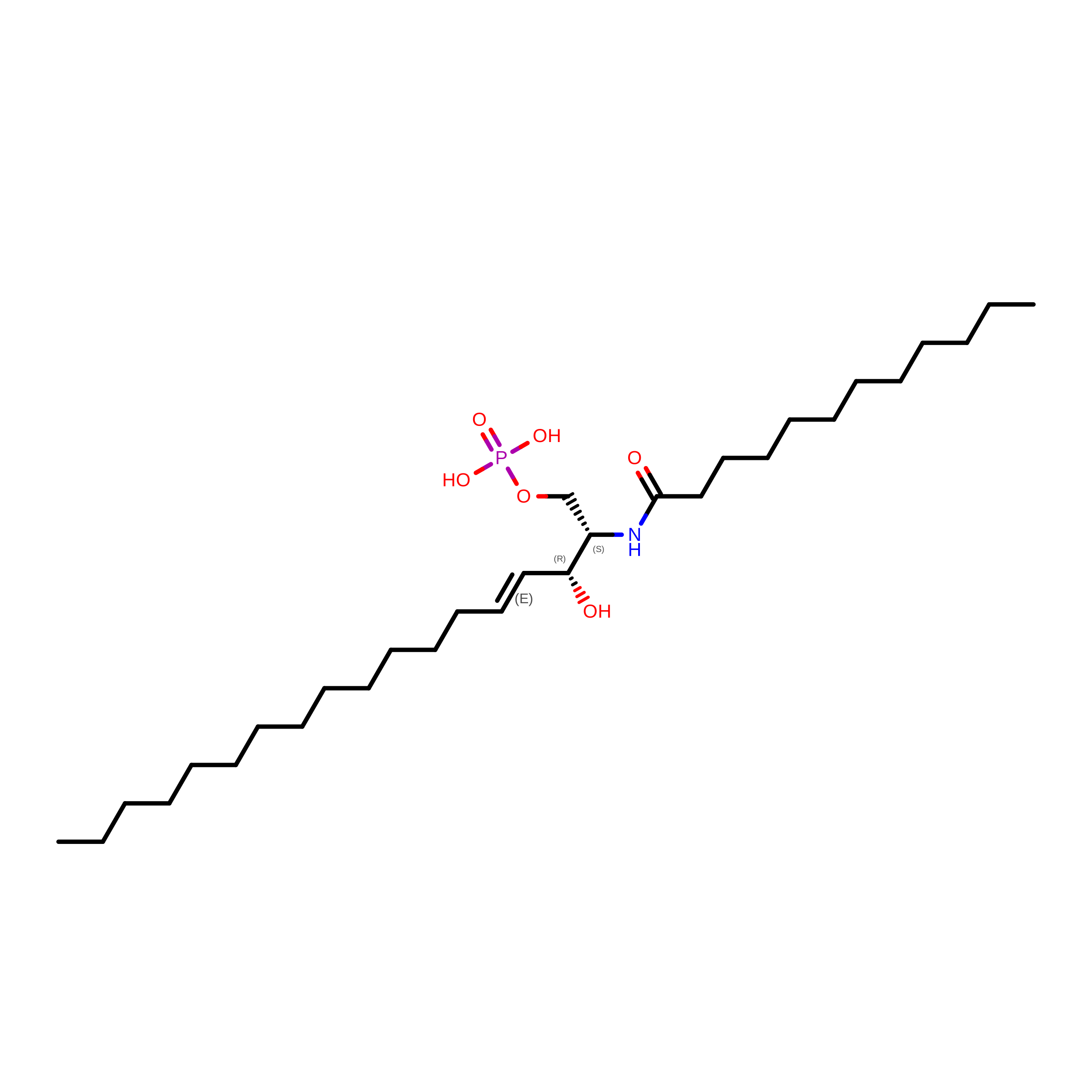
(2S,3R,4E)-2-(dodecanoylamino)-3-hydroxyoctadec-4-en-1-yl dihydrogen phosphate
C30 H60 N O6 P
KXEMZGPJXBKYJP-VARSQMIESA-N

Experimental Data & Validation

Experimental Data

  • Method: X-RAY DIFFRACTION
  • Resolution: 2.55 Å
  • R-Value Free:  0.236 (Depositor), 0.238 (DCC) 
  • R-Value Work:  0.181 (Depositor), 0.185 (DCC) 
  • R-Value Observed: 0.187 (Depositor) 
Space Group: H 3 2
Unit Cell:
Length ( Å )Angle ( ˚ )
a = 101.507α = 90
b = 101.507β = 90
c = 280.732γ = 120
Software Package:
Software NamePurpose
SCALEPACKdata scaling
MOLREPphasing
PHENIXrefinement
PDB_EXTRACTdata extraction
HKL-2000data reduction

Structure Validation

View Full Validation Report


Ligand Structure Quality Assessment 


Entry History 

Deposition Data

Revision History  (Full details and data files)

  • Version 1.0: 2014-02-05
    Type: Initial release
  • Version 1.1: 2014-02-19
    Changes: Database references
  • Version 1.2: 2023-09-20
    Changes: Data collection, Database references, Derived calculations, Refinement description