Download Mendeley
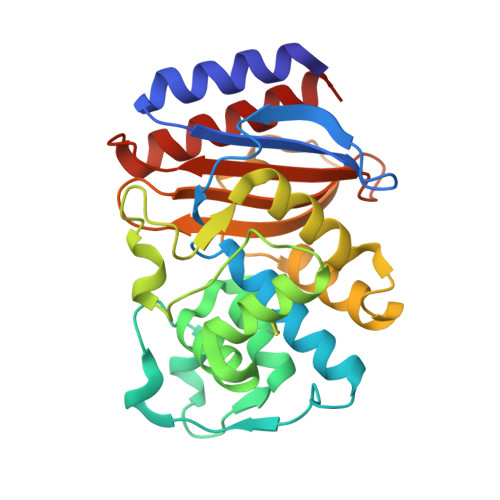
The Structural Dynamics of Engineered beta-Lactamases Vary Broadly on Three Timescales yet Sustain Native Function.
Gobeil, S.M.C., Ebert, M.C.C.J.C., Park, J., Gagne, D., Doucet, N., Berghuis, A.M., Pleiss, J., Pelletier, J.N.(2019) Sci Rep 9: 6656-6656
- PubMed: 31040324 Search on PubMedSearch on PubMed Central
- DOI: https://doi.org/10.1038/s41598-019-42866-8
- Primary Citation Related Structures:
4MEZ, 4R4R, 4R4S - PubMed Abstract:
Understanding the principles of protein dynamics will help guide engineering of protein function: altering protein motions may be a barrier to success or may be an enabling tool for protein engineering. The impact of dynamics on protein function is typically reported over a fraction of the full scope of motional timescales. If motional patterns vary significantly at different timescales, then only by monitoring motions broadly will we understand the impact of protein dynamics on engineering functional proteins. Using an integrative approach combining experimental and in silico methodologies, we elucidate protein dynamics over the entire span of fast to slow timescales (ps to ms) for a laboratory-engineered system composed of five interrelated β-lactamases: two natural homologs and three laboratory-recombined variants. Fast (ps-ns) and intermediate (ns-µs) dynamics were mostly conserved. However, slow motions (µs-ms) were few and conserved in the natural homologs yet were numerous and widely dispersed in their recombinants. Nonetheless, modified slow dynamics were functionally tolerated. Crystallographic B-factors from high-resolution X-ray structures were partly predictive of the conserved motions but not of the new slow motions captured in our solution studies. Our inspection of protein dynamics over a continuous range of timescales vividly illustrates the complexity of dynamic impacts of protein engineering as well as the functional tolerance of an engineered enzyme system to new slow motions.
- Département de biochimie and Center for Green Chemistry and Catalysis (CGCC), Université de Montréal, Montréal, QC, H3T 1J4, Canada.
Organizational Affiliation: