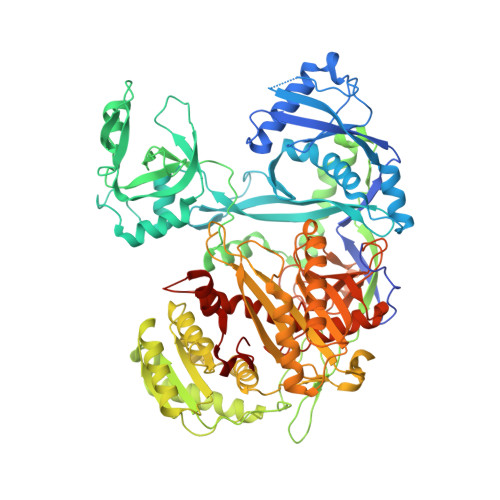
4KXT | pdb_00004kxt

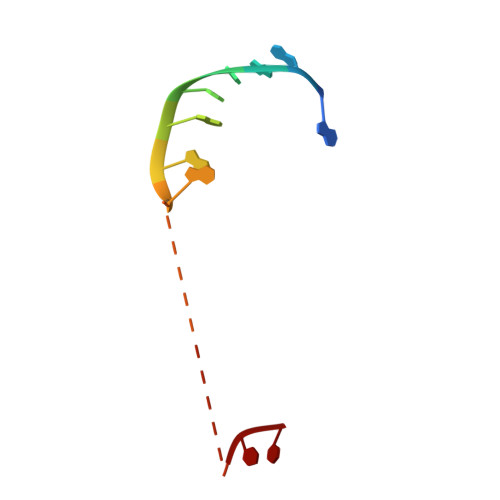
Structure of human ARGONAUTE1 in complex with guide RNA


Experimental Data Snapshot

  • Method: X-RAY DIFFRACTION
  • Resolution: 2.29 Å
  • R-Value Free: 
    0.228 (Depositor), 0.232 (DCC) 
  • R-Value Work: 
    0.175 (Depositor), 0.180 (DCC) 
  • R-Value Observed: 
    0.177 (Depositor) 

wwPDB Validation 3D Report Full Report

Validation slider image for 4KXT

This is version 1.1 of the entry. See complete history

Literature

Eukaryote-Specific Insertion Elements Control Human ARGONAUTE Slicer Activity.

Nakanishi, K.Ascano, M.Gogakos, T.Ishibe-Murakami, S.Serganov, A.A.Briskin, D.Morozov, P.Tuschl, T.Patel, D.J.

(2013) Cell Rep 3: 1893-1900

  • DOI: https://doi.org/10.1016/j.celrep.2013.06.010
  • Primary Citation Related Structures: 
    4KXT

  • PubMed Abstract: 

    We have solved the crystal structure of human ARGONAUTE1 (hAGO1) bound to endogenous 5'-phosphorylated guide RNAs. To identify changes that evolutionarily rendered hAGO1 inactive, we compared our structure with guide-RNA-containing and cleavage-active hAGO2. Aside from mutation of a catalytic tetrad residue, proline residues at positions 670 and 675 in hAGO1 introduce a kink in the cS7 loop, forming a convex surface within the hAGO1 nucleic-acid-binding channel near the inactive catalytic site. We predicted that even upon restoration of the catalytic tetrad, hAGO1-cS7 sterically hinders the placement of a fully paired guide-target RNA duplex into the endonuclease active site. Consistent with this hypothesis, reconstitution of the catalytic tetrad with R805H led to low-level hAGO1 cleavage activity, whereas combining R805H with cS7 substitutions P670S and P675Q substantially augmented hAGO1 activity. Evolutionary amino acid changes to hAGO1 were readily reversible, suggesting that loading of guide RNA and pairing of seed-based miRNA and target RNA constrain its sequence drift.


  • Organizational Affiliation
    • Structural Biology Program, Memorial Sloan-Kettering Cancer Center, New York, NY 10065, USA.

Macromolecule Content 

  • Total Structure Weight: 101.61 kDa 
  • Atom Count: 6,983 
  • Modeled Residue Count: 818 
  • Deposited Residue Count: 874 
  • Unique protein chains: 1
  • Unique nucleic acid chains: 1

Macromolecules


Find similar proteins by:|  3D Structure
Entity ID: 1
MoleculeChains  Sequence LengthOrganismDetailsImage
Protein argonaute-1862Homo sapiensMutation(s): 0 
Gene Names: EIF2C1AGO1
UniProt & NIH Common Fund Data Resources
Find proteins for Q9UL18 (Homo sapiens)
Explore Q9UL18 
Go to UniProtKB:  Q9UL18
PHAROS:  Q9UL18
GTEx:  ENSG00000092847 
Entity Groups
Sequence Clusters30% Identity50% Identity70% Identity90% Identity95% Identity100% Identity
UniProt GroupQ9UL18
Sequence Annotations
Expand
Reference Sequence
Find similar nucleic acids by:  Sequence
Entity ID: 2
MoleculeChains LengthOrganismImage
RNA12Spodoptera frugiperda
Sequence Annotations
Expand
Reference Sequence

Experimental Data & Validation

Experimental Data

  • Method: X-RAY DIFFRACTION
  • Resolution: 2.29 Å
  • R-Value Free:  0.228 (Depositor), 0.232 (DCC) 
  • R-Value Work:  0.175 (Depositor), 0.180 (DCC) 
  • R-Value Observed: 0.177 (Depositor) 
Space Group: P 21 21 21
Unit Cell:
Length ( Å )Angle ( ˚ )
a = 69.879α = 90
b = 100.249β = 90
c = 136.701γ = 90
Software Package:
Software NamePurpose
HKL-2000data collection
PHASERphasing
PHENIXrefinement
HKL-2000data reduction
HKL-2000data scaling

Structure Validation

View Full Validation Report


Entry History 

Deposition Data

Revision History  (Full details and data files)

  • Version 1.0: 2013-07-31
    Type: Initial release
  • Version 1.1: 2024-02-28
    Changes: Data collection, Database references