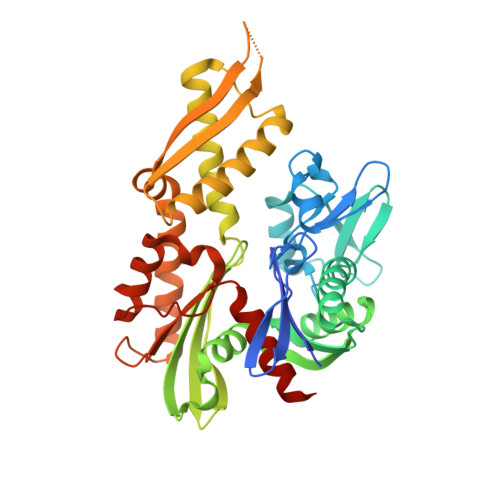
4KBO | pdb_00004kbo

Crystal structure of the human Mortalin (GRP75) ATPase domain in the apo form


Experimental Data Snapshot

  • Method: X-RAY DIFFRACTION
  • Resolution: 2.80 Å
  • R-Value Free: 
    0.271 (Depositor), 0.262 (DCC) 
  • R-Value Work: 
    0.218 (Depositor), 0.215 (DCC) 
  • R-Value Observed: 
    0.221 (Depositor) 

Starting Model: experimental
View more details

wwPDB Validation 3D Report Full Report

Validation slider image for 4KBO

This is version 1.5 of the entry. See complete history

Literature

Crystal structure of the nucleotide-binding domain of mortalin, the mitochondrial Hsp70 chaperone.

Amick, J.Schlanger, S.E.Wachnowsky, C.Moseng, M.A.Emerson, C.C.Dare, M.Luo, W.I.Ithychanda, S.S.Nix, J.C.Cowan, J.A.Page, R.C.Misra, S.

(2014) Protein Sci 23: 833-842

  • DOI: https://doi.org/10.1002/pro.2466
  • Primary Citation Related Structures: 
    4KBO

  • PubMed Abstract: 

    Mortalin, a member of the Hsp70-family of molecular chaperones, functions in a variety of processes including mitochondrial protein import and quality control, Fe-S cluster protein biogenesis, mitochondrial homeostasis, and regulation of p53. Mortalin is implicated in regulation of apoptosis, cell stress response, neurodegeneration, and cancer and is a target of the antitumor compound MKT-077. Like other Hsp70-family members, Mortalin consists of a nucleotide-binding domain (NBD) and a substrate-binding domain. We determined the crystal structure of the NBD of human Mortalin at 2.8 Å resolution. Although the Mortalin nucleotide-binding pocket is highly conserved relative to other Hsp70 family members, we find that its nucleotide affinity is weaker than that of Hsc70. A Parkinson's disease-associated mutation is located on the Mortalin-NBD surface and may contribute to Mortalin aggregation. We present structure-based models for how the Mortalin-NBD may interact with the nucleotide exchange factor GrpEL1, with p53, and with MKT-077. Our structure may contribute to the understanding of disease-associated Mortalin mutations and to improved Mortalin-targeting antitumor compounds.


  • Organizational Affiliation
    • Department of Molecular Cardiology, The Cleveland Clinic, Cleveland, Ohio, 44195.

Macromolecule Content 

  • Total Structure Weight: 41.44 kDa 
  • Atom Count: 2,787 
  • Modeled Residue Count: 374 
  • Deposited Residue Count: 385 
  • Unique protein chains: 1

Macromolecules

Find similar proteins by:|  3D Structure
Entity ID: 1
MoleculeChains  Sequence LengthOrganismDetailsImage
Stress-70 protein, mitochondrial385Homo sapiensMutation(s): 0 
Gene Names: GRP75HSPA9HSPA9B
EC: 3.6.4.10
UniProt & NIH Common Fund Data Resources
Find proteins for P38646 (Homo sapiens)
Explore P38646 
Go to UniProtKB:  P38646
PHAROS:  P38646
GTEx:  ENSG00000113013 
Entity Groups
Sequence Clusters30% Identity50% Identity70% Identity90% Identity95% Identity100% Identity
UniProt GroupP38646
Sequence Annotations
Expand
Reference Sequence

Small Molecules

Ligands 1 Unique
IDChains Name / Formula / InChI Key2D Diagram3D Interactions
NA

Query on NA


Download:Ideal Coordinates CCD File
B [auth A]SODIUM ION
Na
FKNQFGJONOIPTF-UHFFFAOYSA-N

Experimental Data & Validation

Experimental Data

  • Method: X-RAY DIFFRACTION
  • Resolution: 2.80 Å
  • R-Value Free:  0.271 (Depositor), 0.262 (DCC) 
  • R-Value Work:  0.218 (Depositor), 0.215 (DCC) 
  • R-Value Observed: 0.221 (Depositor) 
Space Group: P 21 21 21
Unit Cell:
Length ( Å )Angle ( ˚ )
a = 51.197α = 90
b = 67.812β = 90
c = 120.769γ = 90
Software Package:
Software NamePurpose
ADSCdata collection
PHENIXmodel building
PHENIXrefinement
HKL-3000data reduction
SCALAdata scaling
PHENIXphasing

Structure Validation

View Full Validation Report


Entry History 

Deposition Data

Revision History  (Full details and data files)

  • Version 1.0: 2014-04-02
    Type: Initial release
  • Version 1.1: 2014-04-23
    Changes: Database references
  • Version 1.2: 2014-05-07
    Changes: Other
  • Version 1.3: 2014-05-21
    Changes: Database references
  • Version 1.4: 2014-06-04
    Changes: Database references
  • Version 1.5: 2023-09-20
    Changes: Data collection, Database references, Derived calculations, Refinement description