4ITD | pdb_00004itd

Structures of DNA duplexes containing O6-carboxymethylguanine, a lesion associated with gastrointestinal cancer, reveal a mechanism for inducing transition mutation


Experimental Data Snapshot

  • Method: X-RAY DIFFRACTION
  • Resolution: 1.94 Å
  • R-Value Free: 
    0.254 (Depositor), 0.479 (DCC) 
  • R-Value Work: 
    0.226 (Depositor), 0.423 (DCC) 
  • R-Value Observed: 
    0.228 (Depositor) 

wwPDB Validation 3D Report Full Report

Validation slider image for 4ITD

Ligand Structure Quality Assessment 


This is version 1.2 of the entry. See complete history

Literature

Structures of DNA duplexes containing O6-carboxymethylguanine, a lesion associated with gastrointestinal cancer, reveal a mechanism for inducing pyrimidine transition mutations

Zhang, F.Tsunoda, M.Suzuki, K.Kikuchi, Y.Wilkinson, O.Millington, C.L.Margison, G.P.Williams, D.M.Czarina Morishita, E.Takenaka, A.

(2013) Nucleic Acids Res 41: 5524-5532

  • DOI: https://doi.org/10.1093/nar/gkt198
  • Primary Citation Related Structures: 
    4IJ0, 4ITD

  • PubMed Abstract: 

    N-nitrosation of glycine and its derivatives generates potent alkylating agents that can lead to the formation of O(6)-carboxymethylguanine (O(6)-CMG) in DNA. O(6)-CMG has been identified in DNA derived from human colon tissue, and its occurrence has been linked to diets high in red and processed meats. By analogy to O(6)-methylguanine, O(6)-CMG is expected to be highly mutagenic, inducing G to A mutations during DNA replication that can increase the risk of gastrointestinal and other cancers. Two crystal structures of DNA dodecamers d(CGCG[O(6)-CMG]ATTCGCG) and d(CGC[O(6)-CMG]AATTCGCG) in complex with Hoechst33258 reveal that each can form a self-complementary duplex to retain the B-form conformation. Electron density maps clearly show that O(6)-CMG forms a Watson-Crick-type pair with thymine similar to the canonical A:T pair, and it forms a reversed wobble pair with cytosine. In situ structural modeling suggests that a DNA polymerase can accept the Watson-Crick-type pair of O(6)-CMG with thymine, but might also accept the reversed wobble pair of O(6)-CMG with cytosine. Thus, O(6)-CMG would permit the mis-incorporation of dTTP during DNA replication. Alternatively, the triphosphate that would be formed by carboxymethylation of the nucleotide triphosphate pool d[O(6)-CMG]TP might compete with dATP incorporation opposite thymine in a DNA template.


  • Organizational Affiliation
    • Graduate School of Science and Engineering, Iwaki-Meisei University, Iwaki 970-8551, Japan.

Macromolecule Content 

  • Total Structure Weight: 7.92 kDa 
  • Atom Count: 609 
  • Modeled Residue Count: 24 
  • Deposited Residue Count: 24 
  • Unique nucleic acid chains: 1

Macromolecules

Find similar nucleic acids by:  Sequence
Entity ID: 1
MoleculeChains LengthOrganismImage
DNA (5'-D(*CP*GP*CP*GP*(C6G)P*AP*TP*TP*CP*GP*CP*G)-3')
A, B
12N/A
Sequence Annotations
Expand
Reference Sequence

Small Molecules

Ligands 2 Unique
IDChains Name / Formula / InChI Key2D Diagram3D Interactions
HT

Query on HT


Download:Ideal Coordinates CCD File
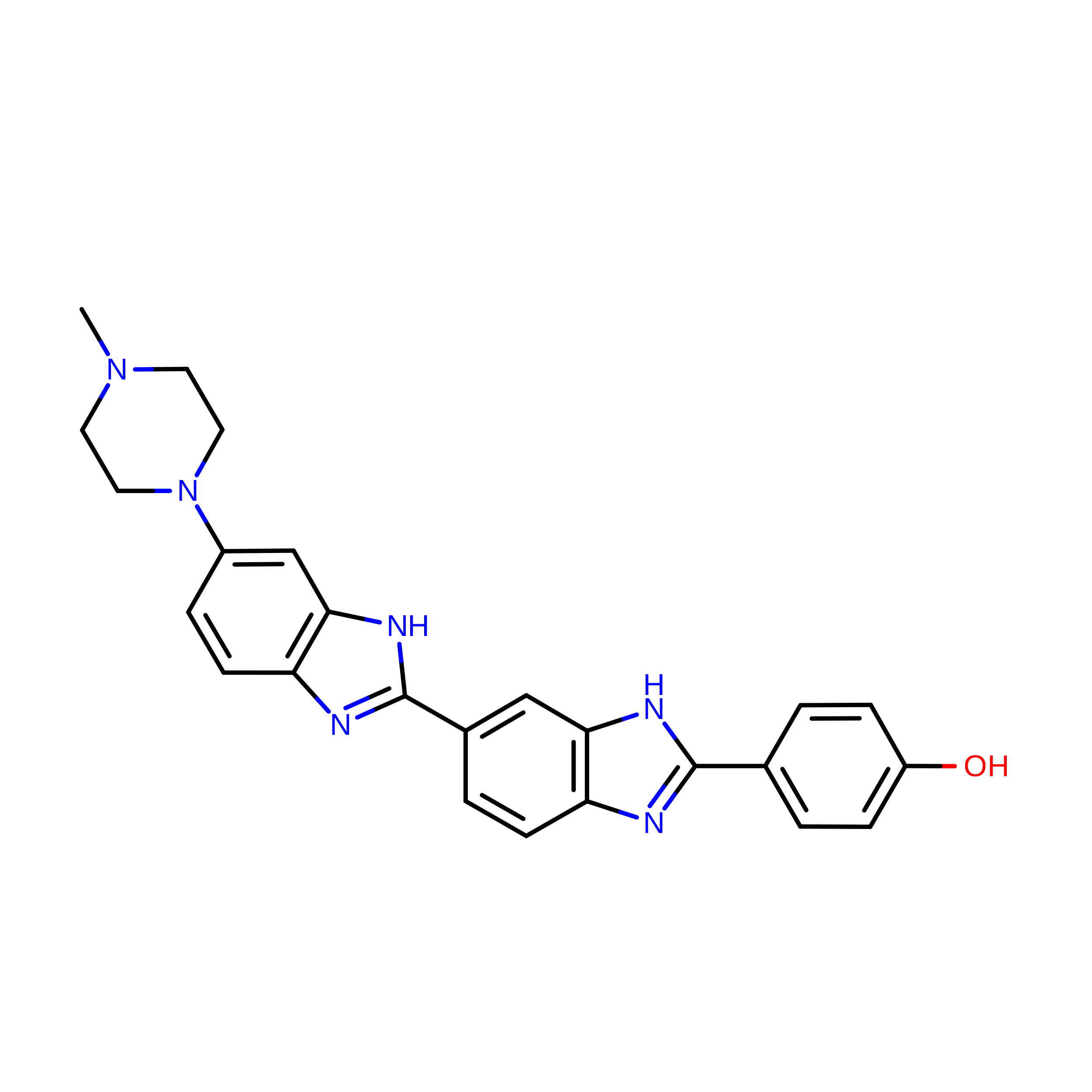
D [auth A]2'-(4-HYDROXYPHENYL)-5-(4-METHYL-1-PIPERAZINYL)-2,5'-BI-BENZIMIDAZOLE
C25 H24 N6 O
INAAIJLSXJJHOZ-UHFFFAOYSA-N
MG

Query on MG


Download:Ideal Coordinates CCD File
C [auth A]MAGNESIUM ION
Mg
JLVVSXFLKOJNIY-UHFFFAOYSA-N

Experimental Data & Validation

Experimental Data

  • Method: X-RAY DIFFRACTION
  • Resolution: 1.94 Å
  • R-Value Free:  0.254 (Depositor), 0.479 (DCC) 
  • R-Value Work:  0.226 (Depositor), 0.423 (DCC) 
  • R-Value Observed: 0.228 (Depositor) 
Space Group: P 21 21 21
Unit Cell:
Length ( Å )Angle ( ˚ )
a = 25.051α = 90
b = 40.404β = 90
c = 65.667γ = 90
Software Package:
Software NamePurpose
SCALEPACKdata scaling
REFMACrefinement
PDB_EXTRACTdata extraction

Structure Validation

View Full Validation Report


Ligand Structure Quality Assessment 


Entry History 

Deposition Data

Revision History  (Full details and data files)

  • Version 1.0: 2013-05-08
    Type: Initial release
  • Version 1.1: 2014-03-19
    Changes: Database references
  • Version 1.2: 2024-03-20
    Changes: Data collection, Database references, Derived calculations