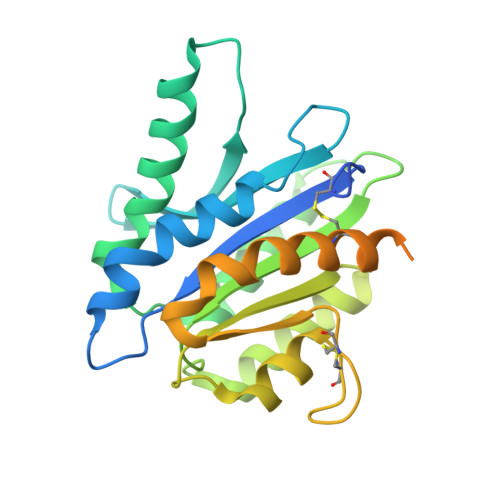
4HQF | pdb_00004hqf

Crystal structure of Plasmodium falciparum TRAP, I4 form


Experimental Data Snapshot

  • Method: X-RAY DIFFRACTION
  • Resolution: 2.20 Å
  • R-Value Free: 
    0.217 (Depositor), 0.213 (DCC) 
  • R-Value Work: 
    0.173 (Depositor) 
  • R-Value Observed: 
    0.175 (Depositor) 

Starting Model: experimental
View more details

wwPDB Validation 3D Report Full Report

Validation slider image for 4HQF

This is version 1.3 of the entry. See complete history

Literature

Shape change in the receptor for gliding motility in Plasmodium sporozoites.

Song, G.Koksal, A.C.Lu, C.Springer, T.A.

(2012) Proc Natl Acad Sci U S A 109: 21420-21425

  • DOI: https://doi.org/10.1073/pnas.1218581109
  • Primary Citation Related Structures: 
    4HQF, 4HQK, 4HQL, 4HQN, 4HQO

  • PubMed Abstract: 

    Sporozoite gliding motility and invasion of mosquito and vertebrate host cells in malaria is mediated by thrombospondin repeat anonymous protein (TRAP). Tandem von Willebrand factor A (VWA) and thrombospondin type I repeat (TSR) domains in TRAP connect through proline-rich stalk, transmembrane, and cytoplasmic domains to the parasite actin-dependent motility apparatus. We crystallized fragments containing the VWA and TSR domains from Plasmodium vivax and Plasmodium falciparum in different crystal lattices. TRAP VWA domains adopt closed and open conformations, and bind a Mg(2+) ion at a metal ion-dependent adhesion site implicated in ligand binding. Metal ion coordination in the open state is identical to that seen in the open high-affinity state of integrin I domains. The closed VWA conformation associates with a disordered TSR domain. In contrast, the open VWA conformation crystallizes with an extensible β ribbon and ordered TSR domain. The extensible β ribbon is composed of disulfide-bonded segments N- and C-terminal to the VWA domain that are largely drawn out of the closed VWA domain in a 15 Å movement to the open conformation. The extensible β ribbon and TSR domain overlap at a conserved interface. The VWA, extensible β ribbon, and TSR domains adopt a highly elongated overall orientation that would be stabilized by tensile force exerted across a ligand-receptor complex by the actin motility apparatus of the sporozoite. Our results provide insights into regulation of "stick-and-slip" parasite motility and for development of sporozoite subunit vaccines.


  • Organizational Affiliation
    • Immune Disease Institute, Program in Cellular and Molecular Medicine, Children's Hospital Boston, MA 02115, USA.

Macromolecule Content 

  • Total Structure Weight: 31.8 kDa 
  • Atom Count: 1,717 
  • Modeled Residue Count: 200 
  • Deposited Residue Count: 281 
  • Unique protein chains: 1

Macromolecules

Find similar proteins by:|  3D Structure
Entity ID: 1
MoleculeChains  Sequence LengthOrganismDetailsImage
Thrombospondin-related anonymous protein, TRAP281Plasmodium falciparum 3D7Mutation(s): 2 
Gene Names: TRAPPF13_0201
UniProt
Find proteins for Q76NM2 (Plasmodium falciparum (isolate 3D7))
Explore Q76NM2 
Go to UniProtKB:  Q76NM2
Entity Groups
Sequence Clusters30% Identity50% Identity70% Identity90% Identity95% Identity100% Identity
UniProt GroupQ76NM2
Sequence Annotations
Expand
Reference Sequence

Small Molecules

Ligands 1 Unique
IDChains Name / Formula / InChI Key2D Diagram3D Interactions
CL

Query on CL


Download:Ideal Coordinates CCD File
B [auth A]CHLORIDE ION
Cl
VEXZGXHMUGYJMC-UHFFFAOYSA-M

Experimental Data & Validation

Experimental Data

  • Method: X-RAY DIFFRACTION
  • Resolution: 2.20 Å
  • R-Value Free:  0.217 (Depositor), 0.213 (DCC) 
  • R-Value Work:  0.173 (Depositor) 
  • R-Value Observed: 0.175 (Depositor) 
Space Group: I 4
Unit Cell:
Length ( Å )Angle ( ˚ )
a = 110.22α = 90
b = 110.22β = 90
c = 47.05γ = 90
Software Package:
Software NamePurpose
HKL-2000data collection
PHASERphasing
PHENIXrefinement
HKL-2000data reduction
HKL-2000data scaling

Structure Validation

View Full Validation Report


Entry History 

Deposition Data

Revision History  (Full details and data files)

  • Version 1.0: 2012-12-26
    Type: Initial release
  • Version 1.1: 2013-01-09
    Changes: Database references
  • Version 1.2: 2023-09-20
    Changes: Data collection, Database references, Derived calculations, Refinement description
  • Version 1.3: 2024-10-16
    Changes: Structure summary