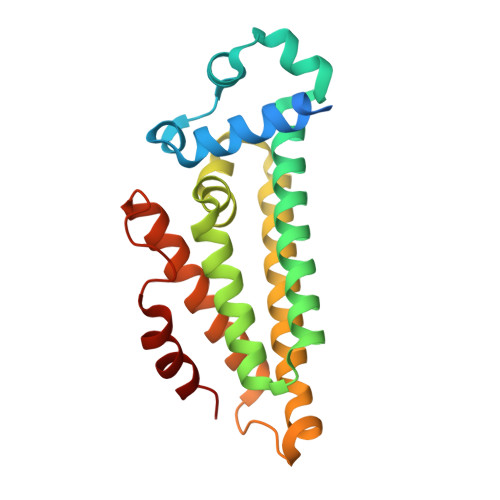
4GCK | pdb_00004gck

structure of no-dna complex


Experimental Data Snapshot

  • Method: X-RAY DIFFRACTION
  • Resolution: 2.05 Å
  • R-Value Free: 
    0.243 (Depositor), 0.246 (DCC) 
  • R-Value Work: 
    0.218 (Depositor), 0.221 (DCC) 
  • R-Value Observed: 
    0.218 (Depositor) 

wwPDB Validation 3D Report Full Report

Validation slider image for 4GCK

This is version 1.2 of the entry. See complete history

Literature

SlmA forms a higher-order structure on DNA that inhibits cytokinetic Z-ring formation over the nucleoid.

Tonthat, N.K.Milam, S.L.Chinnam, N.Whitfill, T.Margolin, W.Schumacher, M.A.

(2013) Proc Natl Acad Sci U S A 110: 10586-10591

  • DOI: https://doi.org/10.1073/pnas.1221036110
  • Primary Citation Related Structures: 
    4GCK, 4GCL, 4GCT, 4GFK, 4GFL

  • PubMed Abstract: 

    The spatial and temporal control of Filamenting temperature sensitive mutant Z (FtsZ) Z-ring formation is crucial for proper cell division in bacteria. In Escherichia coli, the synthetic lethal with a defective Min system (SlmA) protein helps mediate nucleoid occlusion, which prevents chromosome fragmentation by binding FtsZ and inhibiting Z-ring formation over the nucleoid. However, to perform its function, SlmA must be bound to the nucleoid. To deduce the basis for this chromosomal requirement, we performed biochemical, cellular, and structural studies. Strikingly, structures show that SlmA dramatically distorts DNA, allowing it to bind as an orientated dimer-of-dimers. Biochemical data indicate that SlmA dimer-of-dimers can spread along the DNA. Combined structural and biochemical data suggest that this DNA-activated SlmA oligomerization would prevent FtsZ protofilament propagation and bundling. Bioinformatic analyses localize SlmA DNA sites near membrane-tethered chromosomal regions, and cellular studies show that SlmA inhibits FtsZ reservoirs from forming membrane-tethered Z rings. Thus, our combined data indicate that SlmA DNA helps block Z-ring formation over chromosomal DNA by forming higher-order protein-nucleic acid complexes that disable FtsZ filaments from coalescing into proper structures needed for Z-ring creation.


  • Organizational Affiliation
    • Department of Biochemistry, Duke University School of Medicine, Durham, NC 27710, USA.

Macromolecule Content 

  • Total Structure Weight: 104.85 kDa 
  • Atom Count: 7,088 
  • Modeled Residue Count: 782 
  • Deposited Residue Count: 872 
  • Unique protein chains: 1
  • Unique nucleic acid chains: 1

Macromolecules


Find similar proteins by:|  3D Structure
Entity ID: 1
MoleculeChains  Sequence LengthOrganismDetailsImage
Nucleoid occlusion factor SlmA
A, B, C, D
212Klebsiella variicola 342Mutation(s): 0 
Gene Names: slmAKPK_0113
UniProt
Find proteins for B5XTG2 (Klebsiella variicola (strain 342))
Explore B5XTG2 
Go to UniProtKB:  B5XTG2
Entity Groups
Sequence Clusters30% Identity50% Identity70% Identity90% Identity95% Identity100% Identity
UniProt GroupB5XTG2
Sequence Annotations
Expand
Reference Sequence
Find similar nucleic acids by:  Sequence
Entity ID: 2
MoleculeChains LengthOrganismImage
DNA (5'-D(*GP*TP*GP*AP*GP*TP*AP*CP*TP*CP*AP*C)-3')E [auth W],
F [auth Z]
12N/A
Sequence Annotations
Expand
Reference Sequence

Experimental Data & Validation

Experimental Data

  • Method: X-RAY DIFFRACTION
  • Resolution: 2.05 Å
  • R-Value Free:  0.243 (Depositor), 0.246 (DCC) 
  • R-Value Work:  0.218 (Depositor), 0.221 (DCC) 
  • R-Value Observed: 0.218 (Depositor) 
Space Group: P 21 21 21
Unit Cell:
Length ( Å )Angle ( ˚ )
a = 71.49α = 90
b = 80.75β = 90
c = 201.3γ = 90
Software Package:
Software NamePurpose
ADSCdata collection
MOLREPphasing
CNSrefinement
MOSFLMdata reduction
SCALAdata scaling

Structure Validation

View Full Validation Report


Entry History 

Deposition Data

Revision History  (Full details and data files)

  • Version 1.0: 2013-06-19
    Type: Initial release
  • Version 1.1: 2013-07-10
    Changes: Database references
  • Version 1.2: 2024-02-28
    Changes: Data collection, Database references