Download Mendeley
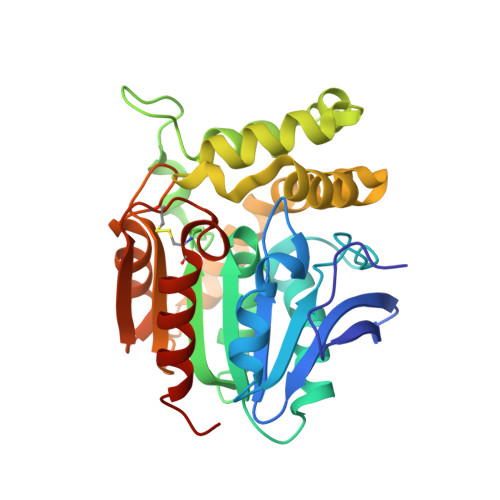
Visualizing the Mechanism of Epoxide Hydrolysis by the Bacterial Virulence Enzyme Cif.
Bahl, C.D., Hvorecny, K.L., Morisseau, C., Gerber, S.A., Madden, D.R.(2016) Biochemistry 55: 788-797
- PubMed: 26752215 Search on PubMedSearch on PubMed Central
- DOI: https://doi.org/10.1021/acs.biochem.5b01229
- Primary Citation Related Structures:
4DMC, 4DNF, 4DNO, 4EHB, 4EUS - PubMed Abstract:
The CFTR inhibitory factor (Cif) is an epoxide hydrolase (EH) virulence factor secreted by the bacterium Pseudomonas aeruginosa. Sequence alignments reveal a pattern of Cif-like substitutions that proved to be characteristic of a new subfamily of bacterial EHs. At the same time, crystallographic and mutagenetic data suggest that EH activity is required for virulence and that Cif's active site remains generally compatible with a canonical two-step EH mechanism. A hallmark of this mechanism is the formation of a covalent hydroxyalkyl-enzyme intermediate by nucleophilic attack. In several well-studied EHs, this intermediate has been captured at near stoichiometric levels, presumably reflecting rate-limiting hydrolysis. Here we show by mass spectrometry that only minimal levels of the expected intermediate can be trapped with WT Cif. In contrast, substantial amounts of intermediate are recovered from an active-site mutant (Cif-E153Q) that selectively targets the second, hydrolytic release step. Utilizing Cif-E153Q and a previously reported nucleophile mutant (Cif-D129S), we then captured Cif in the substrate-bound, hydroxyalkyl-intermediate, and product-bound states for 1,2-epoxyhexane, yielding the first crystallographic snapshots of an EH at these key stages along the reaction coordinate. Taken together, our data illuminate the proposed two-step hydrolytic mechanism of a new class of bacterial virulence factor. They also suggest that the failure of WT Cif to accumulate a covalent hydroxyalkyl-enzyme intermediate reflects an active-site chemistry in which hydrolysis is no longer the rate-limiting step, a noncanonical kinetic regime that may explain similar observations with a number of other EHs.
- Department of Entomology and Nematology, UCD Comprehensive Cancer Center, University of California at Davis , One Shields Ave., Davis, California 95616, United States.
Organizational Affiliation: