4D6G | pdb_00004d6g

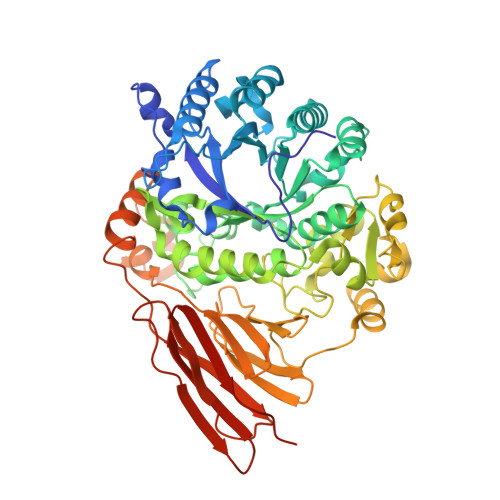
Crystal structure of a family 98 glycoside hydrolase catalytic module (Sp3GH98) in complex with the blood group A-trisaccharide (L19 mutant)


Experimental Data Snapshot

  • Method: X-RAY DIFFRACTION
  • Resolution: 1.24 Å
  • R-Value Free: 
    0.133 (Depositor), 0.139 (DCC) 
  • R-Value Work: 
    0.117 (Depositor), 0.126 (DCC) 
  • R-Value Observed: 
    0.118 (Depositor) 

Starting Model: experimental
View more details

wwPDB Validation 3D Report Full Report

Validation slider image for 4D6G

This is version 2.1 of the entry. See complete history

Literature

Towards Efficient Enzymes for the Generation of Universal Blood Through Structure-Guided Directed Evolution.

Kwan, D.H.Constantinescu, I.Chapanian, R.Higgins, M.A.Koetzler, M.Samain, E.Boraston, A.B.Kizhakkedathu, J.N.Withers, S.G.

(2015) J Am Chem Soc 137: 5695

  • DOI: https://doi.org/10.1021/ja5116088
  • Primary Citation Related Structures: 
    4D6C, 4D6D, 4D6E, 4D6F, 4D6G, 4D6H, 4D6I, 4D6J, 4D71, 4D72

  • PubMed Abstract: 

    Blood transfusions are critically important in many medical procedures, but the presence of antigens on red blood cells (RBCs, erythrocytes) means that careful blood-typing must be carried out prior to transfusion to avoid adverse and sometimes fatal reactions following transfusion. Enzymatic removal of the terminal N-acetylgalactosamine or galactose of A- or B-antigens, respectively, yields universal O-type blood, but is inefficient. Starting with the family 98 glycoside hydrolase from Streptococcus pneumoniae SP3-BS71 (Sp3GH98), which cleaves the entire terminal trisaccharide antigenic determinants of both A- and B-antigens from some of the linkages on RBC surface glycans, through several rounds of evolution, we developed variants with vastly improved activity toward some of the linkages that are resistant to cleavage by the wild-type enzyme. The resulting enzyme effects more complete removal of blood group antigens from cell surfaces, demonstrating the potential for engineering enzymes to generate antigen-null blood from donors of various types.


  • Organizational Affiliation
    • ⊥Department of Biochemistry and Microbiology, University of Victoria, Victoria, British Columbia, Canada V8W 3P6.

Macromolecule Content 

  • Total Structure Weight: 69.66 kDa 
  • Atom Count: 6,168 
  • Modeled Residue Count: 587 
  • Deposited Residue Count: 599 
  • Unique protein chains: 1

Macromolecules

Find similar proteins by:|  3D Structure
Entity ID: 1
MoleculeChains  Sequence LengthOrganismDetailsImage
GLYCOSIDE HYDROLASE599Streptococcus pneumoniae SP3-BS71Mutation(s): 3 
EC: 3.2.1.102

Oligosaccharides

Help  
Entity ID: 2
MoleculeChains Length2D Diagram GlycosylationD Interactions
alpha-L-fucopyranose-(1-2)-[2-acetamido-2-deoxy-alpha-D-galactopyranose-(1-3)]alpha-D-galactopyranose
B
4N/A
Glycosylation Resources
GlyTouCan: G15611BA
GlyCosmos: G15611BA
GlyGen: G15611BA

Small Molecules

Ligands 1 Unique
IDChains Name / Formula / InChI Key2D Diagram3D Interactions
EDO

Query on EDO


Download:Ideal Coordinates CCD File
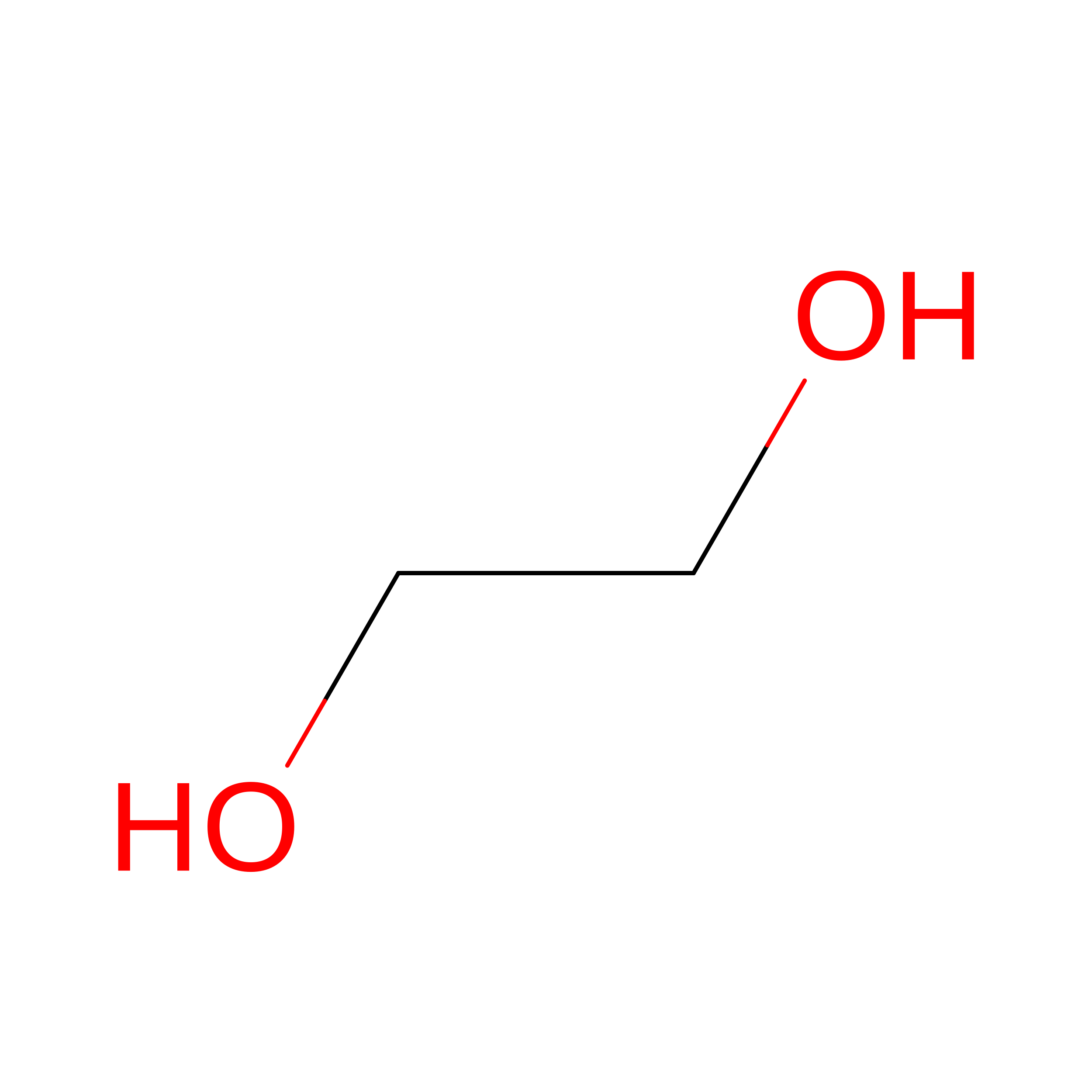
C [auth A]1,2-ETHANEDIOL
C2 H6 O2
LYCAIKOWRPUZTN-UHFFFAOYSA-N

Experimental Data & Validation

Experimental Data

  • Method: X-RAY DIFFRACTION
  • Resolution: 1.24 Å
  • R-Value Free:  0.133 (Depositor), 0.139 (DCC) 
  • R-Value Work:  0.117 (Depositor), 0.126 (DCC) 
  • R-Value Observed: 0.118 (Depositor) 
Space Group: C 2 2 21
Unit Cell:
Length ( Å )Angle ( ˚ )
a = 92.25α = 90
b = 154.02β = 90
c = 96.66γ = 90
Software Package:
Software NamePurpose
REFMACrefinement
MOSFLMdata reduction
Aimlessdata scaling

Structure Validation

View Full Validation Report


Entry History 

Deposition Data

Revision History  (Full details and data files)

  • Version 1.0: 2014-11-26
    Type: Initial release
  • Version 1.1: 2015-04-29
    Changes: Database references
  • Version 1.2: 2015-05-20
    Changes: Database references
  • Version 1.3: 2018-04-18
    Changes: Data collection
  • Version 2.0: 2020-07-29
    Type: Remediation
    Reason: Carbohydrate remediation
    Changes: Advisory, Atomic model, Data collection, Derived calculations, Other, Structure summary
  • Version 2.1: 2023-12-20
    Changes: Data collection, Database references, Refinement description, Structure summary