4CSS | pdb_00004css

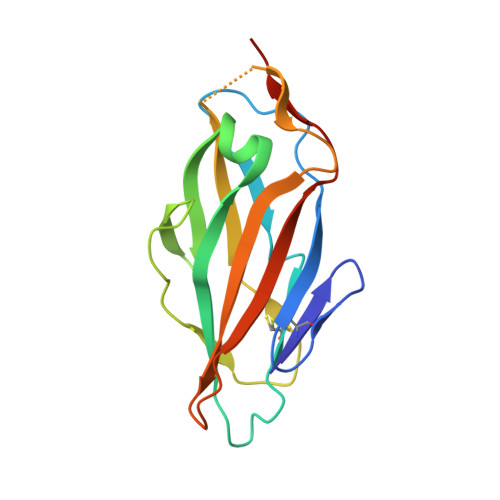
Crystal structure of FimH in complex with a sulfonamide biphenyl alpha D-mannoside


Experimental Data Snapshot

  • Method: X-RAY DIFFRACTION
  • Resolution: 1.07 Å
  • R-Value Free: 
    0.132 (Depositor), 0.134 (DCC) 
  • R-Value Work: 
    0.112 (Depositor), 0.117 (DCC) 
  • R-Value Observed: 
    0.113 (Depositor) 

Starting Model: experimental
View more details

wwPDB Validation 3D Report Full Report

Validation slider image for 4CSS

Ligand Structure Quality Assessment 


This is version 2.2 of the entry. See complete history

Literature

Fimh Antagonists: Bioisosteres to Improve the in Vitro and in Vivo Pk/Pd Profile.

Kleeb, S.Pang, L.Mayer, K.Eris, D.Sigl, A.Preston, R.C.Zihlmann, P.Sharpe, T.Jakob, R.P.Abgottspon, D.Hutter, A.S.Scharenberg, M.Jiang, X.Navarra, G.Rabbani, S.Smiesko, M.Ludin, N.Bezencon, J.Schwardt, O.Maier, T.Ernst, B.

(2015) J Med Chem 58: 2221

  • DOI: https://doi.org/10.1021/jm501524q
  • Primary Citation Related Structures: 
    4CSS, 4CST

  • PubMed Abstract: 

    Urinary tract infections (UTIs), predominantly caused by uropathogenic Escherichia coli (UPEC), belong to the most prevalent infectious diseases worldwide. The attachment of UPEC to host cells is mediated by FimH, a mannose-binding adhesin at the tip of bacterial type 1 pili. To date, UTIs are mainly treated with antibiotics, leading to the ubiquitous problem of increasing resistance against most of the currently available antimicrobials. Therefore, new treatment strategies are urgently needed. Here, we describe the development of an orally available FimH antagonist. Starting from the carboxylate substituted biphenyl α-d-mannoside 9, affinity and the relevant pharmacokinetic parameters (solubility, permeability, renal excretion) were substantially improved by a bioisosteric approach. With 3'-chloro-4'-(α-d-mannopyranosyloxy)biphenyl-4-carbonitrile (10j) a FimH antagonist with an optimal in vitro PK/PD profile was identified. Orally applied, 10j was effective in a mouse model of UTI by reducing the bacterial load in the bladder by about 1000-fold.


  • Organizational Affiliation
    • Institute of Molecular Pharmacy, Pharmacenter, University of Basel , Klingelbergstrasse 50, CH-4056 Basel, Switzerland.

Macromolecule Content 

  • Total Structure Weight: 17.96 kDa 
  • Atom Count: 1,775 
  • Modeled Residue Count: 155 
  • Deposited Residue Count: 163 
  • Unique protein chains: 1

Macromolecules

Find similar proteins by:|  3D Structure
Entity ID: 1
MoleculeChains  Sequence LengthOrganismDetailsImage
PROTEIN FIMH163Escherichia coli K-12Mutation(s): 0 
UniProt
Find proteins for P08191 (Escherichia coli (strain K12))
Explore P08191 
Go to UniProtKB:  P08191
Entity Groups
Sequence Clusters30% Identity50% Identity70% Identity90% Identity95% Identity100% Identity
UniProt GroupP08191
Sequence Annotations
Expand
Reference Sequence

Small Molecules

Ligands 2 Unique
IDChains Name / Formula / InChI Key2D Diagram3D Interactions
CWX

Query on CWX


Download:Ideal Coordinates CCD File
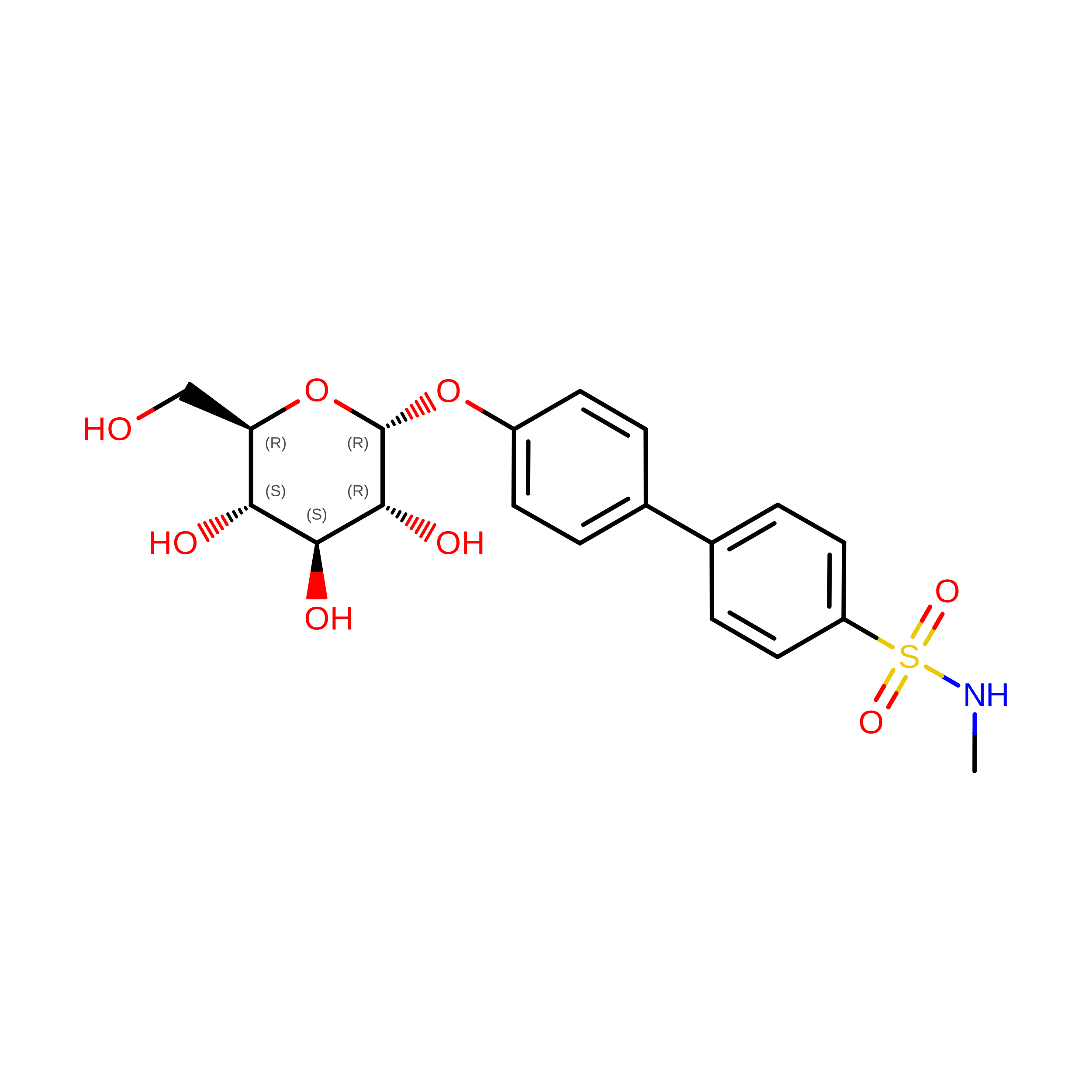
B [auth A]4'-(alpha-D-Mannopyranosyloxy)-biphenyl-4-methyl sulfonamide
C19 H23 N O8 S
CVQPQNFDTNLHAE-FQBWVUSXSA-N
GOL

Query on GOL


Download:Ideal Coordinates CCD File
C [auth A]GLYCEROL
C3 H8 O3
PEDCQBHIVMGVHV-UHFFFAOYSA-N

Experimental Data & Validation

Experimental Data

  • Method: X-RAY DIFFRACTION
  • Resolution: 1.07 Å
  • R-Value Free:  0.132 (Depositor), 0.134 (DCC) 
  • R-Value Work:  0.112 (Depositor), 0.117 (DCC) 
  • R-Value Observed: 0.113 (Depositor) 
Space Group: P 21 21 21
Unit Cell:
Length ( Å )Angle ( ˚ )
a = 48.384α = 90
b = 56.234β = 90
c = 61.595γ = 90
Software Package:
Software NamePurpose
PHENIXrefinement
XDSdata reduction
XDSdata scaling
PHASERphasing

Structure Validation

View Full Validation Report


Ligand Structure Quality Assessment 


Entry History 

Revision History  (Full details and data files)

  • Version 1.0: 2015-02-25
    Type: Initial release
  • Version 1.1: 2015-03-25
    Changes: Database references
  • Version 2.0: 2017-08-23
    Changes: Atomic model, Data collection
  • Version 2.1: 2023-12-20
    Changes: Data collection, Database references, Derived calculations, Other, Refinement description
  • Version 2.2: 2024-11-20
    Changes: Structure summary