Download Mendeley
Microtubule Association of Eml Proteins and the Eml4-Alk Variant 3 Oncoprotein Require an N-Terminal Trimerization Domain.
Richards, M.W., O'Regan, L., Roth, D., Montgomery, J.M., Straube, A., Fry, A.M., Bayliss, R.(2015) Biochem J 467: 529
- PubMed: 25740311 Search on PubMed
- DOI: https://doi.org/10.1042/BJ20150039
- Primary Citation Related Structures:
4CGB, 4CGC - PubMed Abstract:
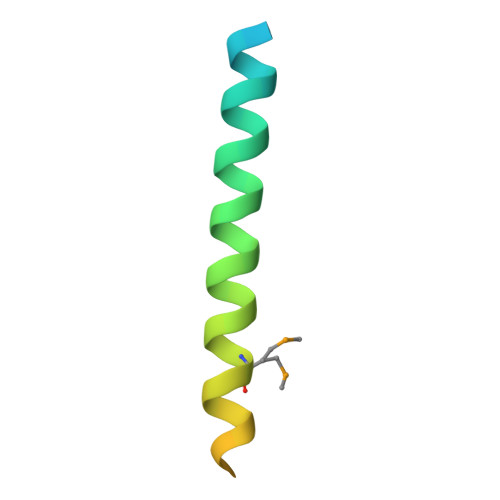
Proteins of the echinoderm microtubule (MT)-associated protein (EMAP)-like (EML) family contribute to formation of the mitotic spindle and interphase MT network. EML1-4 consist of Trp-Asp 40 (WD40) repeats and an N-terminal region containing a putative coiled-coil. Recurrent gene rearrangements in non-small cell lung cancer (NSCLC) fuse EML4 to anaplastic lymphoma kinase (ALK) causing expression of several oncogenic fusion variants. The fusions have constitutive ALK activity due to self-association through the EML4 coiled-coil. We have determined crystal structures of the coiled-coils from EML2 and EML4, which describe the structural basis of both EML self-association and oncogenic EML4-ALK activation. The structures reveal a trimeric oligomerization state directed by a conserved pattern of hydrophobic residues and salt bridges. We show that the trimerization domain (TD) of EML1 is necessary and sufficient for self-association. The TD is also essential for MT binding; however, this property requires an adjacent basic region. These observations prompted us to investigate MT association of EML4-ALK and EML1-ABL1 (Abelson 1) fusions in which variable portions of the EML component are present. Uniquely, EML4-ALK variant 3, which includes the TD and basic region of EML4 but none of the WD40 repeats, was localized to MTs, both when expressed recombinantly and when expressed in a patient-derived NSCLC cell line (H2228). This raises the question of whether the mislocalization of ALK activity to MTs might influence downstream signalling and malignant properties of cells. Furthermore, the structure of EML4 TD may enable the development of protein-protein interaction inhibitors targeting the trimerization interface, providing a possible avenue towards therapeutic intervention in EML4-ALK NSCLC.
- *Department of Biochemistry, University of Leicester, Henry Wellcome Building, Lancaster Road, Leicester LE1 9HN, U.K.
Organizational Affiliation: