4BYI | pdb_00004byi

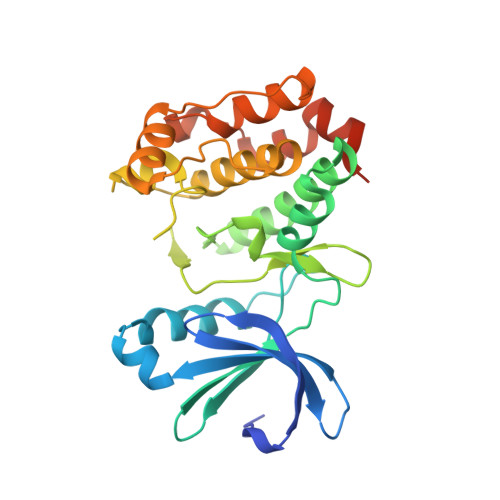
Aurora A kinase bound to a highly selective imidazopyridine inhibitor


Experimental Data Snapshot

  • Method: X-RAY DIFFRACTION
  • Resolution: 2.60 Å
  • R-Value Free: 
    0.253 (Depositor), 0.257 (DCC) 
  • R-Value Work: 
    0.227 (Depositor), 0.238 (DCC) 
  • R-Value Observed: 
    0.228 (Depositor) 

Starting Model: experimental
View more details

wwPDB Validation 3D Report Full Report

Validation slider image for 4BYI

Ligand Structure Quality Assessment 


This is version 1.2 of the entry. See complete history

Literature

Aurora Isoform Selectivity: Design and Synthesis of Imidazo[4,5-B]Pyridine Derivatives as Highly Selective Inhibitors of Aurora-A Kinase in Cells.

Bavetsias, V.Faisal, A.Crumpler, S.Brown, N.Kosmopoulou, M.Joshi, A.Atrash, B.Perez-Fuertes, Y.Schmitt, J.A.Boxall, K.J.Burke, R.Sun, C.Avery, S.Bush, K.Henley, A.Raynaud, F.I.Workman, P.Bayliss, R.Linardopoulos, S.Blagg, J.

(2013) J Med Chem 56: 9122

  • DOI: https://doi.org/10.1021/jm401115g
  • Primary Citation Related Structures: 
    4BYI, 4BYJ

  • PubMed Abstract: 

    Aurora-A differs from Aurora-B/C at three positions in the ATP-binding pocket (L215, T217, and R220). Exploiting these differences, crystal structures of ligand-Aurora protein interactions formed the basis of a design principle for imidazo[4,5-b]pyridine-derived Aurora-A-selective inhibitors. Guided by a computational modeling approach, appropriate C7-imidazo[4,5-b]pyridine derivatization led to the discovery of highly selective inhibitors, such as compound 28c, of Aurora-A over Aurora-B. In HCT116 human colon carcinoma cells, 28c and 40f inhibited the Aurora-A L215R and R220K mutants with IC50 values similar to those seen for the Aurora-A wild type. However, the Aurora-A T217E mutant was significantly less sensitive to inhibition by 28c and 40f compared to the Aurora-A wild type, suggesting that the T217 residue plays a critical role in governing the observed isoform selectivity for Aurora-A inhibition. These compounds are useful small-molecule chemical tools to further explore the function of Aurora-A in cells.


  • Organizational Affiliation
    • Cancer Research UK Cancer Therapeutics Unit, Division of Cancer Therapeutics, The Institute of Cancer Research , London SM2 5NG, United Kingdom.

Macromolecule Content 

  • Total Structure Weight: 33.34 kDa 
  • Atom Count: 2,049 
  • Modeled Residue Count: 254 
  • Deposited Residue Count: 285 
  • Unique protein chains: 1

Macromolecules

Find similar proteins by:|  3D Structure
Entity ID: 1
MoleculeChains  Sequence LengthOrganismDetailsImage
AURORA KINASE A285Homo sapiensMutation(s): 0 
EC: 2.7.11.1
UniProt & NIH Common Fund Data Resources
Find proteins for O14965 (Homo sapiens)
Explore O14965 
Go to UniProtKB:  O14965
PHAROS:  O14965
GTEx:  ENSG00000087586 
Entity Groups
Sequence Clusters30% Identity50% Identity70% Identity90% Identity95% Identity100% Identity
UniProt GroupO14965
Sequence Annotations
Expand
Reference Sequence

Small Molecules

Ligands 1 Unique
IDChains Name / Formula / InChI Key2D Diagram3D Interactions
FH3

Query on FH3


Download:Ideal Coordinates CCD File
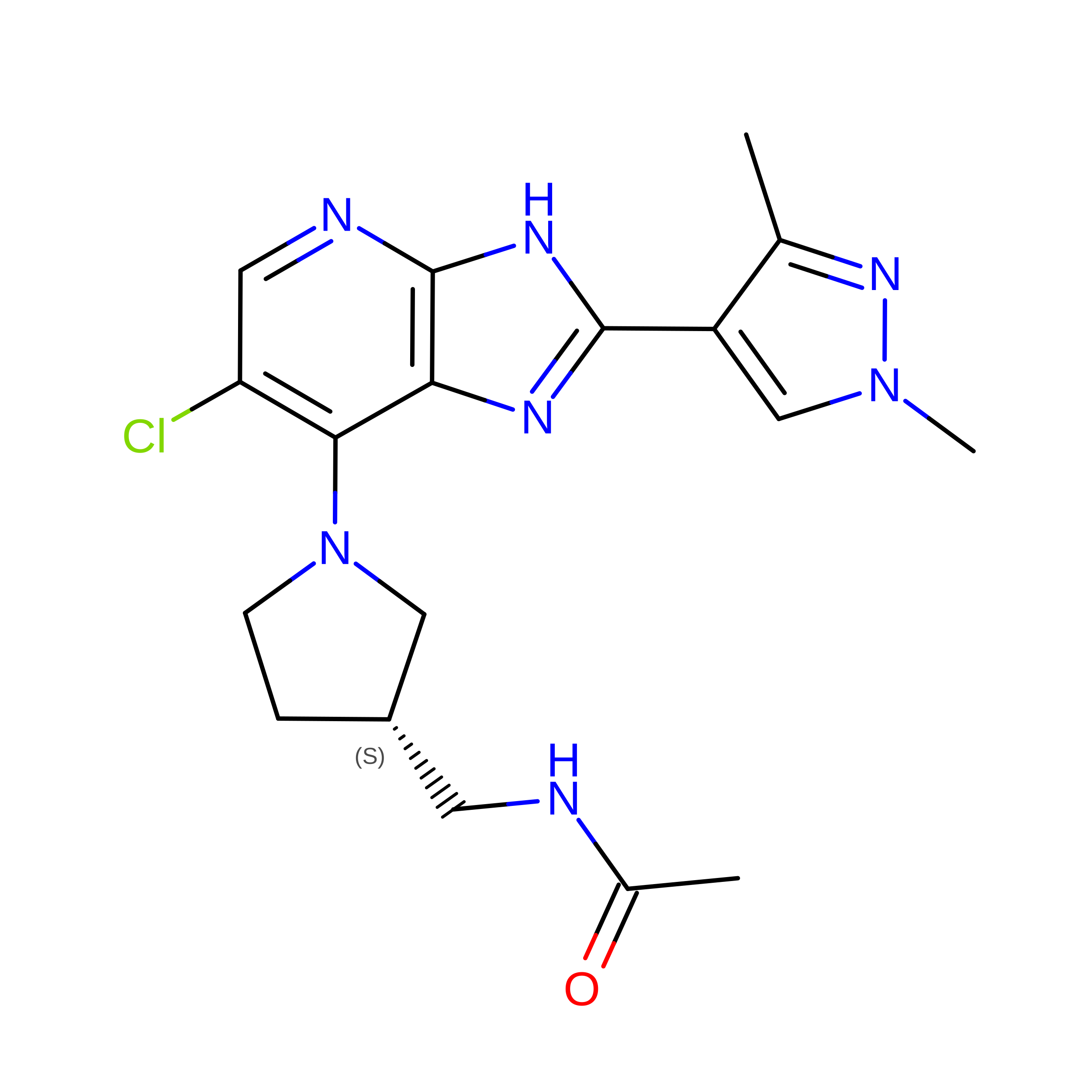
B [auth A](S)-N-((1-(6-chloro-2-(1,3-dimethyl-1H-pyrazol-4-yl)-3H-imidazo[4,5-b]pyridin-7-yl)pyrrolidin-3-yl)methyl)acetamide
C18 H22 Cl N7 O
KLKOJHYRAITDCX-LBPRGKRZSA-N

Experimental Data & Validation

Experimental Data

  • Method: X-RAY DIFFRACTION
  • Resolution: 2.60 Å
  • R-Value Free:  0.253 (Depositor), 0.257 (DCC) 
  • R-Value Work:  0.227 (Depositor), 0.238 (DCC) 
  • R-Value Observed: 0.228 (Depositor) 
Space Group: P 61 2 2
Unit Cell:
Length ( Å )Angle ( ˚ )
a = 82.456α = 90
b = 82.456β = 90
c = 170.664γ = 120
Software Package:
Software NamePurpose
PHENIXrefinement
MOSFLMdata reduction
SCALAdata scaling
PHASERphasing

Structure Validation

View Full Validation Report


Ligand Structure Quality Assessment 


Entry History 

Deposition Data

Revision History  (Full details and data files)

  • Version 1.0: 2013-11-20
    Type: Initial release
  • Version 1.1: 2013-12-11
    Changes: Database references
  • Version 1.2: 2023-12-20
    Changes: Data collection, Database references, Derived calculations, Other, Refinement description