4BY2 | pdb_00004by2

SAS-4 (dCPAP) TCP domain in complex with a Proline Rich Motif of Ana2 (dSTIL) of Drosophila Melanogaster


Experimental Data Snapshot

  • Method: X-RAY DIFFRACTION
  • Resolution: 2.57 Å
  • R-Value Free: 
    0.263 (Depositor), 0.286 (DCC) 
  • R-Value Work: 
    0.245 (Depositor) 
  • R-Value Observed: 
    0.246 (Depositor) 

wwPDB Validation 3D Report Full Report

Validation slider image for 4BY2

This is version 1.6 of the entry. See complete history

Literature

Crystal structures of the CPAP/STIL complex reveal its role in centriole assembly and human microcephaly.

Cottee, M.A.Muschalik, N.Wong, Y.L.Johnson, C.M.Johnson, S.Andreeva, A.Oegema, K.Lea, S.M.Raff, J.W.van Breugel, M.

(2013) Elife 2: e01071-e01071

  • DOI: https://doi.org/10.7554/eLife.01071
  • Primary Citation Related Structures: 
    4BXP, 4BXQ, 4BXR, 4BY2

  • PubMed Abstract: 

    Centrioles organise centrosomes and template cilia and flagella. Several centriole and centrosome proteins have been linked to microcephaly (MCPH), a neuro-developmental disease associated with small brain size. CPAP (MCPH6) and STIL (MCPH7) are required for centriole assembly, but it is unclear how mutations in them lead to microcephaly. We show that the TCP domain of CPAP constitutes a novel proline recognition domain that forms a 1:1 complex with a short, highly conserved target motif in STIL. Crystal structures of this complex reveal an unusual, all-β structure adopted by the TCP domain and explain how a microcephaly mutation in CPAP compromises complex formation. Through point mutations, we demonstrate that complex formation is essential for centriole duplication in vivo. Our studies provide the first structural insight into how the malfunction of centriole proteins results in human disease and also reveal that the CPAP-STIL interaction constitutes a conserved key step in centriole biogenesis. DOI:http://dx.doi.org/10.7554/eLife.01071.001.


  • Organizational Affiliation
    • Sir William Dunn School of Pathology , University of Oxford , Oxford , United Kingdom.

Macromolecule Content 

  • Total Structure Weight: 85.88 kDa 
  • Atom Count: 3,859 
  • Modeled Residue Count: 464 
  • Deposited Residue Count: 756 
  • Unique protein chains: 1

Macromolecules

Find similar proteins by:|  3D Structure
Entity ID: 1
MoleculeChains  Sequence LengthOrganismDetailsImage
ANASTRAL SPINDLE 2, SAS 4
A, B, C
252Drosophila melanogasterMutation(s): 0 
UniProt
Find proteins for Q9VI72 (Drosophila melanogaster)
Explore Q9VI72 
Go to UniProtKB:  Q9VI72
Find proteins for Q9XZ31 (Drosophila melanogaster)
Explore Q9XZ31 
Go to UniProtKB:  Q9XZ31
Entity Groups
Sequence Clusters30% Identity50% Identity70% Identity90% Identity95% Identity100% Identity
UniProt GroupsQ9VI72Q9XZ31
Sequence Annotations
Expand
Reference Sequence

Small Molecules

Ligands 1 Unique
IDChains Name / Formula / InChI Key2D Diagram3D Interactions
EDO

Query on EDO


Download:Ideal Coordinates CCD File
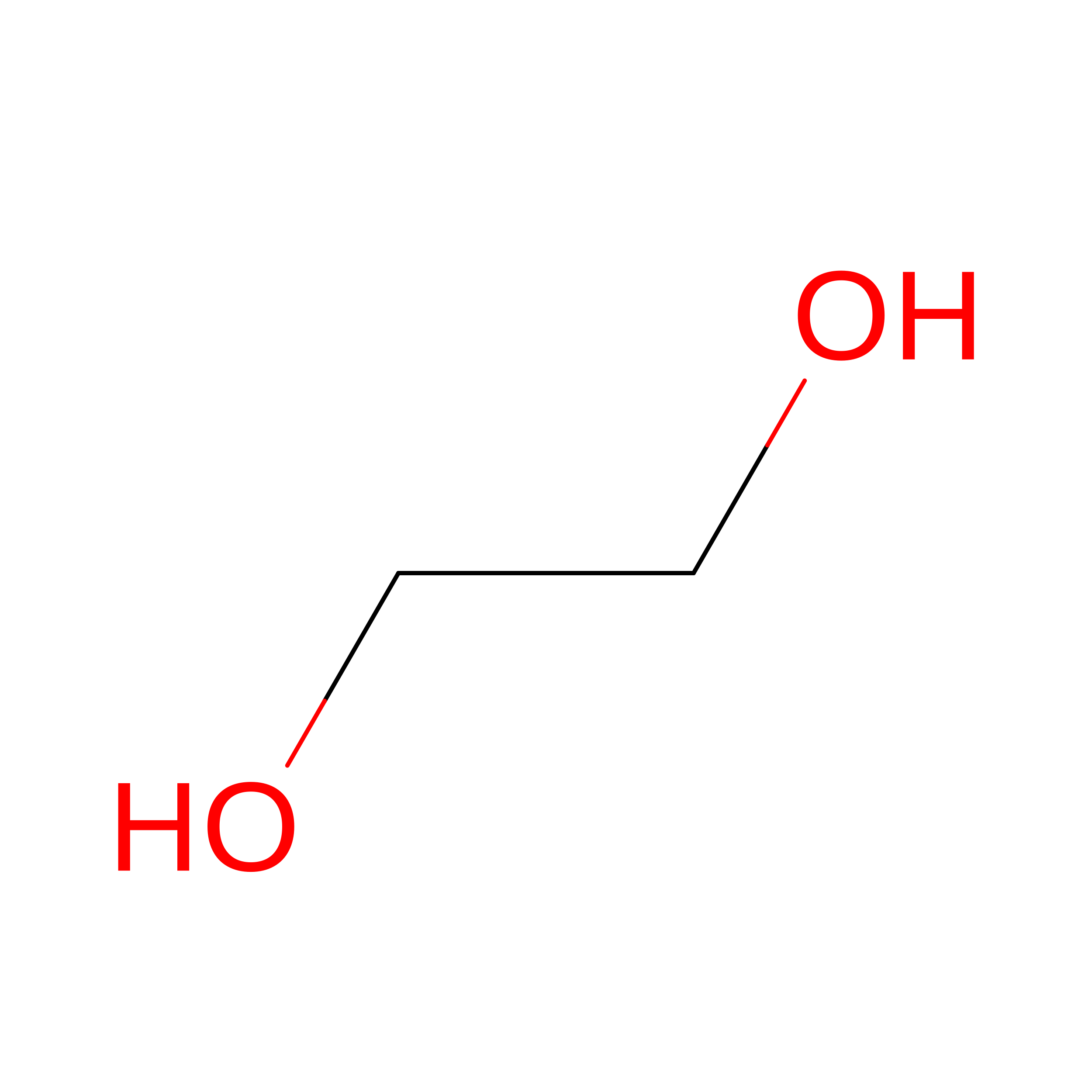
D [auth B]1,2-ETHANEDIOL
C2 H6 O2
LYCAIKOWRPUZTN-UHFFFAOYSA-N

Experimental Data & Validation

Experimental Data

  • Method: X-RAY DIFFRACTION
  • Resolution: 2.57 Å
  • R-Value Free:  0.263 (Depositor), 0.286 (DCC) 
  • R-Value Work:  0.245 (Depositor) 
  • R-Value Observed: 0.246 (Depositor) 
Space Group: P 1
Unit Cell:
Length ( Å )Angle ( ˚ )
a = 58.64α = 86.96
b = 69.91β = 88.64
c = 69.98γ = 67.69
Software Package:
Software NamePurpose
BUSTERrefinement
XDSdata reduction
Aimlessdata scaling
autoSHARPphasing

Structure Validation

View Full Validation Report


Entry History 

Deposition Data

Revision History  (Full details and data files)

  • Version 1.0: 2013-09-18
    Type: Initial release
  • Version 1.1: 2013-10-02
    Changes: Database references
  • Version 1.2: 2017-03-15
    Changes: Source and taxonomy
  • Version 1.3: 2017-12-20
    Changes: Database references, Structure summary
  • Version 1.4: 2018-01-17
    Changes: Database references
  • Version 1.5: 2019-05-08
    Changes: Data collection, Experimental preparation
  • Version 1.6: 2024-05-08
    Changes: Data collection, Database references, Derived calculations, Other