3ZLO | pdb_00003zlo

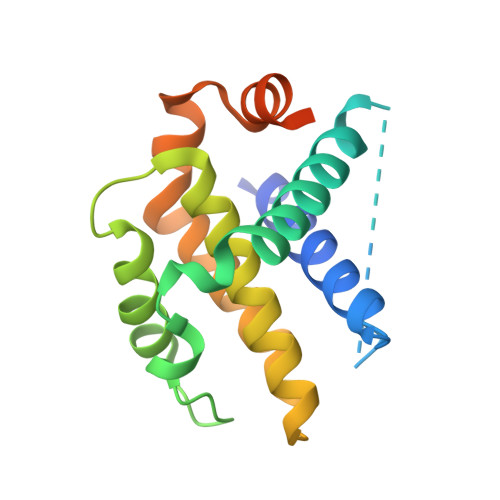
Crystal structure of BCL-XL in complex with inhibitor (Compound 6)


Experimental Data Snapshot

  • Method: X-RAY DIFFRACTION
  • Resolution: 2.60 Å
  • R-Value Free: 
    0.282 (Depositor), 0.288 (DCC) 
  • R-Value Work: 
    0.193 (Depositor), 0.197 (DCC) 
  • R-Value Observed: 
    0.197 (Depositor) 

Starting Model: experimental
View more details

wwPDB Validation 3D Report Full Report

Validation slider image for 3ZLO

Ligand Structure Quality Assessment 


This is version 1.4 of the entry. See complete history

Literature

Structure-Guided Design of a Selective Bcl-Xl Inhibitor

Lessene, G.L.Czabotar, P.E.Sleebs, B.E.Zobel, K.Lowes, K.L.Adams, J.M.Baell, J.B.Colman, P.M.Deshayes, K.Fairbrother, W.J.Flygare, J.A.Gibbons, P.Kersten, W.J.A.Kulasegaram, S.Moss, R.M.Parisot, J.P.Smith, B.J.Street, I.P.Yang, H.Huang, D.C.S.Watson, K.G.

(2013) Nat Chem Biol 9: 390-397

  • DOI: https://doi.org/10.1038/nchembio.1246
  • Primary Citation Related Structures: 
    3ZK6, 3ZLN, 3ZLO, 3ZLR

  • PubMed Abstract: 

    The prosurvival BCL-2 family protein BCL-X(L) is often overexpressed in solid tumors and renders malignant tumor cells resistant to anticancer therapeutics. Enhancing apoptotic responses by inhibiting BCL-X(L) will most likely have widespread utility in cancer treatment and, instead of inhibiting multiple prosurvival BCL-2 family members, a BCL-X(L)-selective inhibitor would be expected to minimize the toxicity to normal tissues. We describe the use of a high-throughput screen to discover a new series of small molecules targeting BCL-X(L) and their structure-guided development by medicinal chemistry. The optimized compound, WEHI-539 (7), has high affinity (subnanomolar) and selectivity for BCL-X(L) and potently kills cells by selectively antagonizing its prosurvival activity. WEHI-539 will be an invaluable tool for distinguishing the roles of BCL-X(L) from those of its prosurvival relatives, both in normal cells and notably in malignant tumor cells, many of which may prove to rely upon BCL-X(L) for their sustained growth.


  • Organizational Affiliation
    • Chemical Biology Division, Walter and Eliza Hall Institute of Medical Research, Parkville, Victoria, Australia. glessene@wehi.edu.au

Macromolecule Content 

  • Total Structure Weight: 21.36 kDa 
  • Atom Count: 1,187 
  • Modeled Residue Count: 142 
  • Deposited Residue Count: 181 
  • Unique protein chains: 1

Macromolecules

Find similar proteins by:|  3D Structure
Entity ID: 1
MoleculeChains  Sequence LengthOrganismDetailsImage
BCL-2-LIKE PROTEIN 1181Homo sapiensMutation(s): 0 
UniProt & NIH Common Fund Data Resources
Find proteins for Q07817 (Homo sapiens)
Explore Q07817 
Go to UniProtKB:  Q07817
PHAROS:  Q07817
GTEx:  ENSG00000171552 
Entity Groups
Sequence Clusters30% Identity50% Identity70% Identity90% Identity95% Identity100% Identity
UniProt GroupQ07817
Sequence Annotations
Expand
Reference Sequence

Small Molecules

Ligands 1 Unique
IDChains Name / Formula / InChI Key2D Diagram3D Interactions
X8U

Query on X8U


Download:Ideal Coordinates CCD File
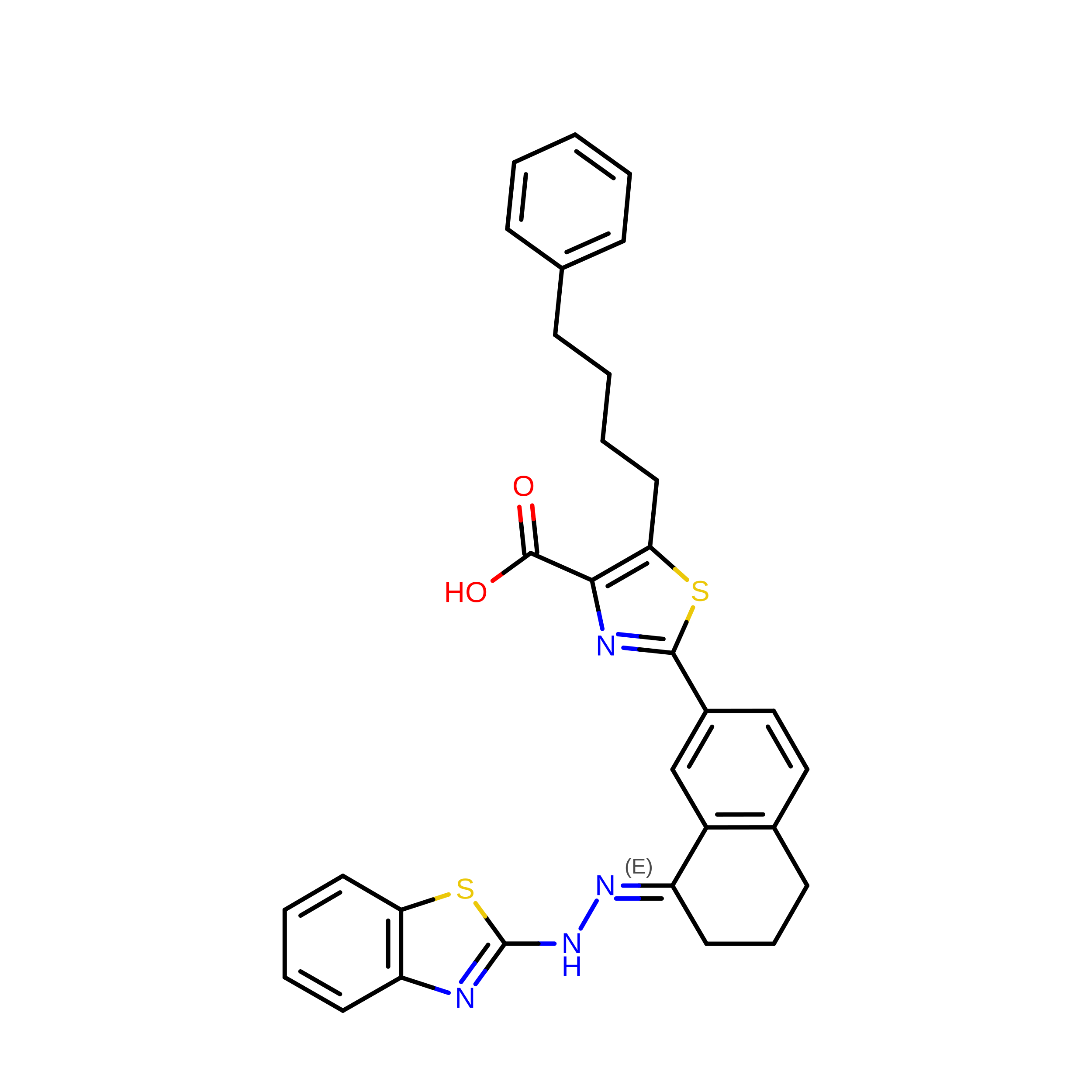
B [auth A]2-[(8E)-8-(1,3-benzothiazol-2-ylhydrazinylidene)-6,7-dihydro-5H-naphthalen-2-yl]-5-(4-phenylbutyl)-1,3-thiazole-4-carboxylic acid
C31 H28 N4 O2 S2
KJRCRYVHSPWAIC-JGRMKTMXSA-N

Experimental Data & Validation

Experimental Data

  • Method: X-RAY DIFFRACTION
  • Resolution: 2.60 Å
  • R-Value Free:  0.282 (Depositor), 0.288 (DCC) 
  • R-Value Work:  0.193 (Depositor), 0.197 (DCC) 
  • R-Value Observed: 0.197 (Depositor) 
Space Group: P 32 2 1
Unit Cell:
Length ( Å )Angle ( ˚ )
a = 67.832α = 90
b = 67.832β = 90
c = 67.383γ = 120
Software Package:
Software NamePurpose
PHENIXrefinement
DENZOdata reduction
SCALEPACKdata scaling
PHASERphasing

Structure Validation

View Full Validation Report


Ligand Structure Quality Assessment 


Entry History 

Deposition Data

Revision History  (Full details and data files)

  • Version 1.0: 2013-04-24
    Type: Initial release
  • Version 1.1: 2013-05-08
    Changes: Database references
  • Version 1.2: 2013-06-05
    Changes: Database references
  • Version 1.3: 2018-06-13
    Changes: Data collection, Database references, Structure summary
  • Version 1.4: 2023-12-20
    Changes: Data collection, Database references, Derived calculations, Other, Refinement description