3WO2 | pdb_00003wo2

Crystal structure of human interleukin-18


Experimental Data Snapshot

  • Method: X-RAY DIFFRACTION
  • Resolution: 2.33 Å
  • R-Value Free: 
    0.271 (Depositor), 0.276 (DCC) 
  • R-Value Work: 
    0.218 (Depositor), 0.225 (DCC) 
  • R-Value Observed: 
    0.221 (Depositor) 

Starting Model: experimental
View more details

wwPDB Validation 3D Report Full Report

Validation slider image for 3WO2

Ligand Structure Quality Assessment 


This is version 1.2 of the entry. See complete history

Literature

The structural basis for receptor recognition of human interleukin-18

Tsutsumi, N.Kimura, T.Arita, K.Ariyoshi, M.Ohnishi, H.Yamamoto, T.Zuo, X.Maenaka, K.Park, E.Y.Kondo, N.Shirakawa, M.Tochio, H.Kato, Z.

(2014) Nat Commun 5: 5340-5340

  • DOI: https://doi.org/10.1038/ncomms6340
  • Primary Citation Related Structures: 
    3WO2, 3WO3, 3WO4

  • PubMed Abstract: 

    Interleukin (IL)-18 is a proinflammatory cytokine that belongs to the IL-1 family and plays an important role in inflammation. The uncontrolled release of this cytokine is associated with severe chronic inflammatory disease. IL-18 forms a signalling complex with the IL-18 receptor α (Rα) and β (Rβ) chains at the plasma membrane, which induces multiple inflammatory cytokines. Here, we present a crystal structure of human IL-18 bound to the two receptor extracellular domains. Generally, the receptors' recognition mode for IL-18 is similar to IL-1β; however, certain notable differences were observed. The architecture of the IL-18 receptor second domain (D2) is unique among the other IL-1R family members, which presumably distinguishes them from the IL-1 receptors that exhibit a more promiscuous ligand recognition mode. The structures and associated biochemical and cellular data should aid in developing novel drugs to neutralize IL-18 activity.


  • Organizational Affiliation
    • Department of Molecular Engineering, Graduate School of Engineering, Kyoto University, Katsura, Nishikyo-ku, Kyoto 615-8510, Japan.

Macromolecule Content 

  • Total Structure Weight: 80.72 kDa 
  • Atom Count: 5,733 
  • Modeled Residue Count: 627 
  • Deposited Residue Count: 628 
  • Unique protein chains: 1

Macromolecules

Find similar proteins by:|  3D Structure
Entity ID: 1
MoleculeChains  Sequence LengthOrganismDetailsImage
Interleukin-18
A, B, C, D
157Homo sapiensMutation(s): 0 
Gene Names: IL18
UniProt & NIH Common Fund Data Resources
Find proteins for Q14116 (Homo sapiens)
Explore Q14116 
Go to UniProtKB:  Q14116
PHAROS:  Q14116
GTEx:  ENSG00000150782 
Entity Groups
Sequence Clusters30% Identity50% Identity70% Identity90% Identity95% Identity100% Identity
UniProt GroupQ14116
Sequence Annotations
Expand
Reference Sequence

Small Molecules

Ligands 2 Unique
IDChains Name / Formula / InChI Key2D Diagram3D Interactions
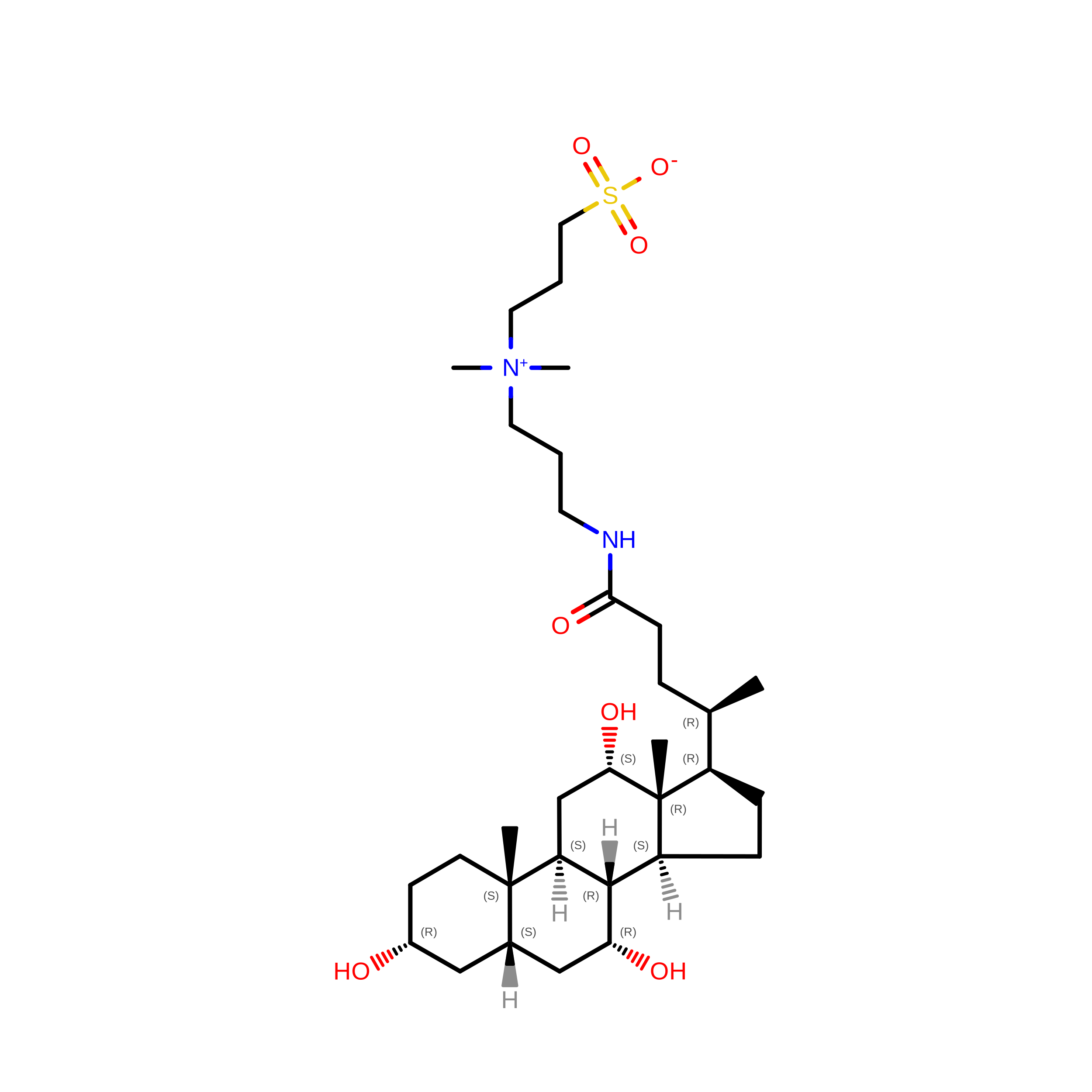
CPS

Query on CPS


Download:Ideal Coordinates CCD File
E [auth A]
F [auth A]
G [auth A]
J [auth B]
K [auth B]
E [auth A],
F [auth A],
G [auth A],
J [auth B],
K [auth B],
L [auth B],
N [auth C],
O [auth C],
P [auth C],
R [auth D],
S [auth D],
T [auth D]
3-[(3-CHOLAMIDOPROPYL)DIMETHYLAMMONIO]-1-PROPANESULFONATE
C32 H58 N2 O7 S
UMCMPZBLKLEWAF-BCTGSCMUSA-N
SO4

Query on SO4


Download:Ideal Coordinates CCD File
H [auth A],
I [auth A],
M [auth B],
Q [auth C]
SULFATE ION
O4 S
QAOWNCQODCNURD-UHFFFAOYSA-L

Experimental Data & Validation

Experimental Data

  • Method: X-RAY DIFFRACTION
  • Resolution: 2.33 Å
  • R-Value Free:  0.271 (Depositor), 0.276 (DCC) 
  • R-Value Work:  0.218 (Depositor), 0.225 (DCC) 
  • R-Value Observed: 0.221 (Depositor) 
Space Group: P 1 21 1
Unit Cell:
Length ( Å )Angle ( ˚ )
a = 68.146α = 90
b = 79.511β = 100.97
c = 73.46γ = 90
Software Package:
Software NamePurpose
BSSdata collection
PHASERphasing
BUSTERrefinement
XDSdata reduction
SCALAdata scaling

Structure Validation

View Full Validation Report


Ligand Structure Quality Assessment 


Entry History 

Deposition Data

Revision History  (Full details and data files)

  • Version 1.0: 2014-12-17
    Type: Initial release
  • Version 1.1: 2016-01-20
    Changes: Database references
  • Version 1.2: 2023-11-08
    Changes: Data collection, Database references, Derived calculations, Refinement description