3OHB | pdb_00003ohb

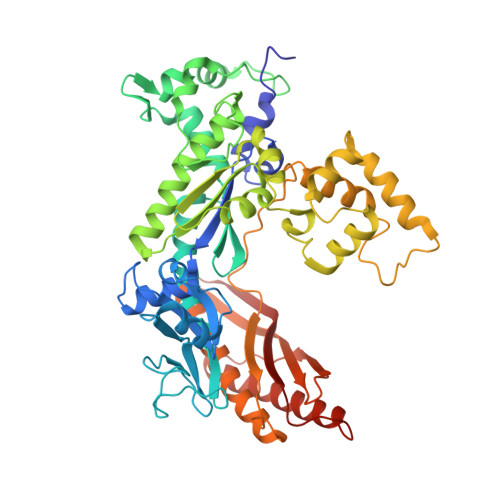
Yeast DNA polymerase eta extending from an 8-oxoG lesion


Experimental Data Snapshot

  • Method: X-RAY DIFFRACTION
  • Resolution: 2.00 Å
  • R-Value Free: 
    0.188 (Depositor), 0.197 (DCC) 
  • R-Value Work: 
    0.156 (Depositor), 0.164 (DCC) 
  • R-Value Observed: 
    0.158 (Depositor) 

Starting Model: experimental
View more details

wwPDB Validation 3D Report Full Report

Validation slider image for 3OHB

Ligand Structure Quality Assessment 


This is version 1.3 of the entry. See complete history

Literature

Structural basis for error-free replication of oxidatively damaged DNA by yeast DNA polymerase eta.

Silverstein, T.D.Jain, R.Johnson, R.E.Prakash, L.Prakash, S.Aggarwal, A.K.

(2010) Structure 18: 1463-1470

  • DOI: https://doi.org/10.1016/j.str.2010.08.019
  • Primary Citation Related Structures: 
    3OHA, 3OHB

  • PubMed Abstract: 

    7,8-dihydro-8-oxoguanine (8-oxoG) adducts are formed frequently by the attack of oxygen-free radicals on DNA. They are among the most mutagenic lesions in cells because of their dual coding potential, where, in addition to normal base-pairing of 8-oxoG(anti) with dCTP, 8-oxoG in the syn conformation can base pair with dATP, causing G to T transversions. We provide here for the first time a structural basis for the error-free replication of 8-oxoG lesions by yeast DNA polymerase η (Polη). We show that the open active site cleft of Polη can accommodate an 8-oxoG lesion in the anti conformation with only minimal changes to the polymerase and the bound DNA: at both the insertion and post-insertion steps of lesion bypass. Importantly, the active site geometry remains the same as in the undamaged complex and provides a basis for the ability of Polη to prevent the mutagenic replication of 8-oxoG lesions in cells.


  • Organizational Affiliation
    • Department of Structural & Chemical Biology, Mount Sinai School of Medicine, Box 1677, 1425 Madison Avenue, New York, NY 10029, USA.

Macromolecule Content 

  • Total Structure Weight: 67.89 kDa 
  • Atom Count: 5,283 
  • Modeled Residue Count: 539 
  • Deposited Residue Count: 547 
  • Unique protein chains: 1
  • Unique nucleic acid chains: 2

Macromolecules


Find similar proteins by:|  3D Structure
Entity ID: 1
MoleculeChains  Sequence LengthOrganismDetailsImage
DNA polymerase eta520Saccharomyces cerevisiaeMutation(s): 2 
Gene Names: DBH1RAD30YDR419W
EC: 2.7.7.7
UniProt
Find proteins for Q04049 (Saccharomyces cerevisiae (strain ATCC 204508 / S288c))
Explore Q04049 
Go to UniProtKB:  Q04049
Entity Groups
Sequence Clusters30% Identity50% Identity70% Identity90% Identity95% Identity100% Identity
UniProt GroupQ04049
Sequence Annotations
Expand
Reference Sequence
Find similar nucleic acids by:  Sequence
Entity ID: 2
MoleculeChains LengthOrganismImage
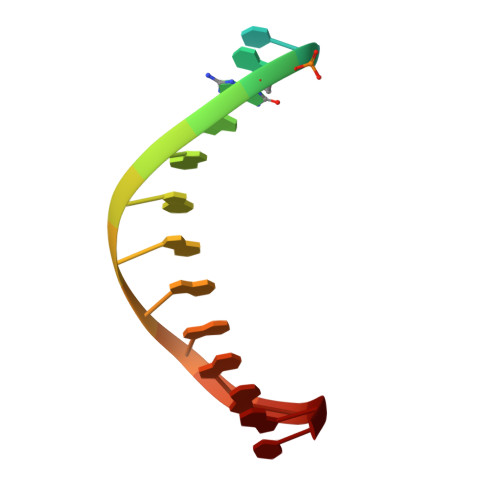
5'-D(*TP*AP*AP*TP*GP*(8OG)P*AP*GP*GP*GP*GP*AP*GP*GP*AP*C)-3'B [auth T]16N/A
Sequence Annotations
Expand
Reference Sequence
Find similar nucleic acids by:  Sequence
Entity ID: 3
MoleculeChains LengthOrganismImage
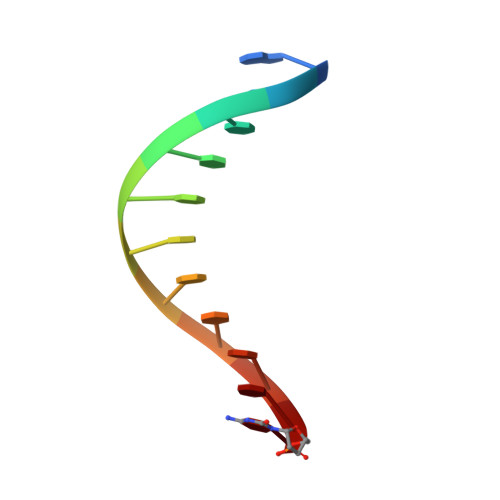
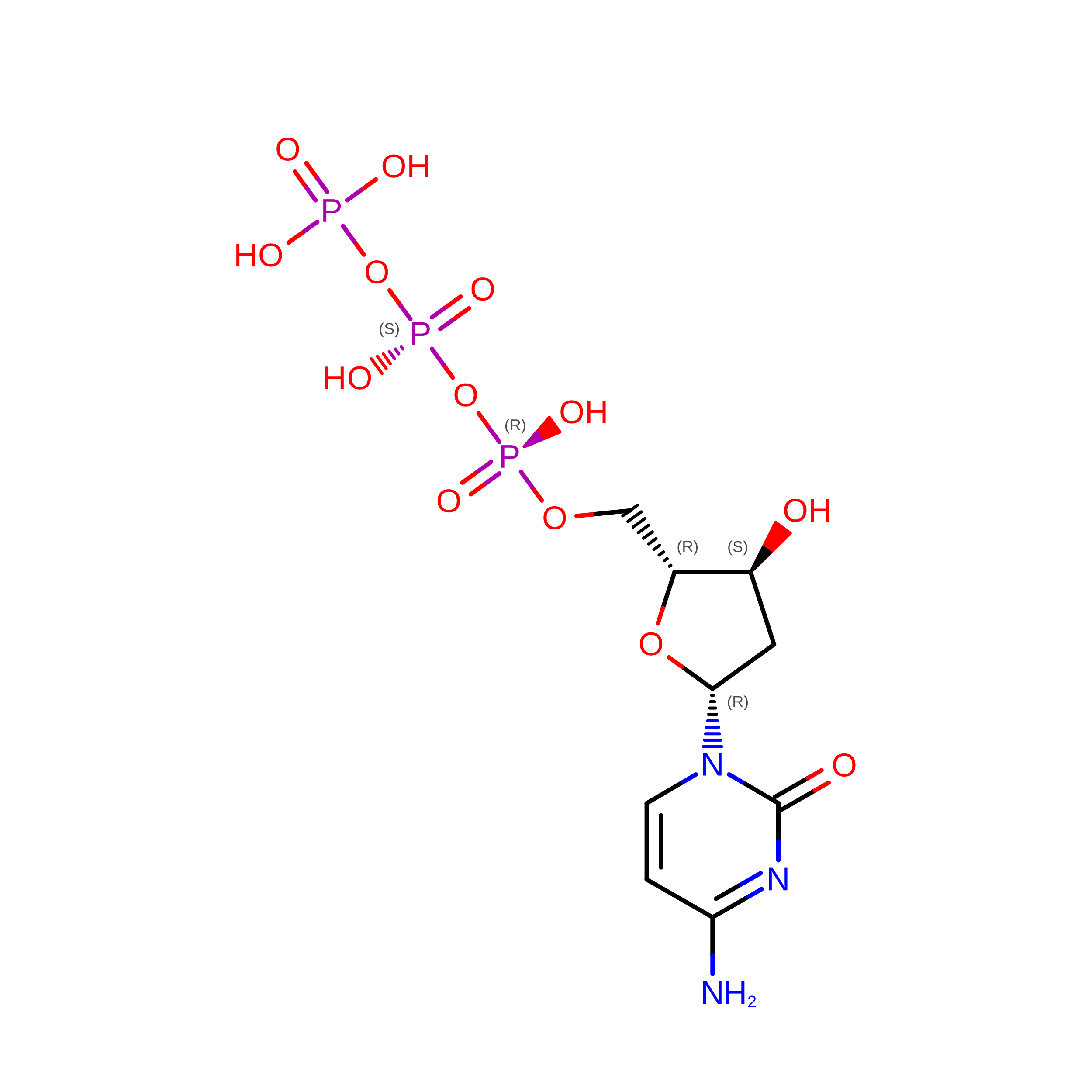
5'-D(*GP*TP*CP*CP*TP*CP*CP*CP*CP*TP*(DOC))-3'C [auth P]11N/A
Sequence Annotations
Expand
Reference Sequence

Experimental Data & Validation

Experimental Data

  • Method: X-RAY DIFFRACTION
  • Resolution: 2.00 Å
  • R-Value Free:  0.188 (Depositor), 0.197 (DCC) 
  • R-Value Work:  0.156 (Depositor), 0.164 (DCC) 
  • R-Value Observed: 0.158 (Depositor) 
Space Group: C 2 2 21
Unit Cell:
Length ( Å )Angle ( ˚ )
a = 87.958α = 90
b = 228.268β = 90
c = 85.932γ = 90
Software Package:
Software NamePurpose
DENZOdata reduction
SCALEPACKdata scaling
PHASERphasing
REFMACrefinement
PDB_EXTRACTdata extraction
HKL-2000data collection

Structure Validation

View Full Validation Report


Ligand Structure Quality Assessment 


Entry History 

Deposition Data

Revision History  (Full details and data files)

  • Version 1.0: 2010-12-22
    Type: Initial release
  • Version 1.1: 2011-07-13
    Changes: Version format compliance
  • Version 1.2: 2017-11-08
    Changes: Refinement description
  • Version 1.3: 2023-09-06
    Changes: Data collection, Database references, Derived calculations, Refinement description