3LIC | pdb_00003lic

Crystal Structure of the extracellular domain of the putative histidine kinase soHK1S-Z6


Experimental Data Snapshot

  • Method: X-RAY DIFFRACTION
  • Resolution: 2.30 Å
  • R-Value Free: 
    0.245 (Depositor), 0.250 (DCC) 
  • R-Value Work: 
    0.181 (Depositor), 0.185 (DCC) 
  • R-Value Observed: 
    0.184 (Depositor) 

wwPDB Validation 3D Report Full Report

Validation slider image for 3LIC

This is version 1.3 of the entry. See complete history

Literature

Structural characterization of the predominant family of histidine kinase sensor domains.

Zhang, Z.Hendrickson, W.A.

(2010) J Mol Biology 400: 335-353

  • DOI: https://doi.org/10.1016/j.jmb.2010.04.049
  • Primary Citation Related Structures: 
    3LI8, 3LI9, 3LIA, 3LIB, 3LIC, 3LID, 3LIE, 3LIF

  • PubMed Abstract: 

    Histidine kinase (HK) receptors are used ubiquitously by bacteria to monitor environmental changes, and they are also prevalent in plants, fungi, and other protists. Typical HK receptors have an extracellular sensor portion that detects a signal, usually a chemical ligand, and an intracellular transmitter portion that includes both the kinase domain itself and the site for histidine phosphorylation. While kinase domains are highly conserved, sensor domains are diverse. HK receptors function as dimers, but the molecular mechanism for signal transduction across cell membranes remains obscure. In this study, eight crystal structures were determined from five sensor domains representative of the most populated family, family HK1, found in a bioinformatic analysis of predicted sensor domains from transmembrane HKs. Each structure contains an inserted repeat of PhoQ/DcuS/CitA (PDC) domains, and similarity between sequence and structure is correlated across these and other double-PDC sensor proteins. Three of the five sensors crystallize as dimers that appear to be physiologically relevant, and comparisons between ligated structures and apo-state structures provide insights into signal transmission. Some HK1 family proteins prove to be sensors for chemotaxis proteins or diguanylate cyclase receptors, implying a combinatorial molecular evolution.


  • Organizational Affiliation
    • Howard Hughes Medical Institute, Columbia University, New York, NY 10032, USA.

Macromolecule Content 

  • Total Structure Weight: 30.7 kDa 
  • Atom Count: 2,228 
  • Modeled Residue Count: 265 
  • Deposited Residue Count: 274 
  • Unique protein chains: 1

Macromolecules

Find similar proteins by:|  3D Structure
Entity ID: 1
MoleculeChains  Sequence LengthOrganismDetailsImage
Sensor protein274Shewanella oneidensisMutation(s): 0 
Gene Names: SO_0859
EC: 2.7.13.3
UniProt
Find proteins for Q8EII0 (Shewanella oneidensis (strain ATCC 700550 / JCM 31522 / CIP 106686 / LMG 19005 / NCIMB 14063 / MR-1))
Explore Q8EII0 
Go to UniProtKB:  Q8EII0
Entity Groups
Sequence Clusters30% Identity50% Identity70% Identity90% Identity95% Identity100% Identity
UniProt GroupQ8EII0
Sequence Annotations
Expand
Reference Sequence

Small Molecules

Ligands 1 Unique
IDChains Name / Formula / InChI Key2D Diagram3D Interactions
EDO

Query on EDO


Download:Ideal Coordinates CCD File
B [auth A]1,2-ETHANEDIOL
C2 H6 O2
LYCAIKOWRPUZTN-UHFFFAOYSA-N
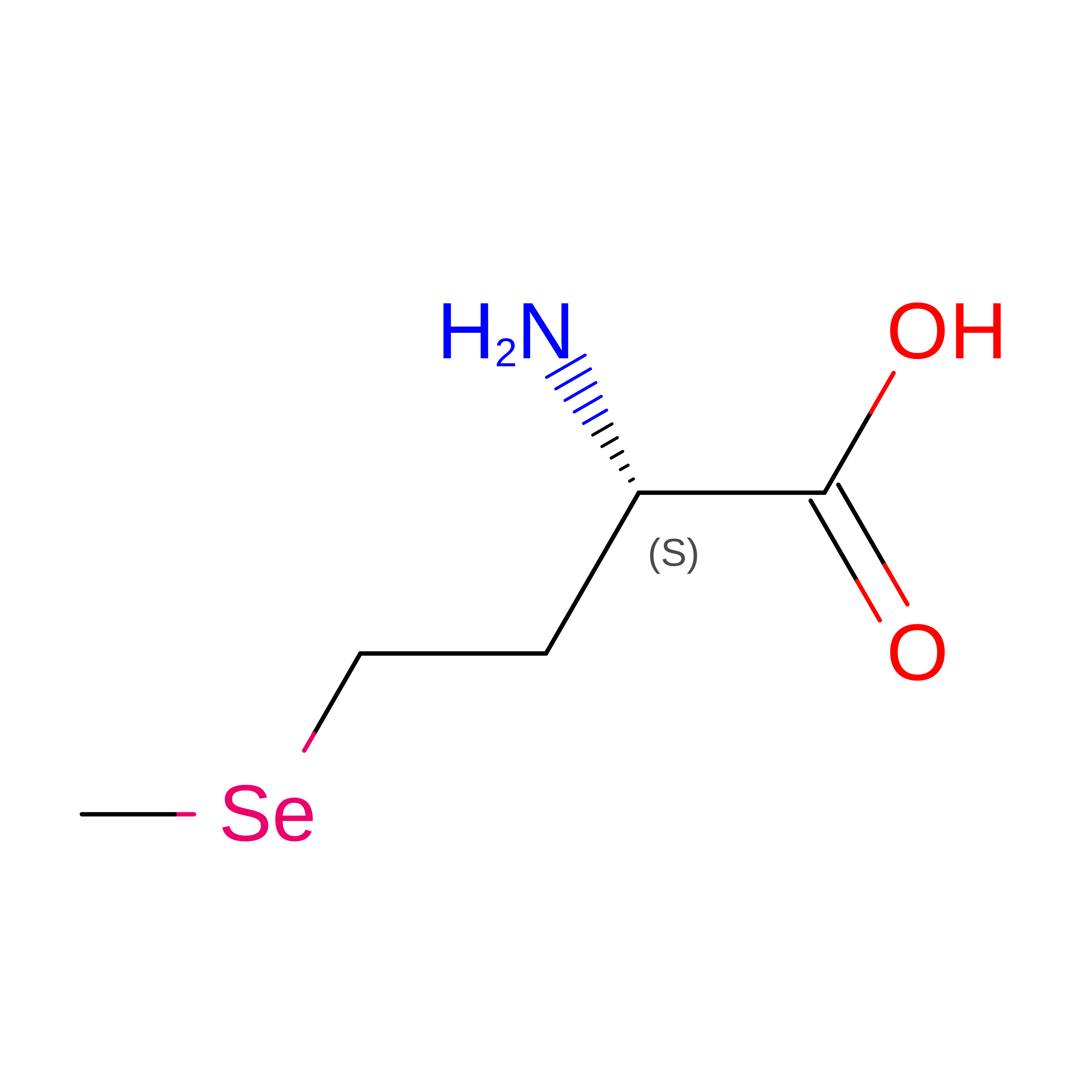
Modified Residues  1 Unique
IDChains TypeFormula2D DiagramParent
MSE
Query on MSE
A
L-PEPTIDE LINKINGC5 H11 N O2 SeMET

Experimental Data & Validation

Experimental Data

  • Method: X-RAY DIFFRACTION
  • Resolution: 2.30 Å
  • R-Value Free:  0.245 (Depositor), 0.250 (DCC) 
  • R-Value Work:  0.181 (Depositor), 0.185 (DCC) 
  • R-Value Observed: 0.184 (Depositor) 
Space Group: P 31 2 1
Unit Cell:
Length ( Å )Angle ( ˚ )
a = 133.069α = 90
b = 133.069β = 90
c = 32.369γ = 120
Software Package:
Software NamePurpose
DENZOdata reduction
SCALEPACKdata scaling
REFMACrefinement
PDB_EXTRACTdata extraction

Structure Validation

View Full Validation Report


Entry History 

Deposition Data

Revision History  (Full details and data files)

  • Version 1.0: 2010-05-05
    Type: Initial release
  • Version 1.1: 2011-07-13
    Changes: Version format compliance
  • Version 1.2: 2017-11-01
    Changes: Refinement description
  • Version 1.3: 2024-11-06
    Changes: Data collection, Database references, Derived calculations, Structure summary