3JSL | pdb_00003jsl

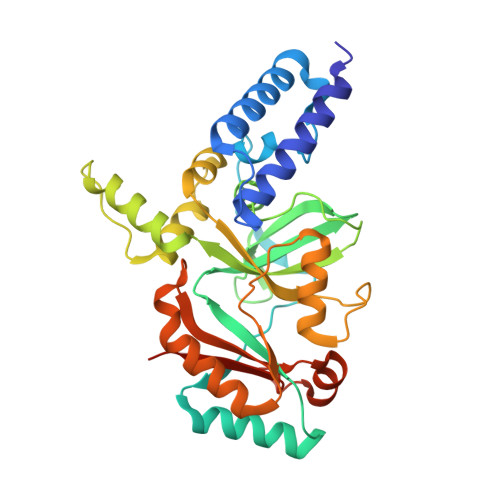
Crystal structure of the adenylation domain of NAD+-dependent DNA ligase from Staphylococcus aureus


Experimental Data Snapshot

  • Method: X-RAY DIFFRACTION
  • Resolution: 1.80 Å
  • R-Value Free: 
    0.250 (Depositor), 0.248 (DCC) 
  • R-Value Work: 
    0.196 (Depositor), 0.195 (DCC) 
  • R-Value Observed: 
    0.198 (Depositor) 

wwPDB Validation 3D Report Full Report

Validation slider image for 3JSL

This is version 1.2 of the entry. See complete history

Literature

Structure of the adenylation domain of NAD(+)-dependent DNA ligase from Staphylococcus aureus.

Han, S.Chang, J.S.Griffor, M.

(2009) Acta Crystallogr Sect F Struct Biol Cryst Commun 65: 1078-1082

  • DOI: https://doi.org/10.1107/S1744309109036872
  • Primary Citation Related Structures: 
    3JSL, 3JSN

  • PubMed Abstract: 

    DNA ligase catalyzes phosphodiester-bond formation between immediately adjacent 5'-phosphate and 3'-hydroxyl groups in double-stranded DNA and plays a central role in many cellular and biochemical processes, including DNA replication, repair and recombination. Bacterial NAD(+)-dependent DNA ligases have been extensively characterized as potential antibacterial targets because of their essentiality and their structural distinction from human ATP-dependent DNA ligases. The high-resolution structure of the adenylation domain of Staphylococcus aureus NAD(+)-dependent DNA ligase establishes the conserved domain architecture with other bacterial adenylation domains. Two apo crystal structures revealed that the active site possesses the preformed NAD(+)-binding pocket and the 'C2 tunnel' lined with hydrophobic residues: Leu80, Phe224, Leu287, Phe295 and Trp302. The C2 tunnel is unique to bacterial DNA ligases and the Leu80 side chain at the mouth of the tunnel points inside the tunnel and forms a narrow funnel in the S. aureus DNA ligase structure. Taken together with other DNA ligase structures, the S. aureus DNA ligase structure provides a basis for a more integrated understanding of substrate recognition and catalysis and will be also be of help in the development of small-molecule inhibitors.


  • Organizational Affiliation
    • Pfizer Inc., Groton, Connecticut 06340, USA. seungil.han@pfizer.com

Macromolecule Content 

  • Total Structure Weight: 74.22 kDa 
  • Atom Count: 5,499 
  • Modeled Residue Count: 616 
  • Deposited Residue Count: 636 
  • Unique protein chains: 1

Macromolecules

Find similar proteins by:|  3D Structure
Entity ID: 1
MoleculeChains  Sequence LengthOrganismDetailsImage
DNA ligase
A, B
318Staphylococcus aureusMutation(s): 0 
Gene Names: LIGA
EC: 6.5.1.2
UniProt
Find proteins for Q9AIU7 (Staphylococcus aureus)
Explore Q9AIU7 
Go to UniProtKB:  Q9AIU7
Entity Groups
Sequence Clusters30% Identity50% Identity70% Identity90% Identity95% Identity100% Identity
UniProt GroupQ9AIU7
Sequence Annotations
Expand
Reference Sequence

Experimental Data & Validation

Experimental Data

  • Method: X-RAY DIFFRACTION
  • Resolution: 1.80 Å
  • R-Value Free:  0.250 (Depositor), 0.248 (DCC) 
  • R-Value Work:  0.196 (Depositor), 0.195 (DCC) 
  • R-Value Observed: 0.198 (Depositor) 
Space Group: P 1
Unit Cell:
Length ( Å )Angle ( ˚ )
a = 40.152α = 90.1
b = 49.193β = 103.2
c = 88.039γ = 90.01
Software Package:
Software NamePurpose
HKL-2000data collection
PHASERphasing
REFMACrefinement
HKL-2000data reduction
HKL-2000data scaling

Structure Validation

View Full Validation Report


Entry History 

Deposition Data

Revision History  (Full details and data files)

  • Version 1.0: 2009-12-15
    Type: Initial release
  • Version 1.1: 2011-07-13
    Changes: Version format compliance
  • Version 1.2: 2024-02-21
    Changes: Data collection, Database references, Derived calculations