3GOY | pdb_00003goy

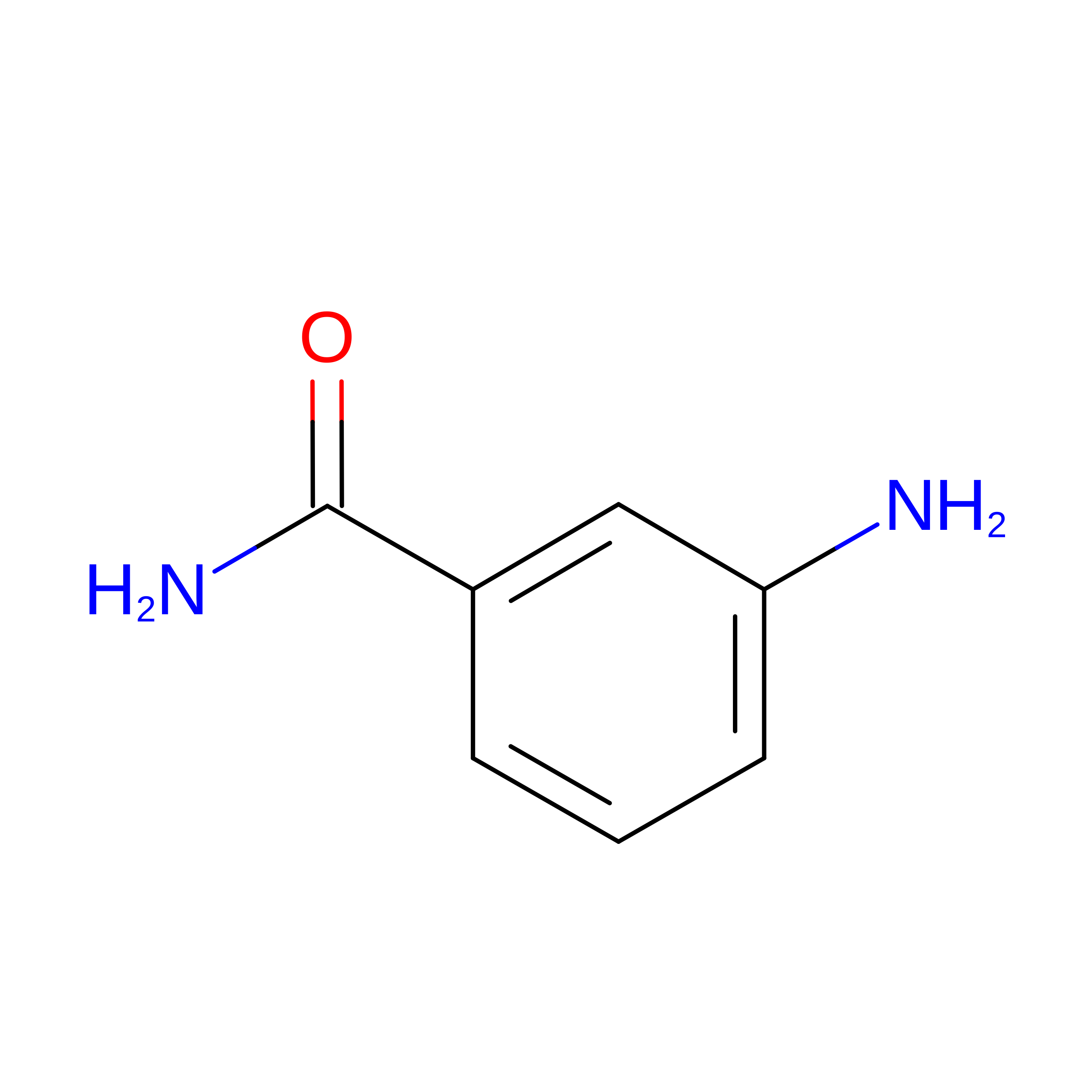
Crystal structure of human poly(adp-ribose) polymerase 14, catalytic fragment in complex with an inhibitor 3-aminobenzamide


Experimental Data Snapshot

  • Method: X-RAY DIFFRACTION
  • Resolution: 2.80 Å
  • R-Value Free: 
    0.292 (Depositor), 0.290 (DCC) 
  • R-Value Work: 
    0.253 (Depositor), 0.253 (DCC) 
  • R-Value Observed: 
    0.255 (Depositor) 

Starting Model: experimental
View more details

wwPDB Validation 3D Report Full Report

Validation slider image for 3GOY

This is version 1.4 of the entry. See complete history

Literature

Family-wide chemical profiling and structural analysis of PARP and tankyrase inhibitors.

Wahlberg, E.Karlberg, T.Kouznetsova, E.Markova, N.Macchiarulo, A.Thorsell, A.G.Pol, E.Frostell, A.Ekblad, T.Oncu, D.Kull, B.Robertson, G.M.Pellicciari, R.Schuler, H.Weigelt, J.

(2012) Nat Biotechnol 30: 283-288

  • DOI: https://doi.org/10.1038/nbt.2121
  • Primary Citation Related Structures: 
    3GOY, 3MHJ, 3MHK, 3P0N, 3P0P, 3P0Q, 3SE2, 3SMI, 3SMJ

  • PubMed Abstract: 

    Inhibitors of poly-ADP-ribose polymerase (PARP) family proteins are currently in clinical trials as cancer therapeutics, yet the specificity of many of these compounds is unknown. Here we evaluated a series of 185 small-molecule inhibitors, including research reagents and compounds being tested clinically, for the ability to bind to the catalytic domains of 13 of the 17 human PARP family members including the tankyrases, TNKS1 and TNKS2. Many of the best-known inhibitors, including TIQ-A, 6(5H)-phenanthridinone, olaparib, ABT-888 and rucaparib, bound to several PARP family members, suggesting that these molecules lack specificity and have promiscuous inhibitory activity. We also determined X-ray crystal structures for five TNKS2 ligand complexes and four PARP14 ligand complexes. In addition to showing that the majority of PARP inhibitors bind multiple targets, these results provide insight into the design of new inhibitors.


  • Organizational Affiliation
    • Structural Genomics Consortium, Karolinska Institutet, Department of Medical Biochemistry and Biophysics, Stockholm, Sweden.

Macromolecule Content 

  • Total Structure Weight: 89.02 kDa 
  • Atom Count: 5,834 
  • Modeled Residue Count: 725 
  • Deposited Residue Count: 772 
  • Unique protein chains: 1

Macromolecules

Find similar proteins by:|  3D Structure
Entity ID: 1
MoleculeChains  Sequence LengthOrganismDetailsImage
Poly [ADP-ribose] polymerase 14
A, B, C, D
193Homo sapiensMutation(s): 0 
Gene Names: BAL2KIAA1268PARP14
EC: 2.4.2.30 (PDB Primary Data), 2.4.2 (UniProt)
UniProt & NIH Common Fund Data Resources
Find proteins for Q460N5 (Homo sapiens)
Explore Q460N5 
Go to UniProtKB:  Q460N5
PHAROS:  Q460N5
GTEx:  ENSG00000173193 
Entity Groups
Sequence Clusters30% Identity50% Identity70% Identity90% Identity95% Identity100% Identity
UniProt GroupQ460N5
Sequence Annotations
Expand
Reference Sequence

Experimental Data & Validation

Experimental Data

  • Method: X-RAY DIFFRACTION
  • Resolution: 2.80 Å
  • R-Value Free:  0.292 (Depositor), 0.290 (DCC) 
  • R-Value Work:  0.253 (Depositor), 0.253 (DCC) 
  • R-Value Observed: 0.255 (Depositor) 
Space Group: C 1 2 1
Unit Cell:
Length ( Å )Angle ( ˚ )
a = 82.75α = 90
b = 144.27β = 100.55
c = 79.7γ = 90
Software Package:
Software NamePurpose
ADSCdata collection
MOLREPphasing
PHENIXrefinement
XDSdata reduction
XSCALEdata scaling

Structure Validation

View Full Validation Report


Entry History 

Revision History  (Full details and data files)

  • Version 1.0: 2009-04-14
    Type: Initial release
  • Version 1.1: 2011-07-13
    Changes: Version format compliance
  • Version 1.2: 2012-03-07
    Changes: Database references, Structure summary
  • Version 1.3: 2012-03-21
    Changes: Database references
  • Version 1.4: 2023-09-06
    Changes: Data collection, Database references, Derived calculations, Refinement description