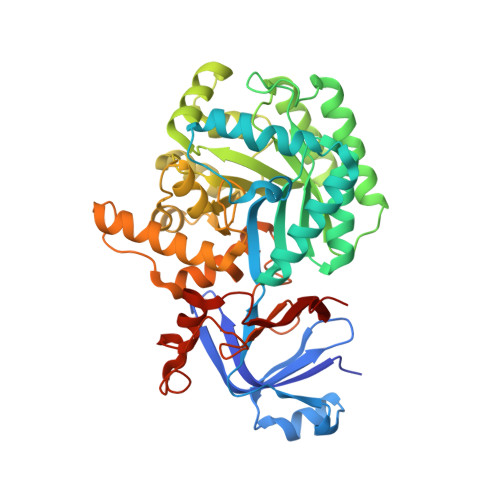
3E0L | pdb_00003e0l

Computationally Designed Ammelide Deaminase


Experimental Data Snapshot

  • Method: X-RAY DIFFRACTION
  • Resolution: 2.37 Å
  • R-Value Free: 
    0.247 (Depositor) 
  • R-Value Work: 
    0.202 (Depositor), 0.204 (DCC) 
  • R-Value Observed: 
    0.205 (Depositor) 

Starting Model: experimental
View more details

wwPDB Validation 3D Report Full Report

Validation slider image for 3E0L

This is version 1.3 of the entry. See complete history

Literature

Alteration of enzyme specificity by computational loop remodeling and design.

Murphy, P.M.Bolduc, J.M.Gallaher, J.L.Stoddard, B.L.Baker, D.

(2009) Proc Natl Acad Sci U S A 106: 9215-9220

  • DOI: https://doi.org/10.1073/pnas.0811070106
  • Primary Citation Related Structures: 
    3E0L

  • PubMed Abstract: 

    Altering the specificity of an enzyme requires precise positioning of side-chain functional groups that interact with the modified groups of the new substrate. This requires not only sequence changes that introduce the new functional groups but also sequence changes that remodel the structure of the protein backbone so that the functional groups are properly positioned. We describe a computational design method for introducing specific enzyme-substrate interactions by directed remodeling of loops near the active site. Benchmark tests on 8 native protein-ligand complexes show that the method can recover native loop lengths and, often, native loop conformations. We then use the method to redesign a critical loop in human guanine deaminase such that a key side-chain interaction is made with the substrate ammelide. The redesigned enzyme is 100-fold more active on ammelide and 2.5e4-fold less active on guanine than wild-type enzyme: The net change in specificity is 2.5e6-fold. The structure of the designed protein was confirmed by X-ray crystallographic analysis: The remodeled loop adopts a conformation that is within 1-A Calpha RMSD of the computational model.


  • Organizational Affiliation
    • Department of Biochemistry, Medical Scientist Training Program, University of Washington, Seattle, WA 98195, USA.

Macromolecule Content 

  • Total Structure Weight: 102.08 kDa 
  • Atom Count: 7,011 
  • Modeled Residue Count: 884 
  • Deposited Residue Count: 910 
  • Unique protein chains: 1

Macromolecules

Find similar proteins by:|  3D Structure
Entity ID: 1
MoleculeChains  Sequence LengthOrganismDetailsImage
Guanine deaminase
A, B
455Homo sapiensMutation(s): 0 
Gene Names: GDA
EC: 3.5.4.3
UniProt & NIH Common Fund Data Resources
Find proteins for Q9Y2T3 (Homo sapiens)
Explore Q9Y2T3 
Go to UniProtKB:  Q9Y2T3
PHAROS:  Q9Y2T3
GTEx:  ENSG00000119125 
Entity Groups
Sequence Clusters30% Identity50% Identity70% Identity90% Identity95% Identity100% Identity
UniProt GroupQ9Y2T3
Sequence Annotations
Expand
Reference Sequence

Experimental Data & Validation

Experimental Data

  • Method: X-RAY DIFFRACTION
  • Resolution: 2.37 Å
  • R-Value Free:  0.247 (Depositor) 
  • R-Value Work:  0.202 (Depositor), 0.204 (DCC) 
  • R-Value Observed: 0.205 (Depositor) 
Space Group: I 21 21 21
Unit Cell:
Length ( Å )Angle ( ˚ )
a = 86.827α = 90
b = 107.315β = 90
c = 233.62γ = 90
Software Package:
Software NamePurpose
REFMACrefinement
HKL-2000data collection
HKL-2000data reduction
HKL-2000data scaling
PHASERphasing

Structure Validation

View Full Validation Report


Entry History 

Deposition Data

Revision History  (Full details and data files)

  • Version 1.0: 2009-03-03
    Type: Initial release
  • Version 1.1: 2011-07-13
    Changes: Version format compliance
  • Version 1.2: 2017-10-25
    Changes: Refinement description
  • Version 1.3: 2023-08-30
    Changes: Data collection, Database references, Derived calculations, Refinement description