3CVF | pdb_00003cvf

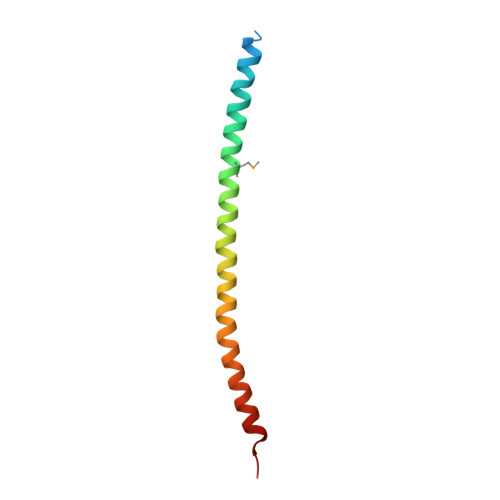
Crystal Structure of the carboxy terminus of Homer3


Experimental Data Snapshot

  • Method: X-RAY DIFFRACTION
  • Resolution: 2.90 Å
  • R-Value Free: 
    0.287 (Depositor), 0.282 (DCC) 
  • R-Value Work: 
    0.252 (Depositor), 0.249 (DCC) 
  • R-Value Observed: 
    0.254 (Depositor) 

Starting Model: experimental
View more details

wwPDB Validation 3D Report Full Report

Validation slider image for 3CVF

This is version 1.6 of the entry. See complete history

Literature

The postsynaptic density proteins Homer and Shank form a polymeric network structure.

Hayashi, M.K.Tang, C.Verpelli, C.Narayanan, R.Stearns, M.H.Xu, R.M.Li, H.Sala, C.Hayashi, Y.

(2009) Cell 137: 159-171

  • DOI: https://doi.org/10.1016/j.cell.2009.01.050
  • Primary Citation Related Structures: 
    3CVE, 3CVF

  • PubMed Abstract: 

    The postsynaptic density (PSD) is crucial for synaptic functions, but the molecular architecture retaining its structure and components remains elusive. Homer and Shank are among the most abundant scaffolding proteins in the PSD, working synergistically for maturation of dendritic spines. Here, we demonstrate that Homer and Shank, together, form a mesh-like matrix structure. Crystallographic analysis of this region revealed a pair of parallel dimeric coiled coils intercalated in a tail-to-tail fashion to form a tetramer, giving rise to the unique configuration of a pair of N-terminal EVH1 domains at each end of the coiled coil. In neurons, the tetramerization is required for structural integrity of the dendritic spines and recruitment of proteins to synapses. We propose that the Homer-Shank complex serves as a structural framework and as an assembly platform for other PSD proteins.


  • Organizational Affiliation
    • RIKEN-MIT Neuroscience Research Center, The Picower Institute for Learning and Memory, Department of Brain and Cognitive Sciences, Massachusetts Institute of Technology, Cambridge, MA 02139, USA. hayashim@mit.edu

Macromolecule Content 

  • Total Structure Weight: 36.25 kDa 
  • Atom Count: 2,306 
  • Modeled Residue Count: 286 
  • Deposited Residue Count: 316 
  • Unique protein chains: 1

Macromolecules

Find similar proteins by:|  3D Structure
Entity ID: 1
MoleculeChains  Sequence LengthOrganismDetailsImage
Homer protein homolog 3
A, B, C, D
79Homo sapiensMutation(s): 0 
Gene Names: HOMER3
UniProt & NIH Common Fund Data Resources
Find proteins for Q9NSC5 (Homo sapiens)
Explore Q9NSC5 
Go to UniProtKB:  Q9NSC5
PHAROS:  Q9NSC5
GTEx:  ENSG00000051128 
Entity Groups
Sequence Clusters30% Identity50% Identity70% Identity90% Identity95% Identity100% Identity
UniProt GroupQ9NSC5
Sequence Annotations
Expand
Reference Sequence

Small Molecules

Modified Residues  1 Unique
IDChains TypeFormula2D DiagramParent
MSE
Query on MSE
A, B, C, D
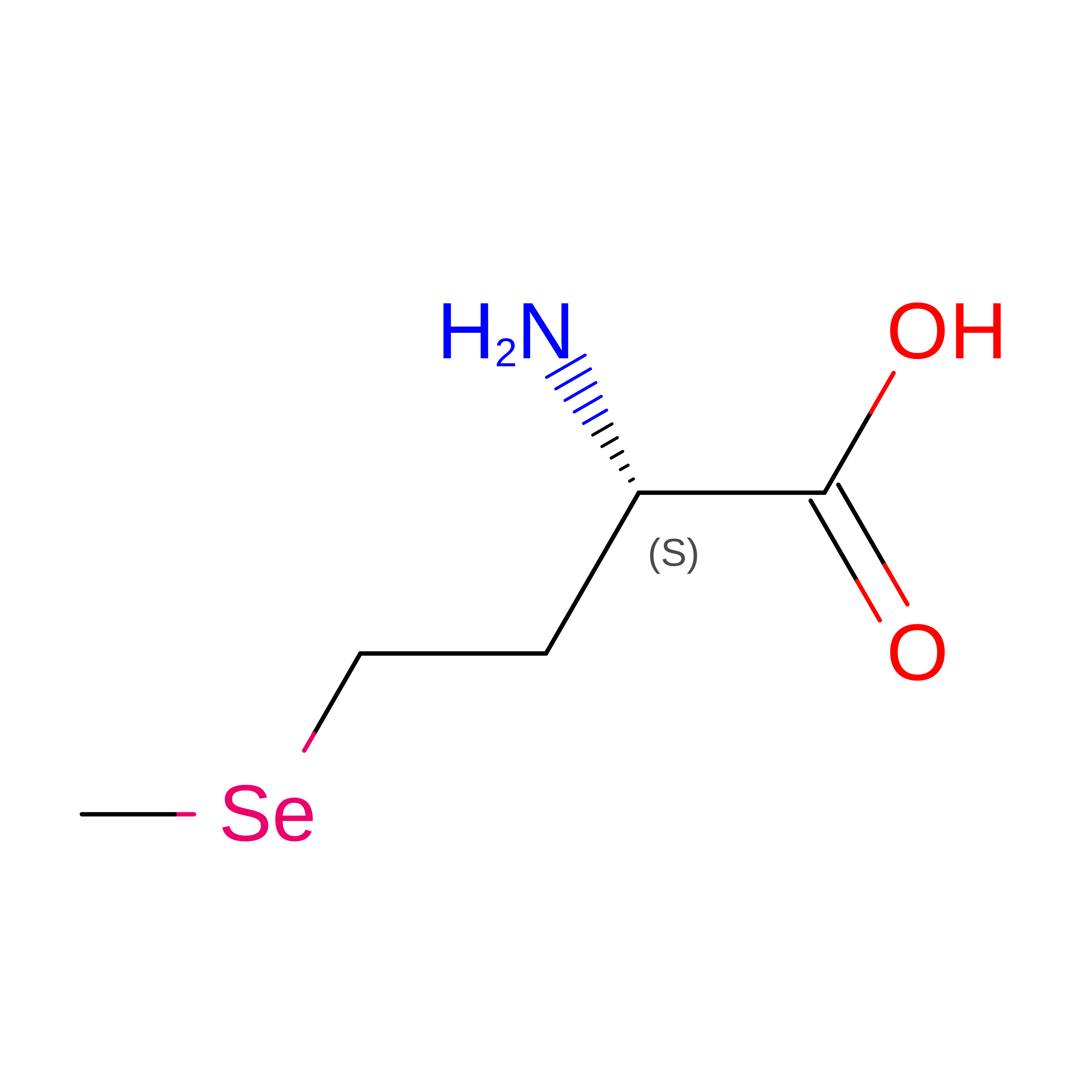
L-PEPTIDE LINKINGC5 H11 N O2 SeMET

Experimental Data & Validation

Experimental Data

  • Method: X-RAY DIFFRACTION
  • Resolution: 2.90 Å
  • R-Value Free:  0.287 (Depositor), 0.282 (DCC) 
  • R-Value Work:  0.252 (Depositor), 0.249 (DCC) 
  • R-Value Observed: 0.254 (Depositor) 
Space Group: P 65
Unit Cell:
Length ( Å )Angle ( ˚ )
a = 172.029α = 90
b = 172.029β = 90
c = 66.446γ = 120
Software Package:
Software NamePurpose
DENZOdata reduction
SCALEPACKdata scaling
REFMACrefinement
PDB_EXTRACTdata extraction
PHASERphasing

Structure Validation

View Full Validation Report


Entry History 

Deposition Data

Revision History  (Full details and data files)

  • Version 1.0: 2009-03-31
    Type: Initial release
  • Version 1.1: 2011-07-13
    Changes: Version format compliance
  • Version 1.2: 2017-10-25
    Changes: Refinement description
  • Version 1.3: 2022-12-21
    Changes: Database references, Derived calculations
  • Version 1.4: 2023-09-20
    Changes: Data collection, Refinement description
  • Version 1.5: 2023-11-15
    Changes: Data collection
  • Version 1.6: 2024-11-06
    Changes: Structure summary