3ASQ | pdb_00003asq

Crystal structure of P domain from Norovirus Funabashi258 stain in the complex with H-antigen


Experimental Data Snapshot

  • Method: X-RAY DIFFRACTION
  • Resolution: 1.60 Å
  • R-Value Free: 
    0.194 (Depositor) 
  • R-Value Work: 
    0.178 (Depositor) 
  • R-Value Observed: 
    0.179 (Depositor) 

wwPDB Validation 3D Report Full Report

Validation slider image for 3ASQ

This is version 2.1 of the entry. See complete history

Literature

Structural basis for the recognition of Lewis antigens by genogroup I norovirus

Kubota, T.Kumagai, A.Ito, H.Furukawa, S.Someya, Y.Takeda, N.Ishii, K.Wakita, T.Narimatsu, H.Shirato, H.

(2012) J Virol 86: 11138-11150

  • DOI: https://doi.org/10.1128/JVI.00278-12
  • Primary Citation Related Structures: 
    3ASP, 3ASQ, 3ASR, 3ASS, 3AST

  • PubMed Abstract: 

    Noroviruses (NoVs) bind to histo-blood group antigens, namely, ABH antigens and Lewis antigens. We previously showed the NoVs GI/2, GI/3, GI/4, and GI/8 were able to strongly bind to Lewis a (Le(a)) antigen, which is expressed by individuals who are nonsecretors. In this study, to investigate how Lewis antigens interact with GI NoV virion protein 1 (VP1), we determined the crystal structures of the P domain of the VP1 protein from the Funabashi 258 (FUV258) strain (GI/2) in complexes with Le(a), Le(b), H type 1, or A type 1 antigens. The structures were compared with those of the NV/68 strain (GI/1), which does not bind to the Le(a) antigen. The four loop structures, loop P, loop S, loop A, and loop B, continuously deviated by more than 2 Å in length between the Cα atoms of the corresponding residues of the FUV258 and NV/68 P domains. The most pronounced differences between the two VP1 proteins were observed in the structures of loop P. In the FUV258 P domain, loop P protruded toward the next protomer, forming a Le(a) antigen-binding site. The Gln389 residue make a significant contribution to the binding of the Le(a) antigen through the stabilization of loop P as well as through direct interactions with the α4-fucosyl residue (α4Fuc) of the Le(a) antigen. Mutation of the Gln389 residue dramatically affected the degree of binding of the Lewis antigens. Collectively, these results suggest that loop P and the amino acid residue at position 389 affect Lewis antigen binding.


  • Organizational Affiliation
    • Research Center for Medical Glycoscience, National Institute of Advanced Industrial Science and Technology, Tsukuba, Ibaraki, Japan.

Macromolecule Content 

  • Total Structure Weight: 71.9 kDa 
  • Atom Count: 5,230 
  • Modeled Residue Count: 613 
  • Deposited Residue Count: 652 
  • Unique protein chains: 1

Macromolecules

Find similar proteins by:|  3D Structure
Entity ID: 1
MoleculeChains  Sequence LengthOrganismDetailsImage
Capsid protein
A, B
326Norwalk-like virusMutation(s): 0 
Gene Names: capsidORF2
UniProt
Find proteins for Q8JW44 (Norwalk-like virus)
Explore Q8JW44 
Go to UniProtKB:  Q8JW44
Entity Groups
Sequence Clusters30% Identity50% Identity70% Identity90% Identity95% Identity100% Identity
UniProt GroupQ8JW44
Sequence Annotations
Expand
Reference Sequence

Oligosaccharides

Help  
Entity ID: 2
MoleculeChains Length2D Diagram GlycosylationD Interactions
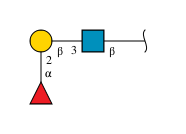
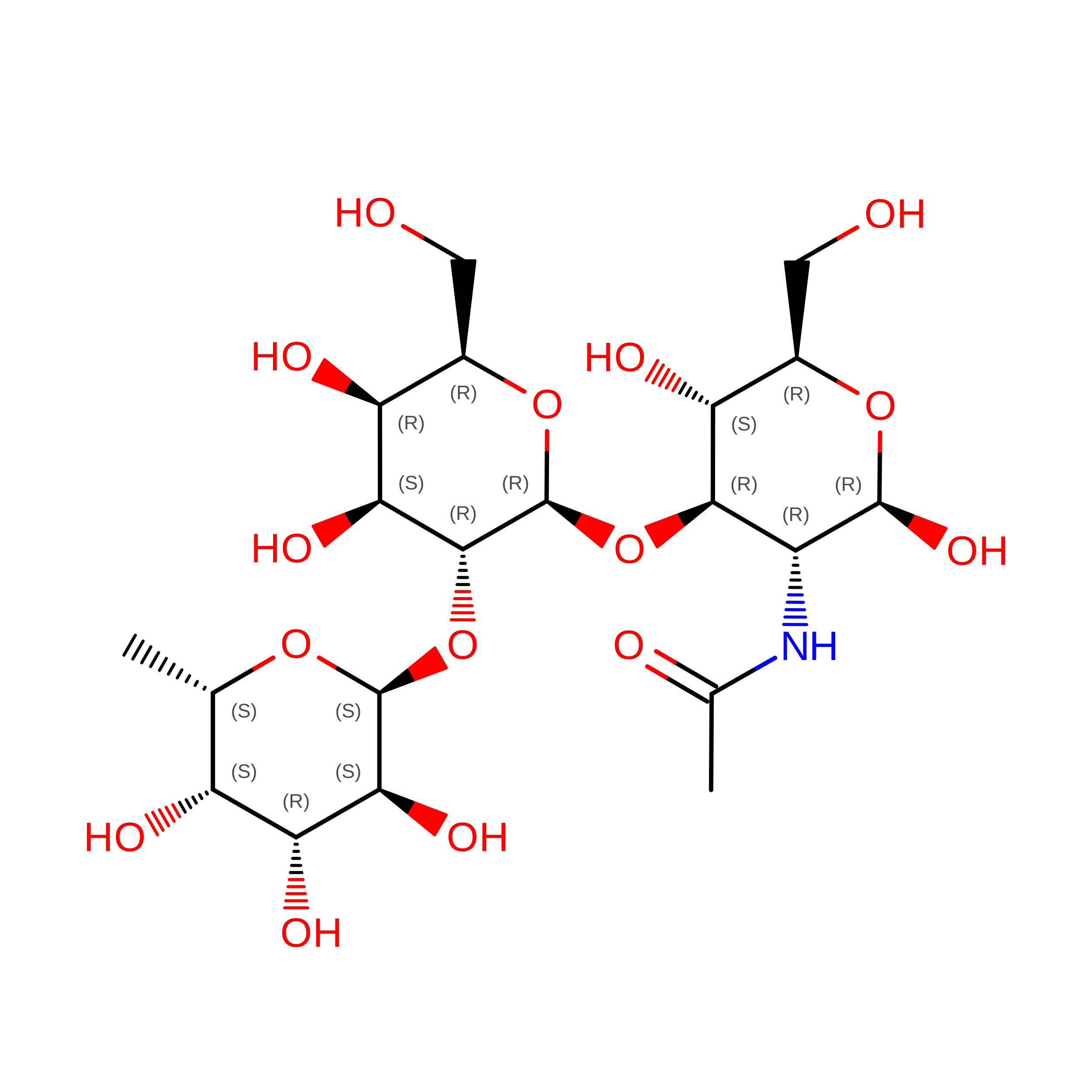
alpha-L-fucopyranose-(1-2)-beta-D-galactopyranose-(1-3)-2-acetamido-2-deoxy-beta-D-glucopyranose
C, D
3N/A
Glycosylation Resources
GlyTouCan: G40696TO
GlyCosmos: G40696TO
GlyGen: G40696TO

Biologically Interesting Molecules (External Reference) 

1 Unique

Experimental Data & Validation

Experimental Data

  • Method: X-RAY DIFFRACTION
  • Resolution: 1.60 Å
  • R-Value Free:  0.194 (Depositor) 
  • R-Value Work:  0.178 (Depositor) 
  • R-Value Observed: 0.179 (Depositor) 
Space Group: P 31
Unit Cell:
Length ( Å )Angle ( ˚ )
a = 74.69α = 90
b = 74.69β = 90
c = 107.106γ = 120
Software Package:
Software NamePurpose
DENZOdata reduction
SCALEPACKdata scaling
PHASERphasing
REFMACrefinement
PDB_EXTRACTdata extraction
HKL-2000data collection
HKL-2000data reduction
HKL-2000data scaling

Structure Validation

View Full Validation Report


Entry History 

Deposition Data

Revision History  (Full details and data files)

  • Version 1.0: 2012-01-25
    Type: Initial release
  • Version 1.1: 2013-11-20
    Changes: Database references
  • Version 1.2: 2017-10-11
    Changes: Refinement description
  • Version 2.0: 2020-07-29
    Type: Remediation
    Reason: Carbohydrate remediation
    Changes: Advisory, Atomic model, Data collection, Database references, Derived calculations, Structure summary
  • Version 2.1: 2024-03-13
    Changes: Data collection, Database references, Structure summary