3ZCL | pdb_00003zcl

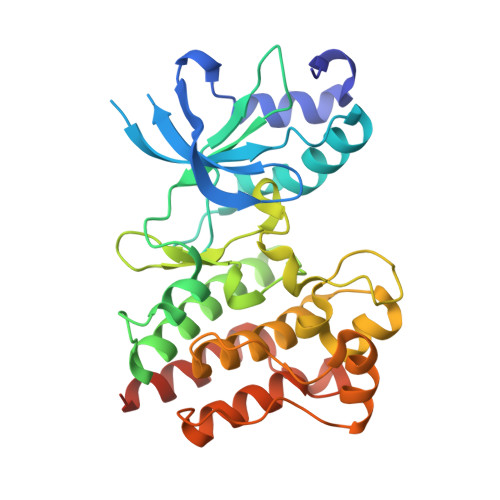
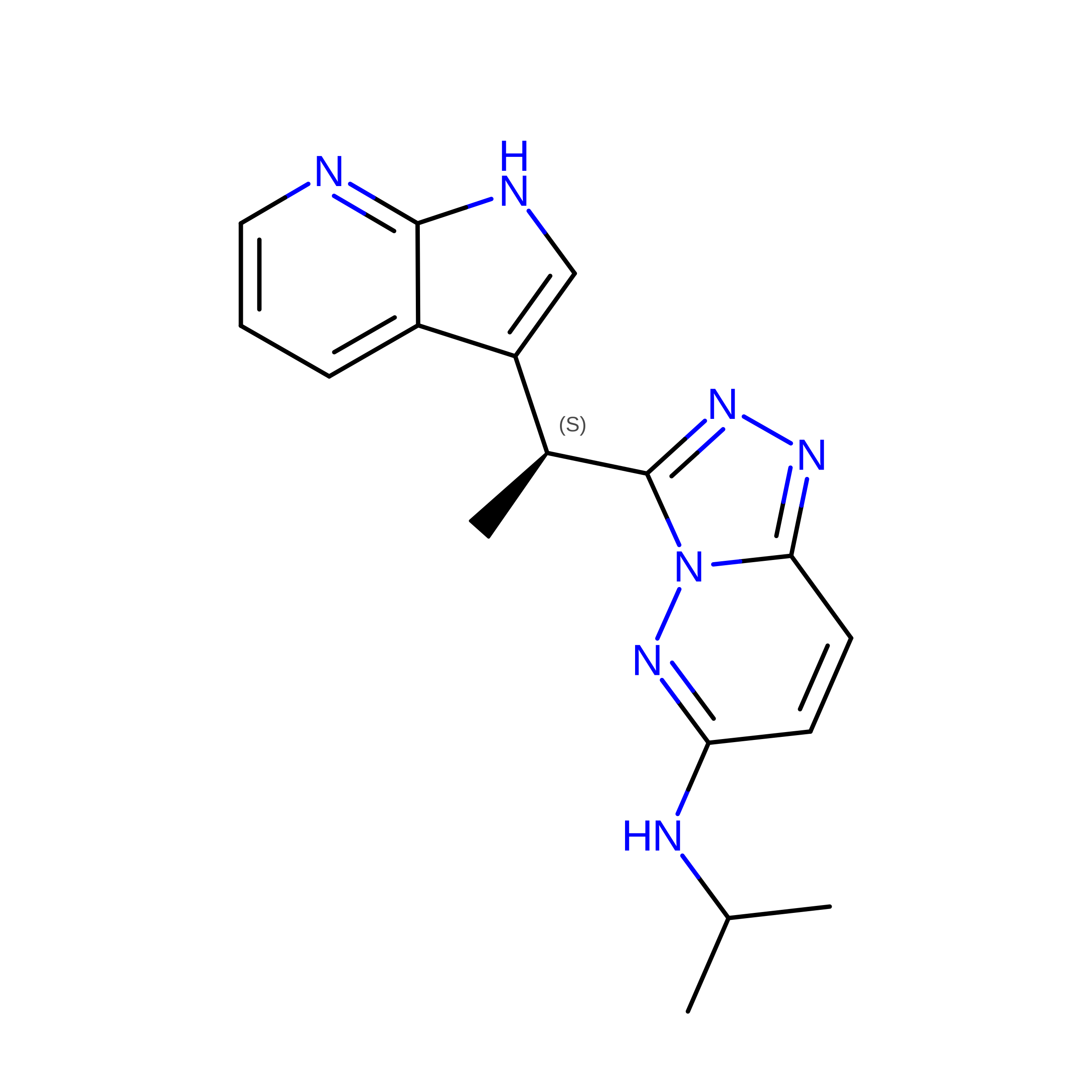
X-ray Structure of c-Met kinase in complex with inhibitor (S)-3-(1-(1H-pyrrolo(2,3-b)pyridin-3-yl)ethyl)-N-isopropyl-(1,2,4)triazolo(4,3- b)pyridazin-6-amine


Experimental Data Snapshot

  • Method: X-RAY DIFFRACTION
  • Resolution: 1.40 Å
  • R-Value Free: 
    0.211 (Depositor) 
  • R-Value Work: 
    0.193 (Depositor) 
  • R-Value Observed: 
    0.194 (Depositor) 

Starting Model: experimental
View more details

wwPDB Validation 3D Report Full Report

Validation slider image for 3ZCL

Ligand Structure Quality Assessment 


This is version 1.2 of the entry. See complete history

Literature

Lessons from (S)-6-(1-(6-(1-Methyl-1H-Pyrazol-4-Yl)-[1,2, 4]Triazolo[4,3-B]Pyridazin-3-Yl)Ethyl)Quinoline (Pf-04254644), an Inhibitor of Receptor Tyrosine Kinase C-met with High Protein Kinase Selectivity But Broad Phosphodiesterase Family Inhibition Leading to Myocardial Degeneration in Rats.

Cui, J.J.Shen, H.Tran-Dube, M.Nambu, M.Mctigue, M.Grodsky, N.Ryan, K.Yamazaki, S.Aguirre, S.Parker, M.Li, Q.Zou, H.Christensen, J.

(2013) J Med Chem 56: 6651

  • DOI: https://doi.org/10.1021/jm400926x
  • Primary Citation Related Structures: 
    3ZBX, 3ZC5, 3ZCL

  • PubMed Abstract: 

    The hepatocyte growth factor (HGF)/c-Met signaling axis is deregulated in many cancers and plays important roles in tumor invasive growth and metastasis. An exclusively selective c-Met inhibitor (S)-6-(1-(6-(1-methyl-1H-pyrazol-4-yl)-[1,2,4]triazolo[4,3-b]pyridazin-3-yl)ethyl)quinoline (8) was discovered from a highly selective high-throughput screening hit via structure-based drug design and medicinal chemistry lead optimization. Compound 8 had many attractive properties meriting preclinical evaluation. Broad off-target screens identified 8 as a pan-phosphodiesterase (PDE) family inhibitor, which was implicated in a sustained increase in heart rate, increased cardiac output, and decreased contractility indices, as well as myocardial degeneration in in vivo safety evaluations in rats. Compound 8 was terminated as a preclinical candidate because of a narrow therapeutic window in cardio-related safety. The learning from multiparameter lead optimization and strategies to avoid the toxicity attrition at the late stage of drug discovery are discussed.


  • Organizational Affiliation
    • La Jolla Laboratories, Pfizer Worldwide Research and Development , 10770 Science Center Drive, San Diego, California 92121, United States.

Macromolecule Content 

  • Total Structure Weight: 35.2 kDa 
  • Atom Count: 2,670 
  • Modeled Residue Count: 291 
  • Deposited Residue Count: 306 
  • Unique protein chains: 1

Macromolecules

Find similar proteins by:|  3D Structure
Entity ID: 1
MoleculeChains  Sequence LengthOrganismDetailsImage
HEPATOCYTE GROWTH FACTOR RECEPTOR306Homo sapiensMutation(s): 0 
EC: 2.7.10.1
UniProt & NIH Common Fund Data Resources
Find proteins for P08581 (Homo sapiens)
Explore P08581 
Go to UniProtKB:  P08581
PHAROS:  P08581
GTEx:  ENSG00000105976 
Entity Groups
Sequence Clusters30% Identity50% Identity70% Identity90% Identity95% Identity100% Identity
UniProt GroupP08581
Sequence Annotations
Expand
Reference Sequence

Small Molecules

Ligands 1 Unique
IDChains Name / Formula / InChI Key2D Diagram3D Interactions
5TF

Query on 5TF


Download:Ideal Coordinates CCD File
B [auth A](S)-3-(1-(1H-pyrrolo(2,3-b)pyridin-3-yl)ethyl)-N-isopropyl-(1,2,4)triazolo(4,3-b)pyridazin-6-amine
C17 H19 N7
PUIUZHJXBDSQEZ-NSHDSACASA-N
Binding Affinity Annotations 
IDSourceBinding Affinity
5TF BindingDB:  3ZCL Ki: 10 (nM) from 1 assay(s)
IC50: 19 (nM) from 1 assay(s)

Experimental Data & Validation

Experimental Data

  • Method: X-RAY DIFFRACTION
  • Resolution: 1.40 Å
  • R-Value Free:  0.211 (Depositor) 
  • R-Value Work:  0.193 (Depositor) 
  • R-Value Observed: 0.194 (Depositor) 
Space Group: P 21 21 2
Unit Cell:
Length ( Å )Angle ( ˚ )
a = 76.997α = 90
b = 94.509β = 90
c = 46.834γ = 90
Software Package:
Software NamePurpose
CNXrefinement
HKL-2000data reduction
SCALEPACKdata scaling
CNXphasing

Structure Validation

View Full Validation Report


Ligand Structure Quality Assessment 


Entry History 

Deposition Data

Revision History  (Full details and data files)

  • Version 1.0: 2013-11-27
    Type: Initial release
  • Version 1.1: 2019-05-08
    Changes: Data collection, Experimental preparation, Other
  • Version 1.2: 2023-12-20
    Changes: Data collection, Database references, Derived calculations, Other, Refinement description