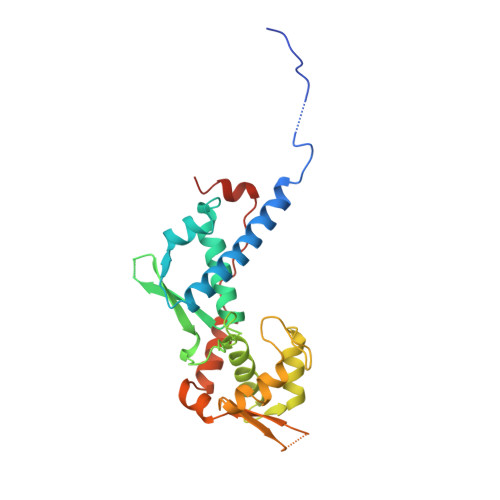
2WA0 | pdb_00002wa0

Crystal structure of the human MAGEA4


Experimental Data Snapshot

  • Method: X-RAY DIFFRACTION
  • Resolution: 2.30 Å
  • R-Value Free: 
    0.274 (Depositor), 0.279 (DCC) 
  • R-Value Work: 
    0.243 (Depositor), 0.241 (DCC) 
  • R-Value Observed: 
    0.244 (Depositor) 

wwPDB Validation 3D Report Full Report

Validation slider image for 2WA0

This is version 1.5 of the entry. See complete history

Literature

Structures of Two Melanoma-Associated Antigens Suggest Allosteric Regulation of Effector Binding.

Newman, J.A.Cooper, C.D.O.Roos, A.K.Aitkenhead, H.Oppermann, U.C.T.Cho, H.J.Osman, R.Gileadi, O.

(2016) PLoS One 11: 48762

  • DOI: https://doi.org/10.1371/journal.pone.0148762
  • Primary Citation Related Structures: 
    2WA0, 4V0P, 5HVQ

  • PubMed Abstract: 

    The MAGE (melanoma associated antigen) protein family are tumour-associated proteins normally present only in reproductive tissues such as germ cells of the testis. The human genome encodes over 60 MAGE genes of which one class (containing MAGE-A3 and MAGE-A4) are exclusively expressed in tumours, making them an attractive target for the development of targeted and immunotherapeutic cancer treatments. Some MAGE proteins are thought to play an active role in driving cancer, modulating the activity of E3 ubiquitin ligases on targets related to apoptosis. Here we determined the crystal structures of MAGE-A3 and MAGE-A4. Both proteins crystallized with a terminal peptide bound in a deep cleft between two tandem-arranged winged helix domains. MAGE-A3 (but not MAGE-A4), is predominantly dimeric in solution. Comparison of MAGE-A3 and MAGE-A3 with a structure of an effector-bound MAGE-G1 suggests that a major conformational rearrangement is required for binding, and that this conformational plasticity may be targeted by allosteric binders.


  • Organizational Affiliation
    • Structural Genomics Consortium, University of Oxford, ORCRB, Roosevelt Drive, Oxford, OX3 7DQ, United Kingdom.

Macromolecule Content 

  • Total Structure Weight: 27.42 kDa 
  • Atom Count: 1,749 
  • Modeled Residue Count: 214 
  • Deposited Residue Count: 240 
  • Unique protein chains: 1

Macromolecules

Find similar proteins by:|  3D Structure
Entity ID: 1
MoleculeChains  Sequence LengthOrganismDetailsImage
MELANOMA-ASSOCIATED ANTIGEN 4240Homo sapiensMutation(s): 0 
UniProt & NIH Common Fund Data Resources
Find proteins for P43358 (Homo sapiens)
Explore P43358 
Go to UniProtKB:  P43358
PHAROS:  P43358
GTEx:  ENSG00000147381 
Entity Groups
Sequence Clusters30% Identity50% Identity70% Identity90% Identity95% Identity100% Identity
UniProt GroupP43358
Sequence Annotations
Expand
Reference Sequence

Experimental Data & Validation

Experimental Data

  • Method: X-RAY DIFFRACTION
  • Resolution: 2.30 Å
  • R-Value Free:  0.274 (Depositor), 0.279 (DCC) 
  • R-Value Work:  0.243 (Depositor), 0.241 (DCC) 
  • R-Value Observed: 0.244 (Depositor) 
Space Group: P 65 2 2
Unit Cell:
Length ( Å )Angle ( ˚ )
a = 81.63α = 90
b = 81.63β = 90
c = 210.891γ = 120
Software Package:
Software NamePurpose
MOSFLMdata reduction
SCALAdata scaling
SHELXphasing
SHARPphasing
REFMACrefinement

Structure Validation

View Full Validation Report


Entry History 

Revision History  (Full details and data files)

  • Version 1.0: 2009-03-10
    Type: Initial release
  • Version 1.1: 2011-07-13
    Changes: Advisory, Version format compliance
  • Version 1.2: 2015-04-29
    Changes: Data collection, Refinement description
  • Version 1.3: 2016-03-09
    Changes: Database references
  • Version 1.4: 2018-01-24
    Changes: Structure summary
  • Version 1.5: 2024-05-08
    Changes: Data collection, Database references, Other