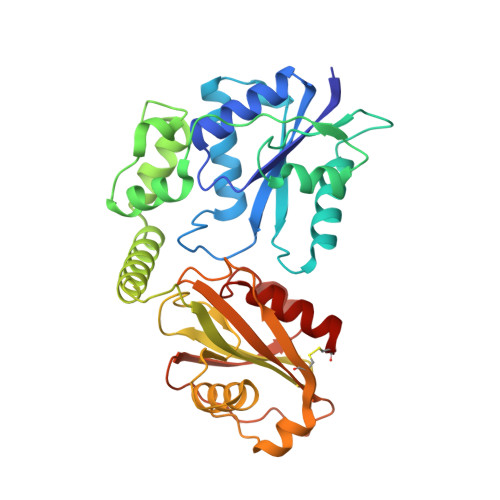
2R5W | pdb_00002r5w

Crystal structure of a bifunctional NMN adenylyltransferase/ADP ribose pyrophosphatase from Francisella tularensis


Experimental Data Snapshot

  • Method: X-RAY DIFFRACTION
  • Resolution: 2.30 Å
  • R-Value Free: 
    0.253 (Depositor), 0.246 (DCC) 
  • R-Value Work: 
    0.194 (Depositor), 0.185 (DCC) 
  • R-Value Observed: 
    0.197 (Depositor) 

wwPDB Validation 3D Report Full Report

Validation slider image for 2R5W

This is version 1.2 of the entry. See complete history

Literature

Bifunctional NMN Adenylyltransferase/ADP-Ribose Pyrophosphatase: Structure and Function in Bacterial NAD Metabolism.

Huang, N.Sorci, L.Zhang, X.Brautigam, C.A.Li, X.Raffaelli, N.Magni, G.Grishin, N.V.Osterman, A.L.Zhang, H.

(2008) Structure 16: 196-209

  • DOI: https://doi.org/10.1016/j.str.2007.11.017
  • Primary Citation Related Structures: 
    2QJO, 2QJT, 2R5W

  • PubMed Abstract: 

    Bacterial NadM-Nudix is a bifunctional enzyme containing a nicotinamide mononucleotide (NMN) adenylyltransferase and an ADP-ribose (ADPR) pyrophosphatase domain. While most members of this enzyme family, such as that from a model cyanobacterium Synechocystis sp., are involved primarily in nicotinamide adenine dinucleotide (NAD) salvage/recycling pathways, its close homolog in a category-A biodefense pathogen, Francisella tularensis, likely plays a central role in a recently discovered novel pathway of NAD de novo synthesis. The crystal structures of NadM-Nudix from both species, including their complexes with various ligands and catalytic metal ions, revealed detailed configurations of the substrate binding and catalytic sites in both domains. The structure of the N-terminal NadM domain may be exploited for designing new antitularemia therapeutics. The ADPR binding site in the C-terminal Nudix domain is substantially different from that of Escherichia coli ADPR pyrophosphatase, and is more similar to human NUDT9. The latter observation provided new insights into the ligand binding mode of ADPR-gated Ca2+ channel TRPM2.


  • Organizational Affiliation
    • Department of Biochemistry, University of Texas Southwestern Medical Center, Dallas, TX 75390, USA.

Macromolecule Content 

  • Total Structure Weight: 82.11 kDa 
  • Atom Count: 6,097 
  • Modeled Residue Count: 689 
  • Deposited Residue Count: 704 
  • Unique protein chains: 1

Macromolecules

Find similar proteins by:|  3D Structure
Entity ID: 1
MoleculeChains  Sequence LengthOrganismDetailsImage
Nicotinamide-nucleotide adenylyltransferaseA [auth B],
B [auth A]
352Francisella tularensis subsp. tularensisMutation(s): 0 
Gene Names: nadM
EC: 2.7.7.1 (PDB Primary Data), 3.6.1 (PDB Primary Data)
UniProt
Find proteins for Q5NHR1 (Francisella tularensis subsp. tularensis (strain SCHU S4 / Schu 4))
Explore Q5NHR1 
Go to UniProtKB:  Q5NHR1
Entity Groups
Sequence Clusters30% Identity50% Identity70% Identity90% Identity95% Identity100% Identity
UniProt GroupQ5NHR1
Sequence Annotations
Expand
Reference Sequence

Small Molecules

Ligands 2 Unique
IDChains Name / Formula / InChI Key2D Diagram3D Interactions
CL

Query on CL


Download:Ideal Coordinates CCD File
F [auth B],
G [auth B],
K [auth A]
CHLORIDE ION
Cl
VEXZGXHMUGYJMC-UHFFFAOYSA-M
MG

Query on MG


Download:Ideal Coordinates CCD File
C [auth B]
D [auth B]
E [auth B]
H [auth A]
I [auth A]
C [auth B],
D [auth B],
E [auth B],
H [auth A],
I [auth A],
J [auth A]
MAGNESIUM ION
Mg
JLVVSXFLKOJNIY-UHFFFAOYSA-N

Experimental Data & Validation

Experimental Data

  • Method: X-RAY DIFFRACTION
  • Resolution: 2.30 Å
  • R-Value Free:  0.253 (Depositor), 0.246 (DCC) 
  • R-Value Work:  0.194 (Depositor), 0.185 (DCC) 
  • R-Value Observed: 0.197 (Depositor) 
Space Group: F 2 2 2
Unit Cell:
Length ( Å )Angle ( ˚ )
a = 124.909α = 90
b = 163.152β = 90
c = 180.792γ = 90
Software Package:
Software NamePurpose
REFMACrefinement
HKL-2000data reduction
HKL-2000data scaling
MOLREPphasing

Structure Validation

View Full Validation Report


Entry History 

Deposition Data

Revision History  (Full details and data files)

  • Version 1.0: 2008-03-04
    Type: Initial release
  • Version 1.1: 2011-07-13
    Changes: Version format compliance
  • Version 1.2: 2024-11-20
    Changes: Data collection, Database references, Derived calculations, Structure summary