2QCD | pdb_00002qcd

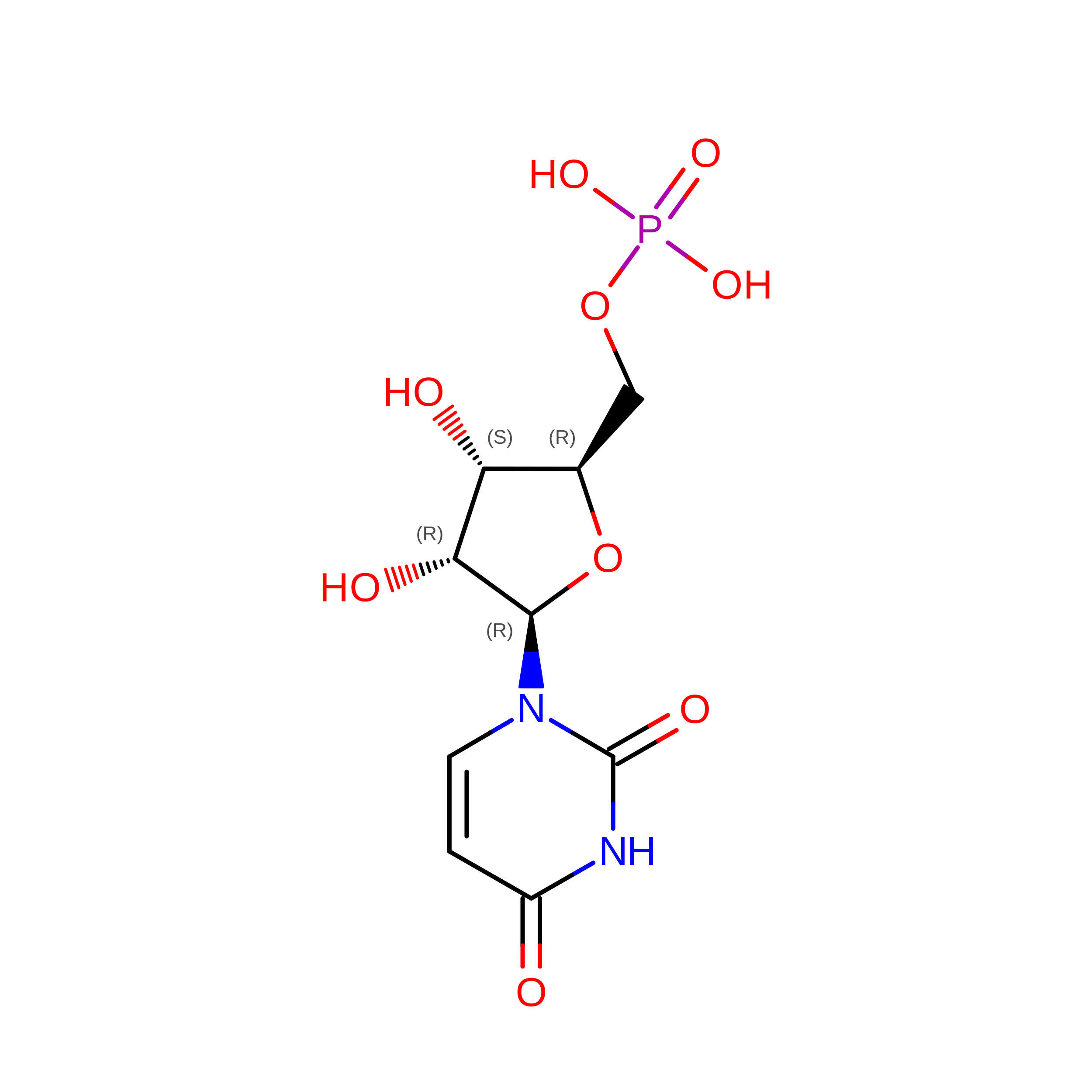
Crystal structure of the orotidine-5'-monophosphate decarboxylase domain of human UMP synthase bound to UMP


Experimental Data Snapshot

  • Method: X-RAY DIFFRACTION
  • Resolution: 2.03 Å
  • R-Value Free: 
    0.195 (Depositor), 0.190 (DCC) 
  • R-Value Work: 
    0.149 (Depositor) 
  • R-Value Observed: 
    0.152 (Depositor) 

wwPDB Validation 3D Report Full Report

Validation slider image for 2QCD

Ligand Structure Quality Assessment 


This is version 1.2 of the entry. See complete history

Literature

Structures of the human orotidine-5'-monophosphate decarboxylase support a covalent mechanism and provide a framework for drug design.

Wittmann, J.G.Heinrich, D.Gasow, K.Frey, A.Diederichsen, U.Rudolph, M.G.

(2008) Structure 16: 82-92

  • DOI: https://doi.org/10.1016/j.str.2007.10.020
  • Primary Citation Related Structures: 
    2QCC, 2QCD, 2QCE, 2QCF, 2QCG, 2QCH, 2QCL, 2QCM, 2QCN

  • PubMed Abstract: 

    UMP synthase (UMPS) catalyzes the last two steps of de novo pyrimidine nucleotide synthesis and is a potential cancer drug target. The C-terminal domain of UMPS is orotidine-5'-monophosphate decarboxylase (OMPD), a cofactor-less yet extremely efficient enzyme. Studies of OMPDs from micro-organisms led to the proposal of several noncovalent decarboxylation mechanisms via high-energy intermediates. We describe nine crystal structures of human OMPD in complex with substrate, product, and nucleotide inhibitors. Unexpectedly, simple compounds can replace the natural nucleotides and induce a closed conformation of OMPD, defining a tripartite catalytic site. The structures outline the requirements drugs must meet to maximize therapeutic effects and minimize cross-species activity. Chemical mimicry by iodide identified a CO(2) product binding site. Plasticity of catalytic residues and a covalent OMPD-UMP complex prompt a reevaluation of the prevailing decarboxylation mechanism in favor of covalent intermediates. This mechanism can also explain the observed catalytic promiscuity of OMPD.


  • Organizational Affiliation
    • Department of Molecular Structural Biology, University of Göttingen, Göttingen, Germany.

Macromolecule Content 

  • Total Structure Weight: 57.28 kDa 
  • Atom Count: 4,404 
  • Modeled Residue Count: 516 
  • Deposited Residue Count: 520 
  • Unique protein chains: 2

Macromolecules

Find similar proteins by:|  3D Structure
Entity ID: 1
MoleculeChains  Sequence LengthOrganismDetailsImage
Uridine 5'-monophosphate synthase (UMP synthase)260Homo sapiensMutation(s): 0 
Gene Names: UMPS
EC: 4.1.1.23 (PDB Primary Data), 2.4.2.10 (UniProt)
UniProt & NIH Common Fund Data Resources
Find proteins for P11172 (Homo sapiens)
Explore P11172 
Go to UniProtKB:  P11172
PHAROS:  P11172
GTEx:  ENSG00000114491 
Entity Groups
Sequence Clusters30% Identity50% Identity70% Identity90% Identity95% Identity100% Identity
UniProt GroupP11172
Sequence Annotations
Expand
Reference Sequence
Find similar proteins by:|  3D Structure
Entity ID: 2
MoleculeChains  Sequence LengthOrganismDetailsImage
Uridine 5'-monophosphate synthase (UMP synthase)260Homo sapiensMutation(s): 0 
Gene Names: UMPS
EC: 2.4.2.10 (UniProt), 4.1.1.23 (UniProt)
UniProt & NIH Common Fund Data Resources
Find proteins for P11172 (Homo sapiens)
Explore P11172 
Go to UniProtKB:  P11172
PHAROS:  P11172
GTEx:  ENSG00000114491 
Entity Groups
Sequence Clusters30% Identity50% Identity70% Identity90% Identity95% Identity100% Identity
UniProt GroupP11172
Sequence Annotations
Expand
Reference Sequence

Small Molecules

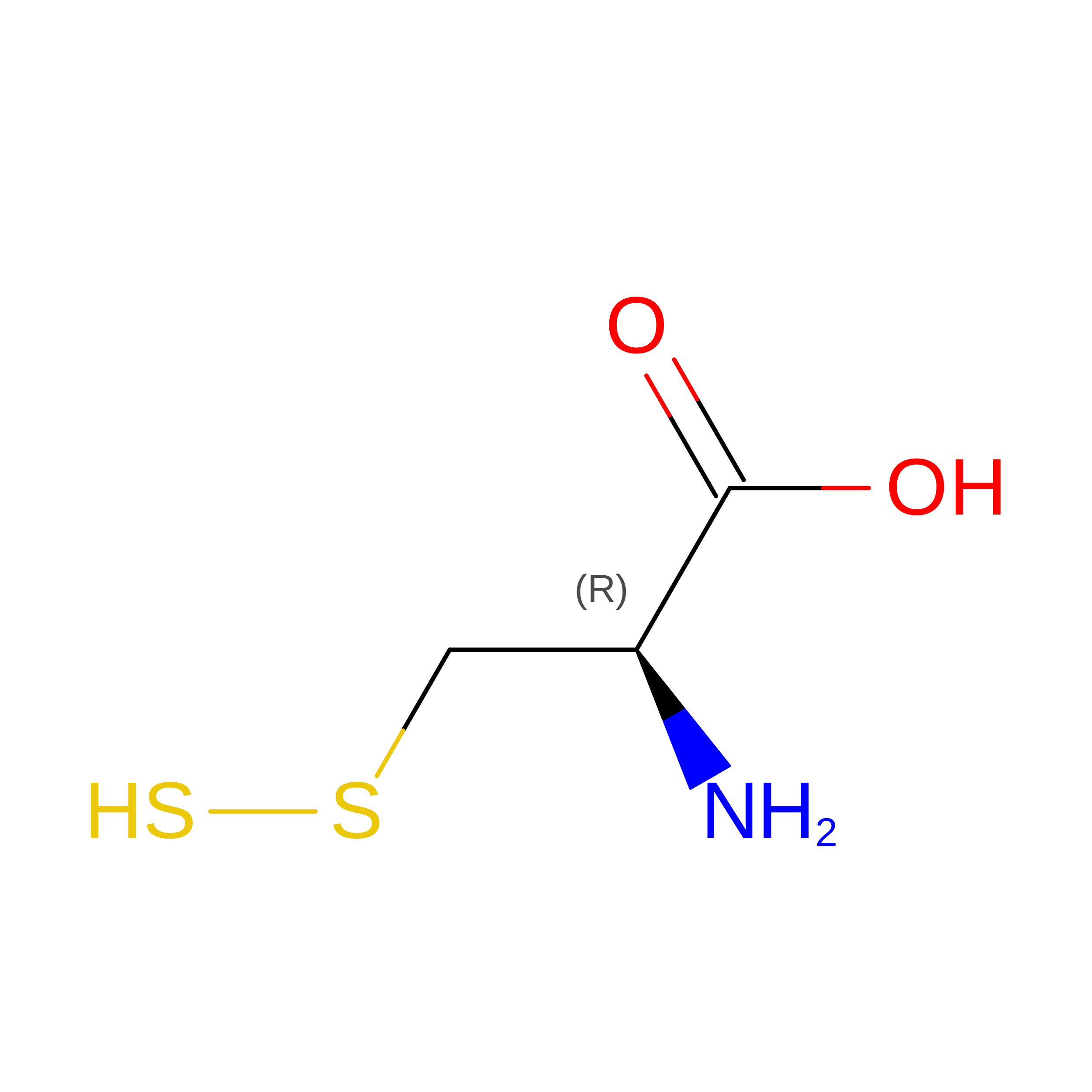
Modified Residues  1 Unique
IDChains TypeFormula2D DiagramParent
CSS
Query on CSS
A
L-PEPTIDE LINKINGC3 H7 N O2 S2CYS

Experimental Data & Validation

Experimental Data

  • Method: X-RAY DIFFRACTION
  • Resolution: 2.03 Å
  • R-Value Free:  0.195 (Depositor), 0.190 (DCC) 
  • R-Value Work:  0.149 (Depositor) 
  • R-Value Observed: 0.152 (Depositor) 
Space Group: P 1 21 1
Unit Cell:
Length ( Å )Angle ( ˚ )
a = 69.394α = 90
b = 61.643β = 112.71
c = 69.97γ = 90
Software Package:
Software NamePurpose
REFMACrefinement
HKL-2000data collection
HKL-2000data reduction
HKL-2000data scaling
COMOphasing

Structure Validation

View Full Validation Report


Ligand Structure Quality Assessment 


Entry History 

Deposition Data

Revision History  (Full details and data files)

  • Version 1.0: 2007-11-06
    Type: Initial release
  • Version 1.1: 2011-07-13
    Changes: Version format compliance
  • Version 1.2: 2024-10-30
    Changes: Data collection, Database references, Derived calculations, Structure summary