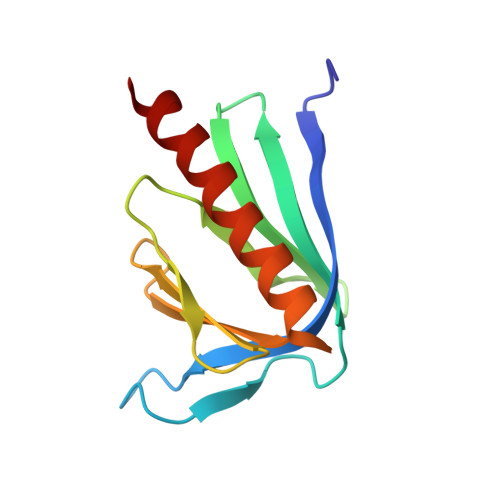
2P8V | pdb_00002p8v

Crystal structure of human Homer3 EVH1 domain


Experimental Data Snapshot

  • Method: X-RAY DIFFRACTION
  • Resolution: 1.85 Å
  • R-Value Free: 
    0.264 (Depositor), 0.269 (DCC) 
  • R-Value Work: 
    0.222 (Depositor), 0.228 (DCC) 

Starting Model: experimental
View more details

wwPDB Validation 3D Report Full Report

Validation slider image for 2P8V

This is version 1.3 of the entry. See complete history

Literature

NFAT binding and regulation of T cell activation by the cytoplasmic scaffolding Homer proteins.

Huang, G.N.Huso, D.L.Bouyain, S.Tu, J.McCorkell, K.A.May, M.J.Zhu, Y.Lutz, M.Collins, S.Dehoff, M.Kang, S.Whartenby, K.Powell, J.Leahy, D.Worley, P.F.

(2008) Science 319: 476-481

  • DOI: https://doi.org/10.1126/science.1151227
  • Primary Citation Related Structures: 
    2P8V

  • PubMed Abstract: 

    T cell receptor (TCR) and costimulatory receptor (CD28) signals cooperate in activating T cells, although understanding of how these pathways are themselves regulated is incomplete. We found that Homer2 and Homer3, members of the Homer family of cytoplasmic scaffolding proteins, are negative regulators of T cell activation. This is achieved through binding of nuclear factor of activated T cells (NFAT) and by competing with calcineurin. Homer-NFAT binding was also antagonized by active serine-threonine kinase AKT, thereby enhancing TCR signaling via calcineurin-dependent dephosphorylation of NFAT. This corresponded with changes in cytokine expression and an increase in effector-memory T cell populations in Homer-deficient mice, which also developed autoimmune-like pathology. These results demonstrate a further means by which costimulatory signals are regulated to control self-reactivity.


  • Organizational Affiliation
    • Program in Biochemistry, Cellular and Molecular Biology, Johns Hopkins University School of Medicine, Baltimore, MD 21205, USA.

Macromolecule Content 

  • Total Structure Weight: 13.27 kDa 
  • Atom Count: 1,019 
  • Modeled Residue Count: 117 
  • Deposited Residue Count: 117 
  • Unique protein chains: 1

Macromolecules

Find similar proteins by:|  3D Structure
Entity ID: 1
MoleculeChains  Sequence LengthOrganismDetailsImage
Homer protein homolog 3117Homo sapiensMutation(s): 0 
Gene Names: HOMER3
UniProt & NIH Common Fund Data Resources
Find proteins for Q9NSC5 (Homo sapiens)
Explore Q9NSC5 
Go to UniProtKB:  Q9NSC5
PHAROS:  Q9NSC5
GTEx:  ENSG00000051128 
Entity Groups
Sequence Clusters30% Identity50% Identity70% Identity90% Identity95% Identity100% Identity
UniProt GroupQ9NSC5
Sequence Annotations
Expand
Reference Sequence

Small Molecules

Ligands 1 Unique
IDChains Name / Formula / InChI Key2D Diagram3D Interactions
SO4

Query on SO4


Download:Ideal Coordinates CCD File
B [auth A]SULFATE ION
O4 S
QAOWNCQODCNURD-UHFFFAOYSA-L

Experimental Data & Validation

Experimental Data

  • Method: X-RAY DIFFRACTION
  • Resolution: 1.85 Å
  • R-Value Free:  0.264 (Depositor), 0.269 (DCC) 
  • R-Value Work:  0.222 (Depositor), 0.228 (DCC) 
Space Group: P 32 2 1
Unit Cell:
Length ( Å )Angle ( ˚ )
a = 49.47α = 90
b = 49.47β = 90
c = 80.71γ = 120
Software Package:
Software NamePurpose
DENZOdata reduction
SCALEPACKdata scaling
MOLREPphasing
CNSrefinement
PDB_EXTRACTdata extraction
ADSCdata collection

Structure Validation

View Full Validation Report


Entry History 

Deposition Data

Revision History  (Full details and data files)

  • Version 1.0: 2007-11-20
    Type: Initial release
  • Version 1.1: 2011-07-13
    Changes: Version format compliance
  • Version 1.2: 2017-10-18
    Changes: Refinement description
  • Version 1.3: 2023-08-30
    Changes: Data collection, Database references, Derived calculations, Refinement description