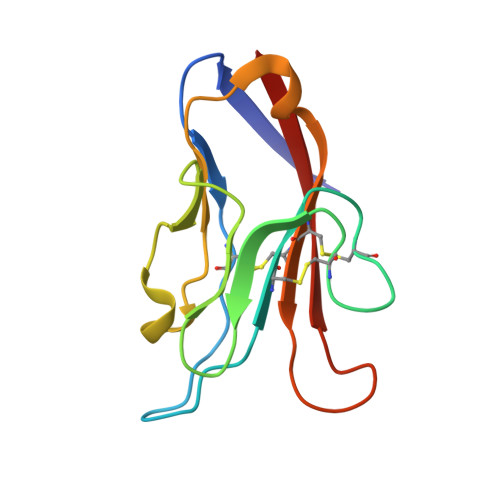
2OYP | pdb_00002oyp

T Cell Immunoglobulin Mucin-3 Crystal Structure Revealed a Galectin-9-independent Binding Surface


Experimental Data Snapshot

  • Method: X-RAY DIFFRACTION
  • Resolution: 1.95 Å
  • R-Value Free: 
    0.200 (Depositor), 0.203 (DCC) 
  • R-Value Work: 
    0.156 (Depositor), 0.157 (DCC) 
  • R-Value Observed: 
    0.158 (Depositor) 

Starting Model: experimental
View more details

wwPDB Validation 3D Report Full Report

Validation slider image for 2OYP

This is version 1.6 of the entry. See complete history. 

Literature

T cell immunoglobulin mucin-3 crystal structure reveals a galectin-9-independent ligand-binding surface

Cao, E., Zang, X., Ramagopal, U.A., Mukhopadhaya, A., Fedorov, A.A., Fedorov, E.V., Zencheck, W.D., Lary, J.W., Cole, J.L., Deng, H., Xiao, H., Dilorenzo, T.P., Allison, J.P., Nathenson, S.G., Almo, S.C.

(2007) Immunity 26: 311-321

  • DOI: https://doi.org/10.1016/j.immuni.2007.01.016
  • Primary Citation Related Structures: 
    2OYP

  • PubMed Abstract: 

    The T cell immunoglobulin mucin (Tim) family of receptors regulates effector CD4(+) T cell functions and is implicated in autoimmune and allergic diseases. Tim-3 induces immunological tolerance, and engagement of the Tim-3 immunoglobulin variable (IgV) domain by galectin-9 is important for appropriate termination of T helper 1-immune responses. The 2 A crystal structure of the Tim-3 IgV domain demonstrated that four cysteines, which are invariant within the Tim family, form two noncanonical disulfide bonds, resulting in a surface not present in other immunoglobulin superfamily members. Biochemical and biophysical studies demonstrated that this unique structural feature mediates a previously unidentified galectin-9-independent binding process and suggested that this structural feature is conserved within the entire Tim family. The current work provided a graphic example of the relationship between sequence, structure, and function and suggested that the interplay between multiple Tim-3-binding activities contributes to the regulated assembly of signaling complexes required for effective Th1-mediated immunity.


  • Organizational Affiliation: 
    • Department of Cell Biology, Albert Einstein College of Medicine, Bronx, NY 10461, USA.

Macromolecule Content 

  • Total Structure Weight: 12.51 kDa 
  • Atom Count: 982 
  • Modeled Residue Count: 109 
  • Deposited Residue Count: 109 
  • Unique protein chains: 1

Macromolecules

Find similar proteins by:|  3D Structure
Entity ID: 1
MoleculeChains  Sequence LengthOrganismDetailsImage
Hepatitis A virus cellular receptor 2109Mus musculusMutation(s): 0 
Gene Names: Havcr2
UniProt & NIH Common Fund Data Resources
Find proteins for Q3KP82 (Mus musculus)
Explore Q3KP82 
Go to UniProtKB:  Q3KP82
IMPC:  MGI:2159682
Entity Groups
Sequence Clusters30% Identity50% Identity70% Identity90% Identity95% Identity100% Identity
UniProt GroupQ3KP82
Sequence Annotations
Expand
Reference Sequence

Small Molecules

Ligands 1 Unique
IDChains Name / Formula / InChI Key2D Diagram3D Interactions
SO4

Query on SO4


Download:Ideal Coordinates CCD File
B [auth A]SULFATE ION
O4 S
QAOWNCQODCNURD-UHFFFAOYSA-L

Experimental Data & Validation

Experimental Data

  • Method: X-RAY DIFFRACTION
  • Resolution: 1.95 Å
  • R-Value Free:  0.200 (Depositor), 0.203 (DCC) 
  • R-Value Work:  0.156 (Depositor), 0.157 (DCC) 
  • R-Value Observed: 0.158 (Depositor) 
Space Group: P 1 21 1
Unit Cell:
Length ( Å )Angle ( ˚ )
a = 23α = 90
b = 52.809β = 100.94
c = 38.941γ = 90
Software Package:
Software NamePurpose
DENZOdata reduction
SCALEPACKdata scaling
REFMACrefinement
PDB_EXTRACTdata extraction
CBASSdata collection
HKL-2000data reduction
MOLREPphasing

Structure Validation

View Full Validation Report


Entry History 

Deposition Data

Revision History  (Full details and data files)

  • Version 1.0: 2007-04-10
    Type: Initial release
  • Version 1.1: 2008-05-01
    Changes: Version format compliance
  • Version 1.2: 2011-07-13
    Changes: Version format compliance
  • Version 1.3: 2013-11-13
    Changes: Database references
  • Version 1.4: 2017-10-18
    Changes: Refinement description
  • Version 1.5: 2023-08-30
    Changes: Data collection, Database references, Derived calculations, Refinement description
  • Version 1.6: 2024-10-30
    Changes: Structure summary