2O9X | pdb_00002o9x

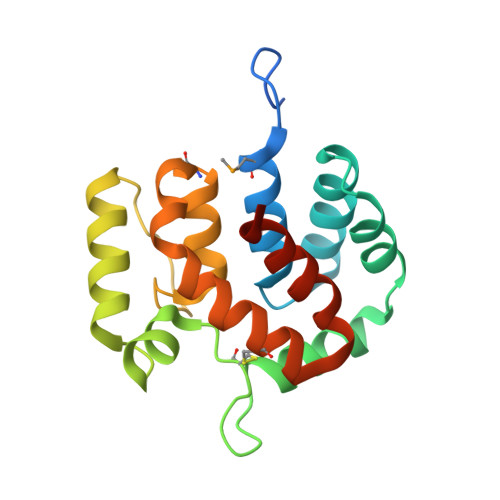
Crystal Structure Of A Putative Redox Enzyme Maturation Protein From Archaeoglobus Fulgidus


Experimental Data Snapshot

  • Method: X-RAY DIFFRACTION
  • Resolution: 3.40 Å
  • R-Value Free: 
    0.285 (Depositor), 0.301 (DCC) 
  • R-Value Work: 
    0.237 (Depositor), 0.239 (DCC) 
  • R-Value Observed: 
    0.239 (Depositor) 

wwPDB Validation 3D Report Full Report

Validation slider image for 2O9X

This is version 1.6 of the entry. See complete history

Literature

An extremely SAD case: structure of a putative redox-enzyme maturation protein from Archaeoglobus fulgidus at 3.4 A resolution.

Kirillova, O.Chruszcz, M.Shumilin, I.A.Skarina, T.Gorodichtchenskaia, E.Cymborowski, M.Savchenko, A.Edwards, A.Minor, W.

(2007) Acta Crystallogr D Biol Crystallogr 63: 348-354

  • DOI: https://doi.org/10.1107/S0907444906055065
  • Primary Citation Related Structures: 
    2O9X

  • PubMed Abstract: 

    This paper describes the crystal structure of AF0173, a putative redox-enzyme maturation protein (REMP) from Archaeoglobus fulgidus. The REMPs serve as chaperones in the maturation of extracytoplasmic oxidoreductases in archaea and bacteria. The all-helical subunits of AF0173 form a dimer arising from the interaction of residues located in a funnel-shaped cavity on one subunit surface with an uncut expression tag from the other subunit. This cavity is likely to represent a binding site for the twin-arginine motif that interacts with REMPs. The conservation of the overall fold in AF0173 and bacterial REMPs as well as the presence of conserved residues in their putative binding sites indicates that REMPs act in a similar manner in archaea and bacteria despite their limited sequence similarity. A model of the binding of the twin-arginine motif by AF0173 is suggested. The solution of the AF0173 structure by the single anomalous dispersion method represents an extreme case of SAD structure determination: low resolution (3.4 A), the absence of NCS and the presence of only two anomalously scattering atoms in the asymmetric unit. An unusually high solvent content (73%) turned out to be important for the success of the density-modification procedures.


  • Organizational Affiliation
    • Department of Molecular Physiology and Biological Physics, University of Virginia, 1340 Jefferson Park Avenue, Charlottesville, VA 22908, USA.

Macromolecule Content 

  • Total Structure Weight: 20.96 kDa 
  • Atom Count: 1,130 
  • Modeled Residue Count: 162 
  • Deposited Residue Count: 181 
  • Unique protein chains: 1

Macromolecules

Find similar proteins by:|  3D Structure
Entity ID: 1
MoleculeChains  Sequence LengthOrganismDetailsImage
Reductase, assembly protein181Archaeoglobus fulgidusMutation(s): 2 
Gene Names: AF0173
UniProt
Find proteins for O30064 (Archaeoglobus fulgidus (strain ATCC 49558 / DSM 4304 / JCM 9628 / NBRC 100126 / VC-16))
Explore O30064 
Go to UniProtKB:  O30064
Entity Groups
Sequence Clusters30% Identity50% Identity70% Identity90% Identity95% Identity100% Identity
UniProt GroupO30064
Sequence Annotations
Expand
Reference Sequence

Small Molecules

Modified Residues  1 Unique
IDChains TypeFormula2D DiagramParent
MSE
Query on MSE
A
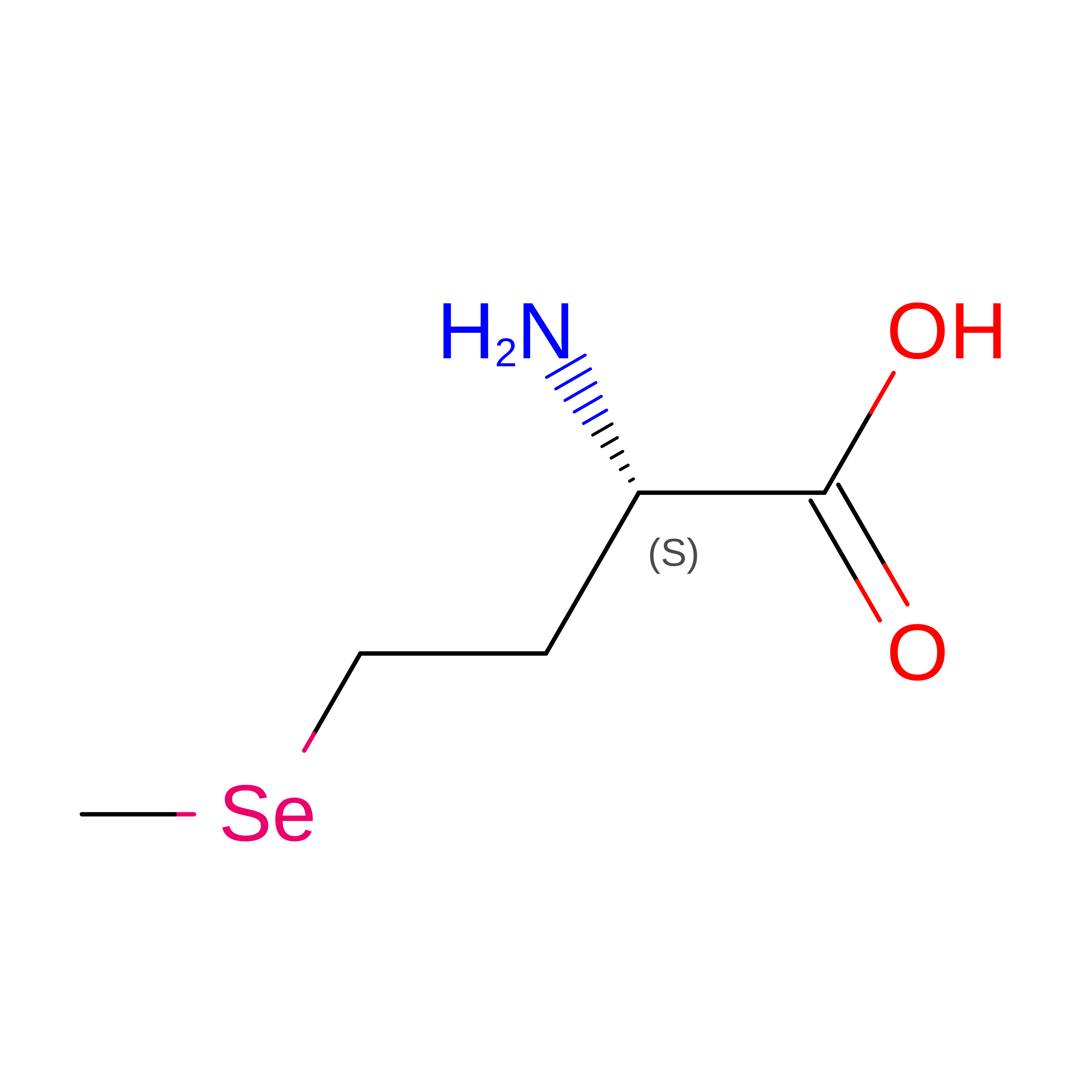
L-PEPTIDE LINKINGC5 H11 N O2 SeMET

Experimental Data & Validation

Experimental Data

  • Method: X-RAY DIFFRACTION
  • Resolution: 3.40 Å
  • R-Value Free:  0.285 (Depositor), 0.301 (DCC) 
  • R-Value Work:  0.237 (Depositor), 0.239 (DCC) 
  • R-Value Observed: 0.239 (Depositor) 
Space Group: P 65 2 2
Unit Cell:
Length ( Å )Angle ( ˚ )
a = 137.51α = 90
b = 137.51β = 90
c = 64.282γ = 120
Software Package:
Software NamePurpose
HKL-2000data scaling
SHELXDphasing
SHELXEmodel building
MLPHAREphasing
DMmodel building
SOLVEphasing
Omodel building
Cootmodel building
CCP4model building
REFMACrefinement
SBC-Collectdata collection
HKL-3000phasing
DMphasing
CCP4phasing

Structure Validation

View Full Validation Report


Entry History 

Revision History  (Full details and data files)

  • Version 1.0: 2007-01-16
    Type: Initial release
  • Version 1.1: 2008-05-01
    Changes: Version format compliance
  • Version 1.2: 2011-07-13
    Changes: Advisory, Derived calculations, Version format compliance
  • Version 1.3: 2017-10-18
    Changes: Refinement description
  • Version 1.4: 2022-04-13
    Changes: Database references, Derived calculations, Structure summary
  • Version 1.5: 2023-12-27
    Changes: Data collection
  • Version 1.6: 2024-11-06
    Changes: Structure summary