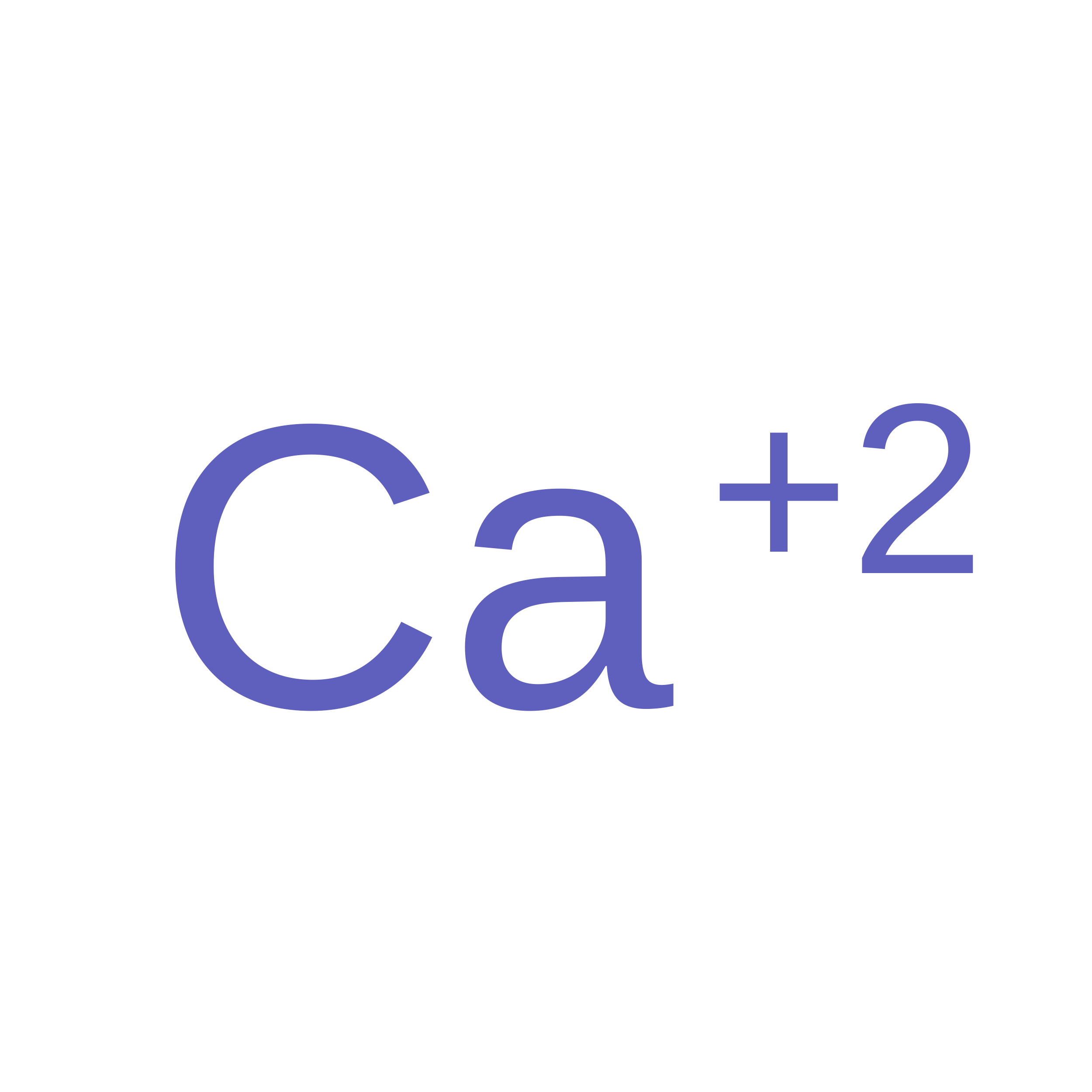
2KDU | pdb_00002kdu

Structural basis of the Munc13-1/Ca2+-Calmodulin interaction: A novel 1-26 calmodulin binding motif with a bipartite binding mode


Experimental Data Snapshot

  • Method: SOLUTION NMR
  • Conformers Calculated: 100 
  • Conformers Submitted: 20 
  • Selection Criteria: structures with the lowest energy 

wwPDB Validation 3D Report Full Report

Validation slider image for 2KDU

This is version 1.3 of the entry. See complete history

Literature

Modular architecture of Munc13/calmodulin complexes: dual regulation by Ca2+ and possible function in short-term synaptic plasticity.

Rodriguez-Castaneda, F.Maestre-Martinez, M.Coudevylle, N.Dimova, K.Junge, H.Lipstein, N.Lee, D.Becker, S.Brose, N.Jahn, O.Carlomagno, T.Griesinger, C.

(2010) EMBO J 29: 680-691

  • DOI: https://doi.org/10.1038/emboj.2009.373
  • Primary Citation Related Structures: 
    2KDU

  • PubMed Abstract: 

    Ca(2+) signalling in neurons through calmodulin (CaM) has a prominent function in regulating synaptic vesicle trafficking, transport, and fusion. Importantly, Ca(2+)-CaM binds a conserved region in the priming proteins Munc13-1 and ubMunc13-2 and thus regulates synaptic neurotransmitter release in neurons in response to residual Ca(2+) signals. We solved the structure of Ca(2+)(4)-CaM in complex with the CaM-binding domain of Munc13-1, which features a novel 1-5-8-26 CaM-binding motif with two separated mobile structural modules, each involving a CaM domain. Photoaffinity labelling data reveal the same modular architecture in the complex with the ubMunc13-2 isoform. The N-module can be dissociated with EGTA to form the half-loaded Munc13/Ca(2+)(2)-CaM complex. The Ca(2+) regulation of these Munc13 isoforms can therefore be explained by the modular nature of the Munc13/Ca(2+)-CaM interactions, where the C-module provides a high-affinity interaction activated at nanomolar [Ca(2+)](i), whereas the N-module acts as a sensor at micromolar [Ca(2+)](i). This Ca(2+)/CaM-binding mode of Munc13 likely constitutes a key molecular correlate of the characteristic Ca(2+)-dependent modulation of short-term synaptic plasticity.


  • Organizational Affiliation
    • Department of NMR-based Structural Biology, Max Planck Institute for Biophysical Chemistry, Göttingen, Germany.

Macromolecule Content 

  • Total Structure Weight: 21.06 kDa 
  • Atom Count: 1,463 
  • Modeled Residue Count: 184 
  • Deposited Residue Count: 184 
  • Unique protein chains: 2

Macromolecules

Find similar proteins by:|  3D Structure
Entity ID: 1
MoleculeChains  Sequence LengthOrganismDetailsImage
Calmodulin148Xenopus laevisMutation(s): 0 
Gene Names: calm1calm2
UniProt
Find proteins for P0DP33 (Xenopus laevis)
Explore P0DP33 
Go to UniProtKB:  P0DP33
Entity Groups
Sequence Clusters30% Identity50% Identity70% Identity90% Identity95% Identity100% Identity
UniProt GroupP0DP33
Sequence Annotations
Expand
Reference Sequence
Find similar proteins by:|  3D Structure
Entity ID: 2
MoleculeChains  Sequence LengthOrganismDetailsImage
Protein unc-13 homolog A36Rattus norvegicusMutation(s): 0 
Gene Names: Unc13a
UniProt
Find proteins for Q62768 (Rattus norvegicus)
Explore Q62768 
Go to UniProtKB:  Q62768
Entity Groups
Sequence Clusters30% Identity50% Identity70% Identity90% Identity95% Identity100% Identity
UniProt GroupQ62768
Sequence Annotations
Expand
Reference Sequence

Experimental Data & Validation

Experimental Data

  • Method: SOLUTION NMR
  • Conformers Calculated: 100 
  • Conformers Submitted: 20 
  • Selection Criteria: structures with the lowest energy 

Structure Validation

View Full Validation Report


Entry History 

Revision History  (Full details and data files)

  • Version 1.0: 2009-12-15
    Type: Initial release
  • Version 1.1: 2011-07-13
    Changes: Version format compliance
  • Version 1.2: 2022-03-16
    Changes: Data collection, Database references, Derived calculations
  • Version 1.3: 2024-05-22
    Changes: Data collection