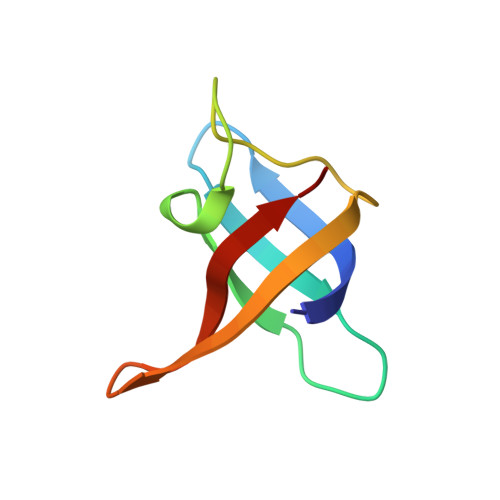
2I5M | pdb_00002i5m

Crystal structure of Bacillus subtilis cold shock protein CspB variant A46K S48R


Experimental Data Snapshot

  • Method: X-RAY DIFFRACTION
  • Resolution: 2.30 Å
  • R-Value Free: 
    0.227 (Depositor), 0.250 (DCC) 
  • R-Value Work: 
    0.204 (Depositor), 0.214 (DCC) 
  • R-Value Observed: 
    0.205 (Depositor) 

Starting Model: experimental
View more details

wwPDB Validation 3D Report Full Report

Validation slider image for 2I5M

This is version 1.5 of the entry. See complete history

Literature

Optimized variants of the cold shock protein from in vitro selection: structural basis of their high thermostability.

Max, K.E.Wunderlich, M.Roske, Y.Schmid, F.X.Heinemann, U.

(2007) J Mol Biology 369: 1087-1097

  • DOI: https://doi.org/10.1016/j.jmb.2007.04.016
  • Primary Citation Related Structures: 
    2I5L, 2I5M

  • PubMed Abstract: 

    The bacterial cold shock proteins (Csp) are widely used as models for the experimental and computational analysis of protein stability. In a previous study, in vitro evolution was employed to identify strongly stabilizing mutations in Bs-CspB from Bacillus subtilis. The best variant found by this approach contained the mutations M1R, E3K and K65I, which raised the midpoint of thermal unfolding of Bs-CspB from 53.8 degrees C to 83.7 degrees C, and increased the Gibbs free energy of stabilization by 20.9 kJ mol(-1). Another selected variant with the two mutations A46K and S48R was stabilized by 11.1 kJ mol(-1). To elucidate the molecular basis of these stabilizations, we determined the crystal structures of these two Bs-CspB variants. The mutated residues are generally well ordered and provide additional stabilizing interactions, such as charge interactions, additional hydrogen bonds and improved side-chain packing. Several mutations improve the electrostatic interactions, either by the removal of unfavorable charges (E3K) or by compensating their destabilizing interactions (A46K, S48R). The stabilizing mutations are clustered at a contiguous surface area of Bs-CspB, which apparently is critically important for the stability of the beta-barrel structure but not well optimized in the wild-type protein.


  • Organizational Affiliation
    • Makromolekulare Strukturen und Interaktionen, Max-Delbrück-Centrum für Molekulare Medizin, Berlin, Germany.

Macromolecule Content 

  • Total Structure Weight: 7.52 kDa 
  • Atom Count: 554 
  • Modeled Residue Count: 66 
  • Deposited Residue Count: 67 
  • Unique protein chains: 1

Macromolecules

Find similar proteins by:|  3D Structure
Entity ID: 1
MoleculeChains  Sequence LengthOrganismDetailsImage
Cold shock protein cspBA [auth X]67Bacillus subtilisMutation(s): 2 
Gene Names: cspBcspA
UniProt
Find proteins for P32081 (Bacillus subtilis (strain 168))
Explore P32081 
Go to UniProtKB:  P32081
Entity Groups
Sequence Clusters30% Identity50% Identity70% Identity90% Identity95% Identity100% Identity
UniProt GroupP32081
Sequence Annotations
Expand
Reference Sequence

Small Molecules

Ligands 1 Unique
IDChains Name / Formula / InChI Key2D Diagram3D Interactions
MG

Query on MG


Download:Ideal Coordinates CCD File
B [auth X]MAGNESIUM ION
Mg
JLVVSXFLKOJNIY-UHFFFAOYSA-N

Experimental Data & Validation

Experimental Data

  • Method: X-RAY DIFFRACTION
  • Resolution: 2.30 Å
  • R-Value Free:  0.227 (Depositor), 0.250 (DCC) 
  • R-Value Work:  0.204 (Depositor), 0.214 (DCC) 
  • R-Value Observed: 0.205 (Depositor) 
Space Group: P 32 2 1
Unit Cell:
Length ( Å )Angle ( ˚ )
a = 58.627α = 90
b = 58.627β = 90
c = 46.798γ = 120
Software Package:
Software NamePurpose
XSCALEdata scaling
AMoREphasing
REFMACrefinement
PDB_EXTRACTdata extraction
MAR345data collection
XDSdata reduction

Structure Validation

View Full Validation Report


Entry History 

Deposition Data

Revision History  (Full details and data files)

  • Version 1.0: 2007-05-22
    Type: Initial release
  • Version 1.1: 2008-05-01
    Changes: Version format compliance
  • Version 1.2: 2011-07-13
    Changes: Advisory, Derived calculations, Version format compliance
  • Version 1.3: 2017-10-18
    Changes: Refinement description
  • Version 1.4: 2021-10-20
    Changes: Database references, Derived calculations
  • Version 1.5: 2023-08-30
    Changes: Data collection, Refinement description