Download Mendeley
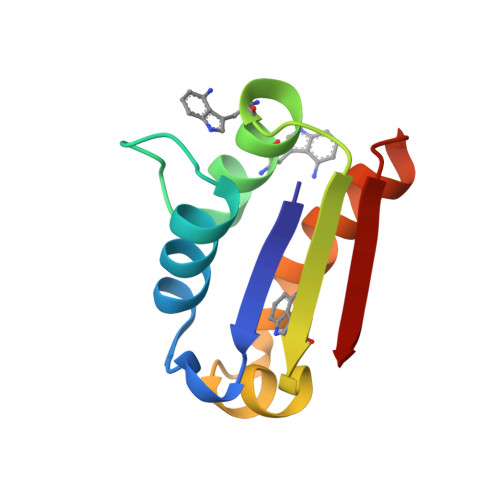
Aminotryptophan-containing barstar
Rubini, M., Lepthien, S., Golbik, R., Budisa, N.(2006) Biochim Biophys Acta 1764: 1147-1158
- PubMed: 16782415 Search on PubMed
- DOI: https://doi.org/10.1016/j.bbapap.2006.04.012
- Primary Citation Related Structures:
2HXX - PubMed Abstract:
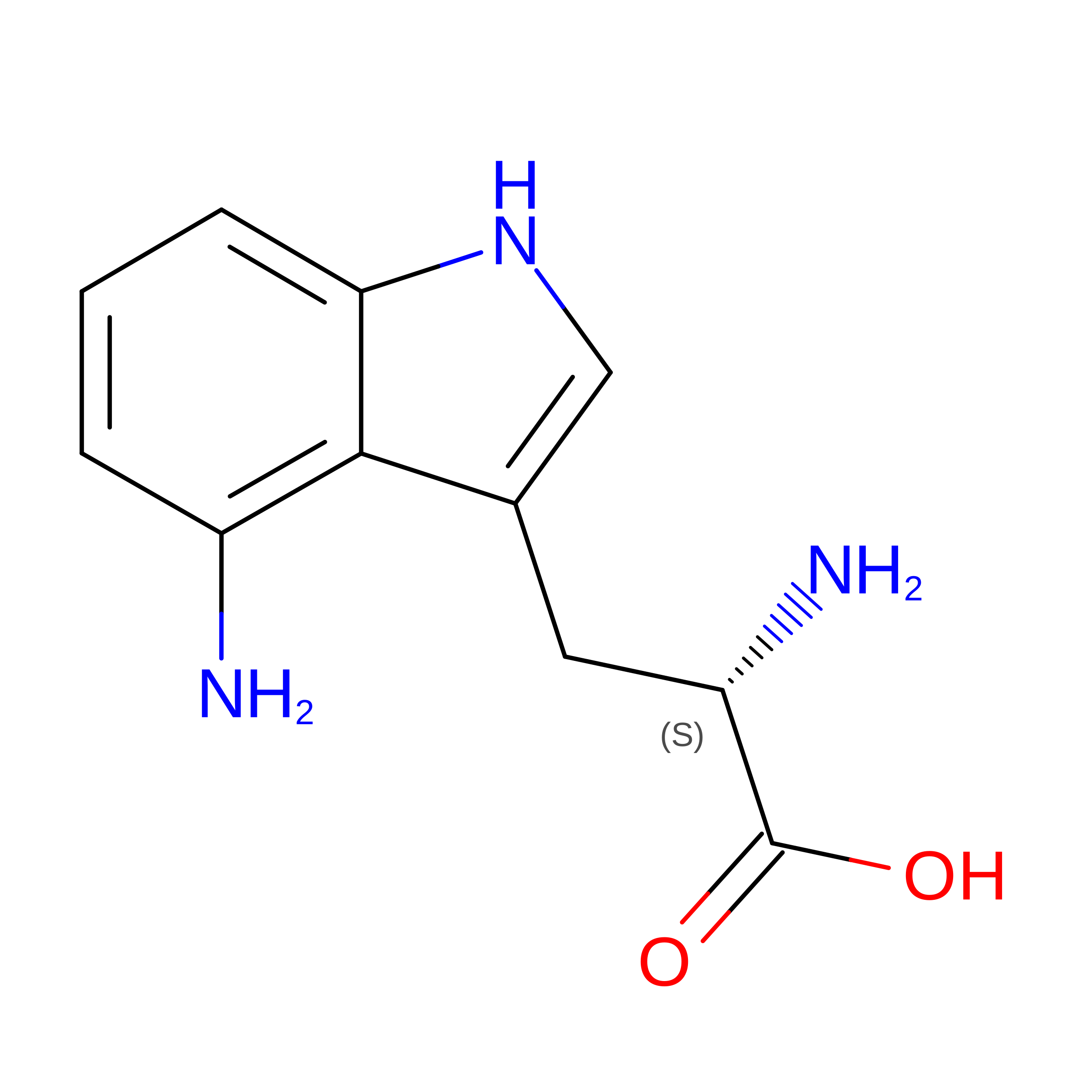
The indole ring of the canonical amino acid tryptophan (Trp) possesses distinguished features, such as sterical bulk, hydrophobicity and the nitrogen atom which is capable of acting as a hydrogen bond donor. The introduction of an amino group into the indole moiety of Trp yields the structural analogs 4-aminotryptophan ((4-NH(2))Trp) and 5-aminotryptophan ((5-NH(2))Trp). Their hydrophobicity and spectral properties are substantially different when compared to those of Trp. They resemble the purine bases of DNA and share their capacity for pH-sensitive intramolecular charge transfer. The Trp --> aminotryptophan substitution in proteins during ribosomal translation is expected to result in related protein variants that acquire these features. These expectations have been fulfilled by incorporating (4-NH(2))Trp and (5-NH(2))Trp into barstar, an intracellular inhibitor of the ribonuclease barnase from Bacillus amyloliquefaciens. The crystal structure of (4-NH(2))Trp-barstar is similar to that of the parent protein, whereas its spectral and thermodynamic behavior is found to be remarkably different. The T(m) value of (4-NH(2))Trp- and (5-NH(2))Trp-barstar is lowered by about 20 degrees Celsius, and they exhibit a strongly reduced unfolding cooperativity and substantial loss of free energy in folding. Furthermore, folding kinetic study of (4-NH(2))Trp-barstar revealed that the denatured state is even preferred over native one. The combination of structural and thermodynamic analyses clearly shows how structures of substituted barstar display a typical structure-function tradeoff: the acquirement of unique pH-sensitive charge transfer as a novel function is achieved at the expense of protein stability. These findings provide a new insight into the evolution of the amino acid repertoire of the universal genetic code and highlight possible problems regarding protein engineering and design by using an expanded genetic code.
- Max-Planck-Institut für Biochemie, Am Klopferspitz 18, D-82152 Martinsried, Germany.
Organizational Affiliation: