2CWW | pdb_00002cww

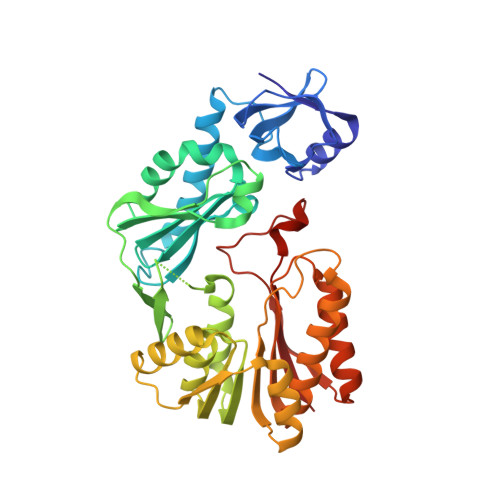
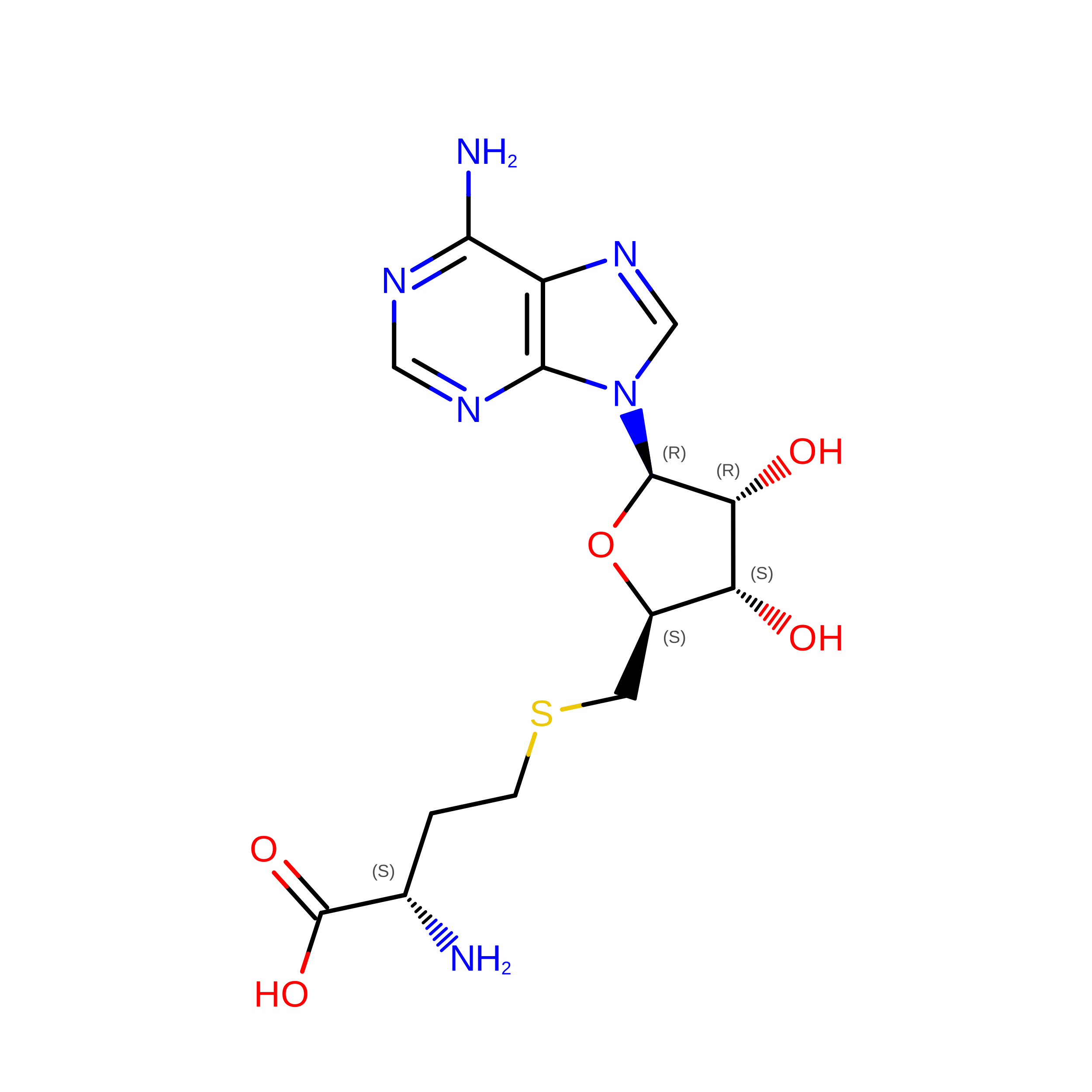
Crystal structure of Thermus thermophilus TTHA1280, a putative SAM-dependent RNA methyltransferase, in complex with S-adenosyl-L-homocysteine


Experimental Data Snapshot

  • Method: X-RAY DIFFRACTION
  • Resolution: 2.60 Å
  • R-Value Free: 
    0.297 (Depositor), 0.292 (DCC) 
  • R-Value Work: 
    0.258 (Depositor), 0.255 (DCC) 
  • R-Value Observed: 
    0.258 (Depositor) 

Starting Model: experimental
View more details

wwPDB Validation 3D Report Full Report

Validation slider image for 2CWW

Ligand Structure Quality Assessment 


This is version 1.3 of the entry. See complete history

Literature

Structures of a putative RNA 5-methyluridine methyltransferase, Thermus thermophilus TTHA1280, and its complex with S-adenosyl-L-homocysteine.

Pioszak, A.A.Murayama, K.Nakagawa, N.Ebihara, A.Kuramitsu, S.Shirouzu, M.Yokoyama, S.

(2005) Acta Crystallogr Sect F Struct Biol Cryst Commun 61: 867-874

  • DOI: https://doi.org/10.1107/S1744309105029842
  • Primary Citation Related Structures: 
    1WXW, 1WXX, 2CWW

  • PubMed Abstract: 

    The Thermus thermophilus hypothetical protein TTHA1280 belongs to a family of predicted S-adenosyl-L-methionine (AdoMet) dependent RNA methyltransferases (MTases) present in many bacterial and archaeal species. Inspection of amino-acid sequence motifs common to class I Rossmann-fold-like MTases suggested a specific role as an RNA 5-methyluridine MTase. Selenomethionine (SeMet) labelled and native versions of the protein were expressed, purified and crystallized. Two crystal forms of the SeMet-labelled apoprotein were obtained: SeMet-ApoI and SeMet-ApoII. Cocrystallization of the native protein with S-adenosyl-L-homocysteine (AdoHcy) yielded a third crystal form, Native-AdoHcy. The SeMet-ApoI structure was solved by the multiple anomalous dispersion method and refined at 2.55 A resolution. The SeMet-ApoII and Native-AdoHcy structures were solved by molecular replacement and refined at 1.80 and 2.60 A, respectively. TTHA1280 formed a homodimer in the crystals and in solution. Each subunit folds into a three-domain structure composed of a small N-terminal PUA domain, a central alpha/beta-domain and a C-terminal Rossmann-fold-like MTase domain. The three domains form an overall clamp-like shape, with the putative active site facing a deep cleft. The architecture of the active site is consistent with specific recognition of uridine and catalysis of methyl transfer to the 5-carbon position. The cleft is suitable in size and charge distribution for binding single-stranded RNA.


  • Organizational Affiliation
    • RIKEN Genomic Sciences Center, Yokohama, Japan.

Macromolecule Content 

  • Total Structure Weight: 87.05 kDa 
  • Atom Count: 6,135 
  • Modeled Residue Count: 758 
  • Deposited Residue Count: 764 
  • Unique protein chains: 1

Macromolecules

Find similar proteins by:|  3D Structure
Entity ID: 1
MoleculeChains  Sequence LengthOrganismDetailsImage
putative SAM-dependent RNA methyltransferase
A, B
382Thermus thermophilus HB8Mutation(s): 0 
Gene Names: TTHA1280
EC: 2.1.1.191
UniProt
Find proteins for Q5SIT4 (Thermus thermophilus (strain ATCC 27634 / DSM 579 / HB8))
Explore Q5SIT4 
Go to UniProtKB:  Q5SIT4
Entity Groups
Sequence Clusters30% Identity50% Identity70% Identity90% Identity95% Identity100% Identity
UniProt GroupQ5SIT4
Sequence Annotations
Expand
Reference Sequence

Experimental Data & Validation

Experimental Data

  • Method: X-RAY DIFFRACTION
  • Resolution: 2.60 Å
  • R-Value Free:  0.297 (Depositor), 0.292 (DCC) 
  • R-Value Work:  0.258 (Depositor), 0.255 (DCC) 
  • R-Value Observed: 0.258 (Depositor) 
Space Group: C 1 2 1
Unit Cell:
Length ( Å )Angle ( ˚ )
a = 137.805α = 90
b = 46.065β = 109.93
c = 134.127γ = 90
Software Package:
Software NamePurpose
CNSrefinement
HKL-2000data reduction
SCALEPACKdata scaling
CNSphasing

Structure Validation

View Full Validation Report


Ligand Structure Quality Assessment 


Entry History 

Revision History  (Full details and data files)

  • Version 1.0: 2005-10-11
    Type: Initial release
  • Version 1.1: 2008-04-30
    Changes: Version format compliance
  • Version 1.2: 2011-07-13
    Changes: Source and taxonomy, Version format compliance
  • Version 1.3: 2023-10-25
    Changes: Data collection, Database references, Derived calculations, Refinement description