2CRD | pdb_00002crd

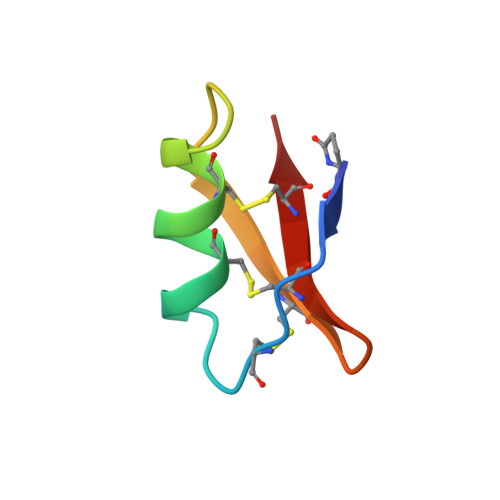
ANALYSIS OF SIDE-CHAIN ORGANIZATION ON A REFINED MODEL OF CHARYBDOTOXIN: STRUCTURAL AND FUNCTIONAL IMPLICATIONS


Experimental Data Snapshot

  • Method: SOLUTION NMR
  • Conformers Submitted: 12 

wwPDB Validation 3D Report Full Report

Validation slider image for 2CRD

This is version 2.1 of the entry. See complete history

Literature

Analysis of side-chain organization on a refined model of charybdotoxin: structural and functional implications.

Bontems, F.Gilquin, B.Roumestand, C.Menez, A.Toma, F.

(1992) Biochemistry 31: 7756-7764

  • DOI: https://doi.org/10.1021/bi00149a003
  • Primary Citation Related Structures: 
    2CRD

  • PubMed Abstract: 

    The spatial organization of side chains on a refined model of charybdotoxin is presented. First, the structural role of two groups of well-defined, low-accessible side chains (Thr3, Val5, Val16, Leu20, Cys33 and Leu20, His21, Thr23, Cys17, Cys35) is discussed. These side chains are conserved in three out of the five known scorpion toxins acting on K+ channels. Interestingly, they are not conserved in scyllatoxin which presents a slightly different secondary structure organization. Second, the spatial organization of all positively charged residues is analyzed. Comparison with the results presented by Park and Miller [(1992) Biochemistry (preceding paper in this issue)] shows that all functionally important positive residues are located on the beta-sheet side of the toxin. These results are different from those obtained by Auguste et al. [(1992) Biochemistry 31, 648-654] on scyllatoxin, which blocks a different type of K+ channel. This study shows, in fact, that functionally important positive residues are located on the helix side of the toxin. Thus, charybdotoxin and scyllatoxin, which present the same global fold, interact with two different classes of K+ channels by two different parts of the motif.


  • Organizational Affiliation
    • Département d'Ingénierie et d'Etude des Protéines, CE-Saclay, Gif-sur-Yvette, France.

Macromolecule Content 

  • Total Structure Weight: 4.31 kDa 
  • Atom Count: 295 
  • Modeled Residue Count: 37 
  • Deposited Residue Count: 37 
  • Unique protein chains: 1

Macromolecules

Find similar proteins by:|  3D Structure
Entity ID: 1
MoleculeChains  Sequence LengthOrganismDetailsImage
CHARYBDOTOXIN37Leiurus hebraeusMutation(s): 0 
Membrane Entity: Yes 
UniProt
Find proteins for P13487 (Leiurus hebraeus)
Explore P13487 
Go to UniProtKB:  P13487
Entity Groups
Sequence Clusters30% Identity50% Identity70% Identity90% Identity95% Identity100% Identity
UniProt GroupP13487
Sequence Annotations
Expand
Reference Sequence

Small Molecules

Modified Residues  1 Unique
IDChains TypeFormula2D DiagramParent
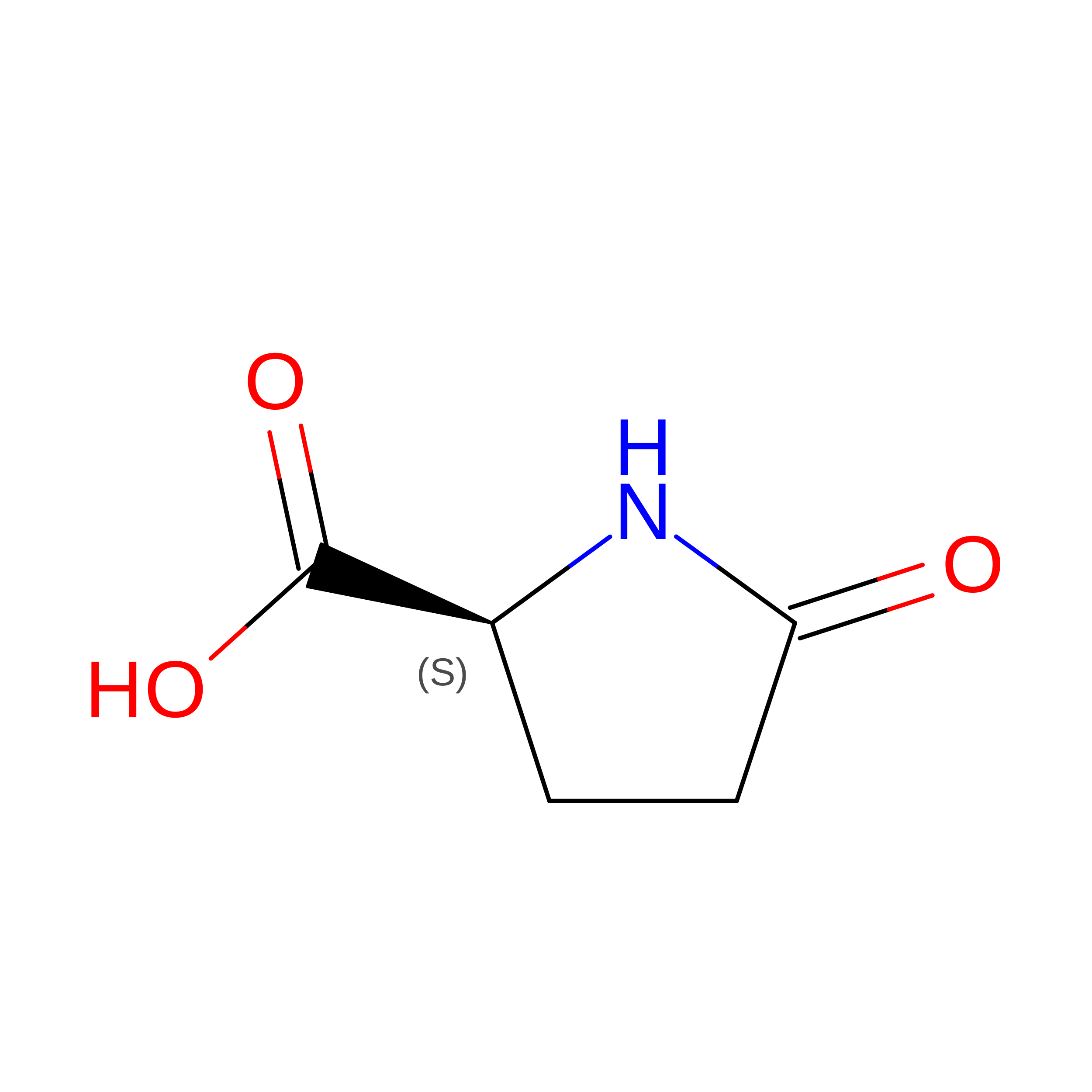
PCA
Query on PCA
A
L-PEPTIDE LINKINGC5 H7 N O3GLN

Experimental Data & Validation

Experimental Data

  • Method: SOLUTION NMR
  • Conformers Submitted: 12 

Structure Validation

View Full Validation Report


Entry History 

Deposition Data

Revision History  (Full details and data files)

  • Version 1.0: 1993-07-15
    Type: Initial release
  • Version 1.1: 2008-03-24
    Changes: Version format compliance
  • Version 1.2: 2011-07-13
    Changes: Version format compliance
  • Version 1.3: 2017-11-29
    Changes: Derived calculations, Other
  • Version 2.0: 2019-12-25
    Changes: Derived calculations, Polymer sequence
  • Version 2.1: 2024-11-06
    Changes: Data collection, Database references, Structure summary