2APC | pdb_00002apc

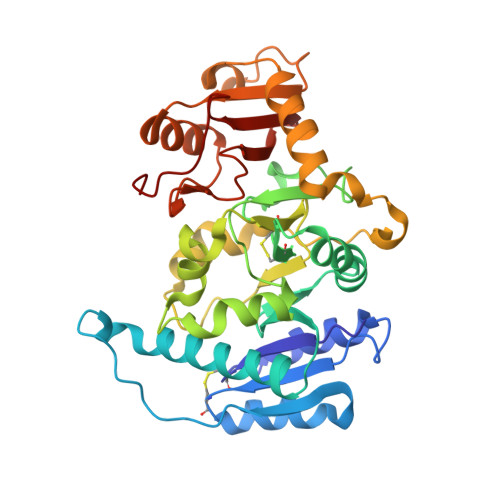
Crystal Structure of N-Acetylglucosaminyltransferase I in Complex with UDP-GlcNAc phosphonate


Experimental Data Snapshot

  • Method: X-RAY DIFFRACTION
  • Resolution: 1.50 Å
  • R-Value Free: 
    0.220 (Depositor), 0.190 (DCC) 
  • R-Value Work: 
    0.210 (Depositor), 0.176 (DCC) 

Starting Models: experimental
View more details

wwPDB Validation 3D Report Full Report

Validation slider image for 2APC

Ligand Structure Quality Assessment 


This is version 1.4 of the entry. See complete history

Literature

X-ray Crystal Structures of Rabbit N-acetylglucosaminyltransferase I (GnT I) in Complex with Donor Substrate Analogues.

Gordon, R.D.Sivarajah, P.Satkunarajah, M.Ma, D.Tarling, C.A.Vizitiu, D.Withers, S.G.Rini, J.M.

(2006) J Mol Biology 360: 67-79

  • DOI: https://doi.org/10.1016/j.jmb.2006.04.058
  • Primary Citation Related Structures: 
    2AM3, 2AM4, 2AM5, 2APC

  • PubMed Abstract: 

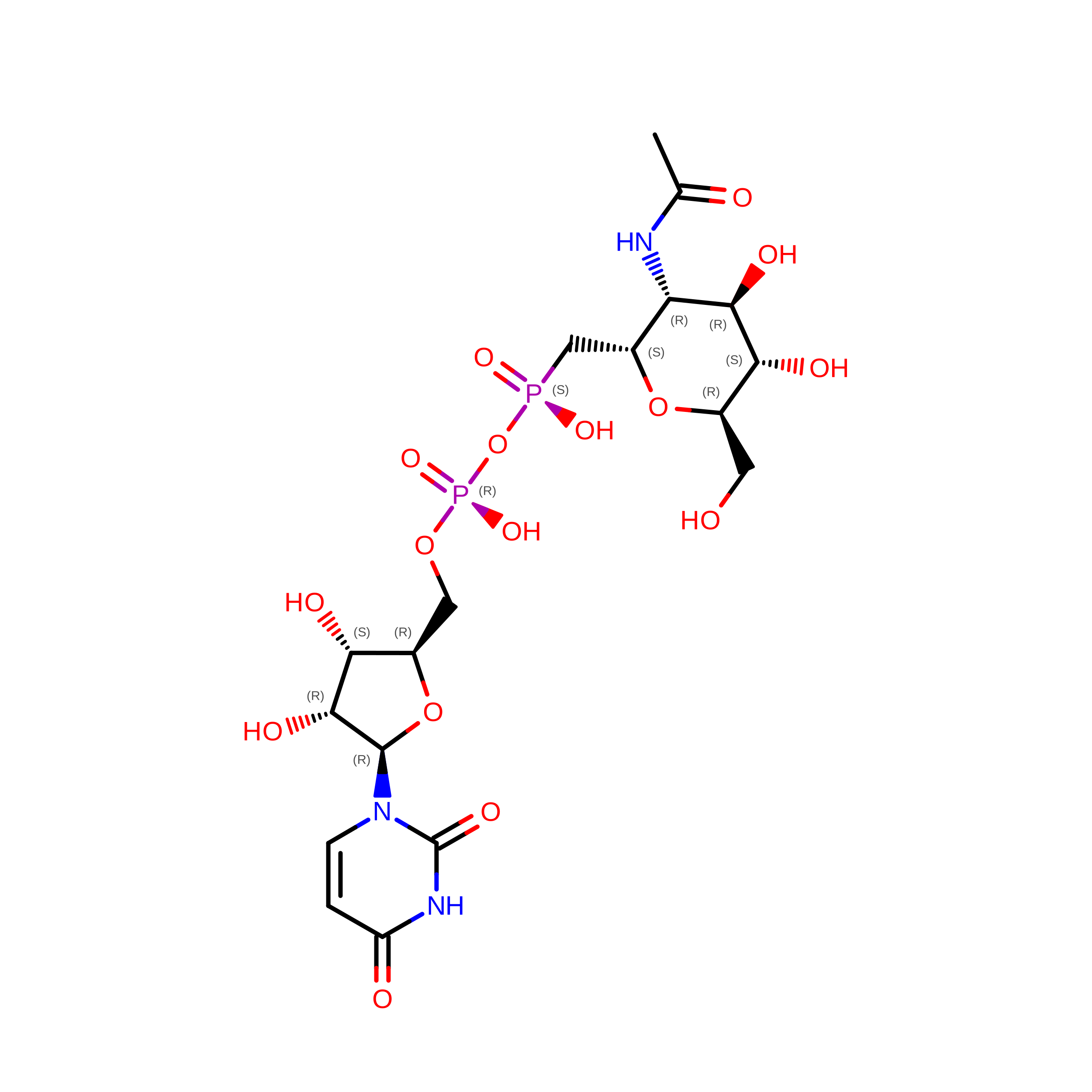
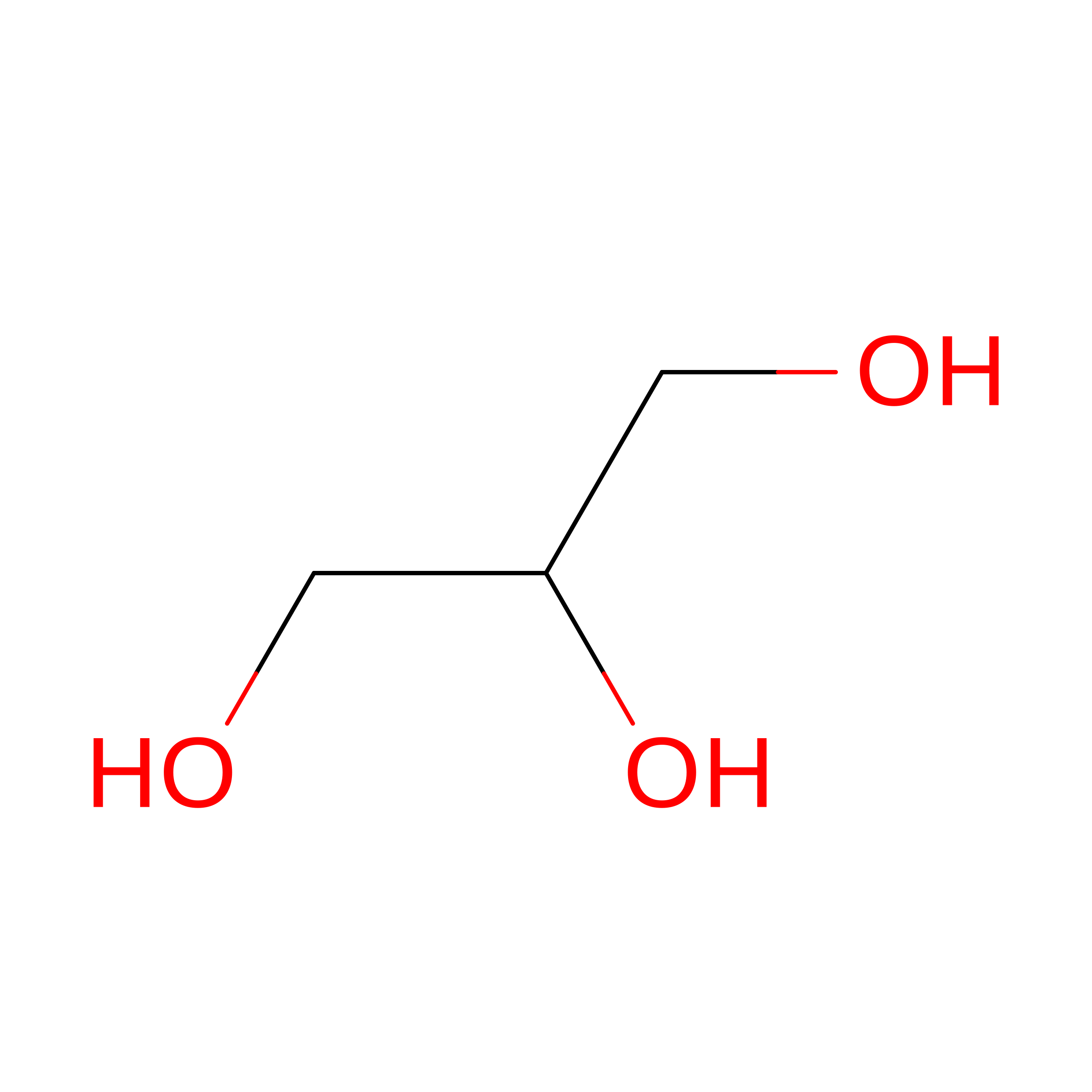
    The Golgi-resident glycosyltransferase, UDP-N-acetyl-d-glucosamine:alpha-3-d-mannoside beta-1,2-N-acetylglucosaminyltransferase I (GnT I), initiates the conversion of high-mannose oligosaccharides to complex and hybrid structures in the biosynthesis of N-linked glycans. Reported here are the X-ray crystal structures of GnT I in complex with UDP-CH2-GlcNAc (a non-hydrolyzable C-glycosidic phosphonate), UDP-2-deoxy-2-fluoro-glucose, UDP-glucose and UDP. Collectively, these structures provide evidence for the importance of the GlcNAc moiety and its N-acetyl group in donor substrate binding, as well as insight into the role played by the flexible 318-330 loop in substrate binding and product release. In addition, the UDP-CH2-GlcNAc complex reveals a well-defined glycerol molecule poised for nucleophilic attack on the C1 atom of the donor substrate analogue. The position and orientation of this glycerol molecule have allowed us to model the binding of the Manalpha1,3Manbeta1 moiety of the acceptor substrate and, based on the model, to suggest a rationalization for the main determinants of GnT I acceptor specificity.


  • Organizational Affiliation
    • Department of Biochemistry, University of Toronto, Toronto, Ontario, Canada M5S 1A8.

Macromolecule Content 

  • Total Structure Weight: 40.94 kDa 
  • Atom Count: 3,218 
  • Modeled Residue Count: 342 
  • Deposited Residue Count: 342 
  • Unique protein chains: 1

Macromolecules

Find similar proteins by:|  3D Structure
Entity ID: 1
MoleculeChains  Sequence LengthOrganismDetailsImage
Alpha-1,3-mannosyl-glycoprotein 2-beta-N-acetylglucosaminyltransferase342Oryctolagus cuniculusMutation(s): 0 
EC: 2.4.1.101
UniProt
Find proteins for P27115 (Oryctolagus cuniculus)
Explore P27115 
Go to UniProtKB:  P27115
Entity Groups
Sequence Clusters30% Identity50% Identity70% Identity90% Identity95% Identity100% Identity
UniProt GroupP27115
Sequence Annotations
Expand
Reference Sequence

Small Molecules

Ligands 3 Unique
IDChains Name / Formula / InChI Key2D Diagram3D Interactions
UDM

Query on UDM


Download:Ideal Coordinates CCD File
C [auth A]URIDINE-DIPHOSPHATE-METHYLENE-N-ACETYL-GLUCOSAMINE
C18 H29 N3 O16 P2
KUFKOJZYUNOEES-DLLWPQOWSA-N
GOL

Query on GOL


Download:Ideal Coordinates CCD File
D [auth A]
E [auth A]
F [auth A]
G [auth A]
H [auth A]
D [auth A],
E [auth A],
F [auth A],
G [auth A],
H [auth A],
I [auth A]
GLYCEROL
C3 H8 O3
PEDCQBHIVMGVHV-UHFFFAOYSA-N
MN

Query on MN


Download:Ideal Coordinates CCD File
B [auth A]MANGANESE (II) ION
Mn
WAEMQWOKJMHJLA-UHFFFAOYSA-N

Experimental Data & Validation

Experimental Data

  • Method: X-RAY DIFFRACTION
  • Resolution: 1.50 Å
  • R-Value Free:  0.220 (Depositor), 0.190 (DCC) 
  • R-Value Work:  0.210 (Depositor), 0.176 (DCC) 
Space Group: P 21 21 21
Unit Cell:
Length ( Å )Angle ( ˚ )
a = 40.964α = 90
b = 82.499β = 90
c = 102.422γ = 90
Software Package:
Software NamePurpose
CNSrefinement
DENZOdata reduction
SCALEPACKdata scaling
CNSphasing

Structure Validation

View Full Validation Report


Ligand Structure Quality Assessment 


Entry History 

Deposition Data

Revision History  (Full details and data files)

  • Version 1.0: 2006-06-27
    Type: Initial release
  • Version 1.1: 2008-04-30
    Changes: Version format compliance
  • Version 1.2: 2011-07-13
    Changes: Non-polymer description, Version format compliance
  • Version 1.3: 2023-08-23
    Changes: Data collection, Database references, Derived calculations, Refinement description
  • Version 1.4: 2024-11-20
    Changes: Structure summary