284D | pdb_0000284d

THE BI-LOOP, A NEW GENERAL FOUR-STRANDED DNA MOTIF


Experimental Data Snapshot

  • Method: X-RAY DIFFRACTION
  • Resolution: 1.10 Å
  • R-Value Work: 
    0.236 (DCC) 
  • R-Value Observed: 
    0.199 (Depositor) 

wwPDB Validation 3D Report Full Report

Validation slider image for 284D

This is version 1.3 of the entry. See complete history

Literature

The bi-loop, a new general four-stranded DNA motif.

Salisbury, S.A.Wilson, S.E.Powell, H.R.Kennard, O.Lubini, P.Sheldrick, G.M.Escaja, N.Alazzouzi, E.Grandas, A.Pedroso, E.

(1997) Proc Natl Acad Sci U S A 94: 5515-5518

  • DOI: https://doi.org/10.1073/pnas.94.11.5515
  • Primary Citation Related Structures: 
    284D

  • PubMed Abstract: 

    The crystal structure of the cyclic octanucleotide d contains two independent molecules that form a novel quadruplex by means of intermolecular Watson-Crick A.T pairs and base stacking. A virtually identical quadruplex composed of G.C pairs was found by earlier x-ray analysis of the linear heptamer d(GCATGCT), when the DNA was looped in the crystal. The close correspondence between these two structures of markedly dissimilar oligonucleotides suggests that they are both examples of a previously unrecognized motif. Their nucleotide sequences have little in common except for two separated 5'-purine-pyrimidine dinucleotides forming the quadruplex, and by implication these so-called "bi-loops" could occur widely in natural DNA. Such structures provide a mechanism for noncovalent linking of polynucleotides in vivo. Their capacity to associate by base stacking, demonstrated in the crystal structure of d(GCATGCT), creates a compact molecular framework made up of four DNA chains within which strand exchange could take place.


  • Organizational Affiliation
    • Cambridge Crystallographic Data Centre, 12 Union Road, Cambridge CB2 1EZ, United Kingdom.

Macromolecule Content 

  • Total Structure Weight: 6.29 kDa 
  • Atom Count: 437 
  • Modeled Residue Count: 16 
  • Deposited Residue Count: 16 
  • Unique nucleic acid chains: 1

Macromolecules

Find similar nucleic acids by:  Sequence
Entity ID: 1
MoleculeChains LengthOrganismImage
DNA (5'-CD(*P*AP*TP*TP*CP*AP*TP*TP*C)-3')
A, B
8N/A
Sequence Annotations
Expand
Reference Sequence

Small Molecules

Ligands 2 Unique
IDChains Name / Formula / InChI Key2D Diagram3D Interactions
BA

Query on BA


Download:Ideal Coordinates CCD File
D [auth A]
E [auth A]
F [auth A]
G [auth B]
H [auth B]
D [auth A],
E [auth A],
F [auth A],
G [auth B],
H [auth B],
I [auth B],
J [auth B],
K [auth B],
L [auth B],
M [auth B],
N [auth B]
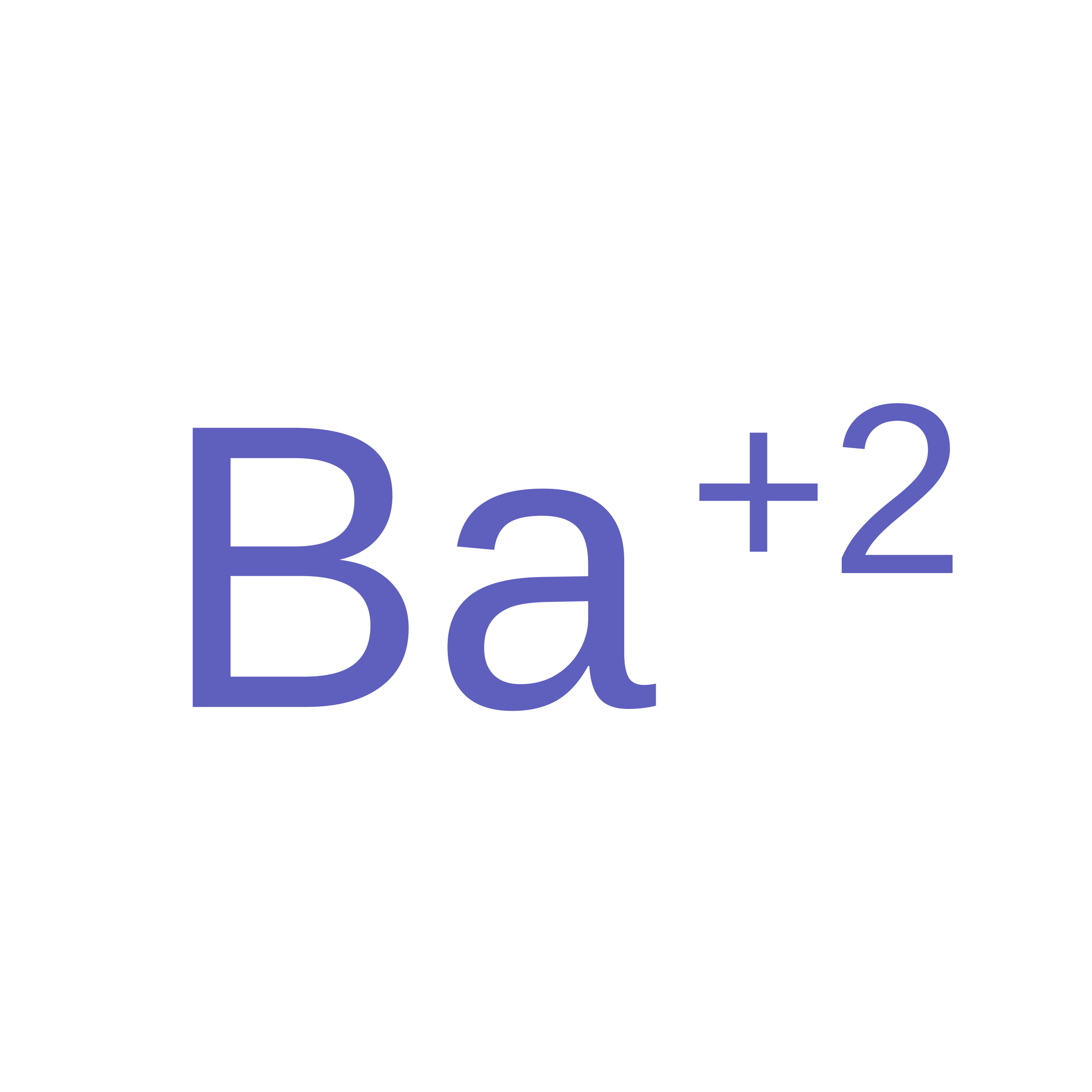
BARIUM ION
Ba
XDFCIPNJCBUZJN-UHFFFAOYSA-N
NA

Query on NA


Download:Ideal Coordinates CCD File
C [auth A]SODIUM ION
Na
FKNQFGJONOIPTF-UHFFFAOYSA-N

Experimental Data & Validation

Experimental Data

  • Method: X-RAY DIFFRACTION
  • Resolution: 1.10 Å
  • R-Value Work:  0.236 (DCC) 
  • R-Value Observed: 0.199 (Depositor) 
Space Group: P 21 21 21
Unit Cell:
Length ( Å )Angle ( ˚ )
a = 22.844α = 90
b = 27.676β = 90
c = 55.37γ = 90
Software Package:
Software NamePurpose
SHELXL-96refinement
DENZOdata reduction
SCALEPACKdata scaling

Structure Validation

View Full Validation Report


Entry History 

Deposition Data

Revision History  (Full details and data files)

  • Version 1.0: 1997-06-11
    Type: Initial release
  • Version 1.1: 2008-05-22
    Changes: Version format compliance
  • Version 1.2: 2011-07-13
    Changes: Version format compliance
  • Version 1.3: 2024-02-14
    Changes: Data collection, Database references, Derived calculations