1YUC | pdb_00001yuc

Human Nuclear Receptor Liver Receptor Homologue-1, LRH-1, Bound to Phospholipid and a Fragment of Human SHP


Experimental Data Snapshot

  • Method: X-RAY DIFFRACTION
  • Resolution: 1.90 Å
  • R-Value Free: 
    0.248 (Depositor), 0.248 (DCC) 
  • R-Value Work: 
    0.217 (Depositor), 0.217 (DCC) 
  • R-Value Observed: 
    0.217 (Depositor) 

wwPDB Validation 3D Report Full Report

Validation slider image for 1YUC

This is version 1.4 of the entry. See complete history. 

Literature

Modulation of human nuclear receptor LRH-1 activity by phospholipids and SHP

Ortlund, E.A., Lee, Y., Solomon, I.H., Hager, J.M., Safi, R., Choi, Y., Guan, Z., Tripathy, A., Raetz, C.R.H., McDonnell, D.P., Moore, D.D., Redinbo, M.R.

(2005) Nat Struct Mol Biol 12: 357-363

  • DOI: https://doi.org/10.1038/nsmb910
  • Primary Citation Related Structures: 
    1YUC

  • PubMed Abstract: 

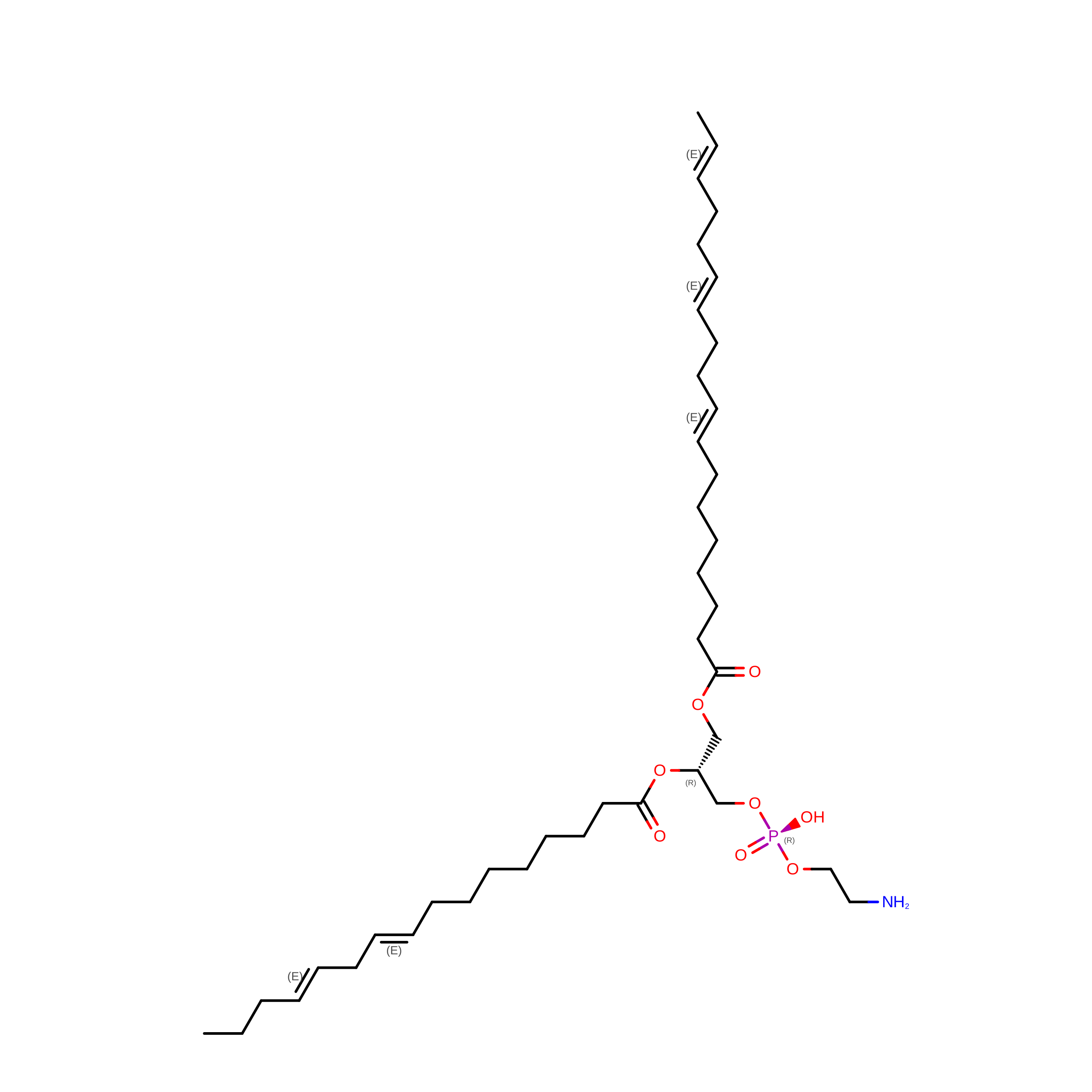
    The human nuclear receptor liver receptor homolog 1 (hLRH-1) plays an important role in the development of breast carcinomas. This orphan receptor is efficiently downregulated by the unusual co-repressor SHP and has been thought to be ligand-independent. We present the crystal structure at a resolution of 1.9 A of the ligand-binding domain of hLRH-1 in complex with the NR box 1 motif of human SHP, which we find contacts the AF-2 region of hLRH-1 using selective structural motifs. Electron density indicates phospholipid bound within the ligand-binding pocket, which we confirm using mass spectrometry of solvent-extracted samples. We further show that pocket mutations reduce phospholipid binding and receptor activity in vivo. Our results indicate that hLRH-1's control of gene expression is mediated by phospholipid binding, and establish hLRH-1 as a novel target for compounds designed to slow breast cancer development.


  • Organizational Affiliation: 
    • Department of Chemistry, Lineberger Comprehensive Cancer Center, School of Medicine, University of North Carolina at Chapel Hill, 27599, USA.

Macromolecule Content 

  • Total Structure Weight: 63.52 kDa 
  • Atom Count: 4,443 
  • Modeled Residue Count: 505 
  • Deposited Residue Count: 538 
  • Unique protein chains: 2

Macromolecules

Find similar proteins by:|  3D Structure
Entity ID: 1
MoleculeChains  Sequence LengthOrganismDetailsImage
Orphan nuclear receptor NR5A2
A, B
255Homo sapiensMutation(s): 0 
Gene Names: NR5A2
UniProt & NIH Common Fund Data Resources
Find proteins for O00482 (Homo sapiens)
Explore O00482 
Go to UniProtKB:  O00482
PHAROS:  O00482
GTEx:  ENSG00000116833 
Entity Groups
Sequence Clusters30% Identity50% Identity70% Identity90% Identity95% Identity100% Identity
UniProt GroupO00482
Sequence Annotations
Expand
Reference Sequence
Find similar proteins by:  Sequence   |   3D Structure  
Entity ID: 2
MoleculeChains  Sequence LengthOrganismDetailsImage
Nuclear receptor 0B2
C, D
14N/AMutation(s): 0 
UniProt & NIH Common Fund Data Resources
Find proteins for Q15466 (Homo sapiens)
Explore Q15466 
Go to UniProtKB:  Q15466
PHAROS:  Q15466
GTEx:  ENSG00000131910 
Entity Groups
Sequence Clusters30% Identity50% Identity70% Identity90% Identity95% Identity100% Identity
UniProt GroupQ15466
Sequence Annotations
Expand
Reference Sequence

Experimental Data & Validation

Experimental Data

  • Method: X-RAY DIFFRACTION
  • Resolution: 1.90 Å
  • R-Value Free:  0.248 (Depositor), 0.248 (DCC) 
  • R-Value Work:  0.217 (Depositor), 0.217 (DCC) 
  • R-Value Observed: 0.217 (Depositor) 
Space Group: P 1 21 1
Unit Cell:
Length ( Å )Angle ( ˚ )
a = 63.67α = 90
b = 59.64β = 100.69
c = 73.24γ = 90
Software Package:
Software NamePurpose
Blu-Icedata collection
HKL-2000data reduction
MOLREPphasing
CNSrefinement
HKL-2000data scaling

Structure Validation

View Full Validation Report


Entry History 

Revision History  (Full details and data files)

  • Version 1.0: 2005-03-01
    Type: Initial release
  • Version 1.1: 2008-04-30
    Changes: Version format compliance
  • Version 1.2: 2011-07-13
    Changes: Non-polymer description, Version format compliance
  • Version 1.3: 2018-01-31
    Changes: Advisory, Experimental preparation
  • Version 1.4: 2024-02-14
    Changes: Advisory, Data collection, Database references, Derived calculations