1WMG | pdb_00001wmg

Crystal structure of the UNC5H2 death domain


Experimental Data Snapshot

  • Method: X-RAY DIFFRACTION
  • Resolution: 2.10 Å
  • R-Value Free: 
    0.269 (Depositor), 0.263 (DCC) 
  • R-Value Work: 
    0.229 (Depositor), 0.223 (DCC) 
  • R-Value Observed: 
    0.229 (Depositor) 

wwPDB Validation 3D Report Full Report

Validation slider image for 1WMG

This is version 1.4 of the entry. See complete history

Literature

Structure of the UNC5H2 death domain

Handa, N.Kukimoto-Niino, M.Akasaka, R.Murayama, K.Terada, T.Inoue, M.Yabuki, T.Aoki, M.Seki, E.Matsuda, T.Nunokawa, E.Tanaka, A.Hayashizaki, Y.Kigawa, T.Shirouzu, M.Yokoyama, S.

(2006) Acta Crystallogr D Biol Crystallogr 62: 1502-1509

  • DOI: https://doi.org/10.1107/S0907444906039369
  • Primary Citation Related Structures: 
    1WMG

  • PubMed Abstract: 

    UNC5Hs (UNC5H1-4) are netrin 1 receptors that are involved in axonal guidance and neuronal migration. They are dependence receptors that mediate apoptosis in the absence of netrin 1. UNC5H2-induced apoptosis depends on the interaction of the death domain at the C-terminus with the DAP-kinase death domain and caspase cleavage near the transmembrane region. Here, the crystal structure of the mouse UNC5H2 death domain has been determined at 2.1 A resolution. The domain adopts a six-helix bundle fold, which is similar to those of the other members of the death-domain superfamily. The UNC5H2 death domain is a dimer in the crystal and in solution. This homodimerized structure may represent the structure of the death domain when netrin 1 binds to the UNC5H2 receptor. Homodimerization of UNC5H2 may block the access of caspase to the cleavage site. In the death-domain dimer, residues in alpha3 and the 3(10)-helix preceding alpha3 and the residues in alpha4 make significant contacts, mainly by hydrophobic and van der Waals interactions.


  • Organizational Affiliation
    • RIKEN Genomic Sciences Center, Tsurumi, Yokohama 230-0045, Japan.

Macromolecule Content 

  • Total Structure Weight: 68.07 kDa 
  • Atom Count: 4,298 
  • Modeled Residue Count: 522 
  • Deposited Residue Count: 618 
  • Unique protein chains: 1

Macromolecules

Find similar proteins by:|  3D Structure
Entity ID: 1
MoleculeChains  Sequence LengthOrganismDetailsImage
netrin receptor Unc5h2
A, B, C, D, E
A, B, C, D, E, F
103Mus musculusMutation(s): 4 
UniProt
Find proteins for Q8K1S3 (Mus musculus)
Explore Q8K1S3 
Go to UniProtKB:  Q8K1S3
Entity Groups
Sequence Clusters30% Identity50% Identity70% Identity90% Identity95% Identity100% Identity
UniProt GroupQ8K1S3
Sequence Annotations
Expand
Reference Sequence

Small Molecules

Ligands 2 Unique
IDChains Name / Formula / InChI Key2D Diagram3D Interactions
SO4

Query on SO4


Download:Ideal Coordinates CCD File
J [auth C],
O [auth E],
P [auth F]
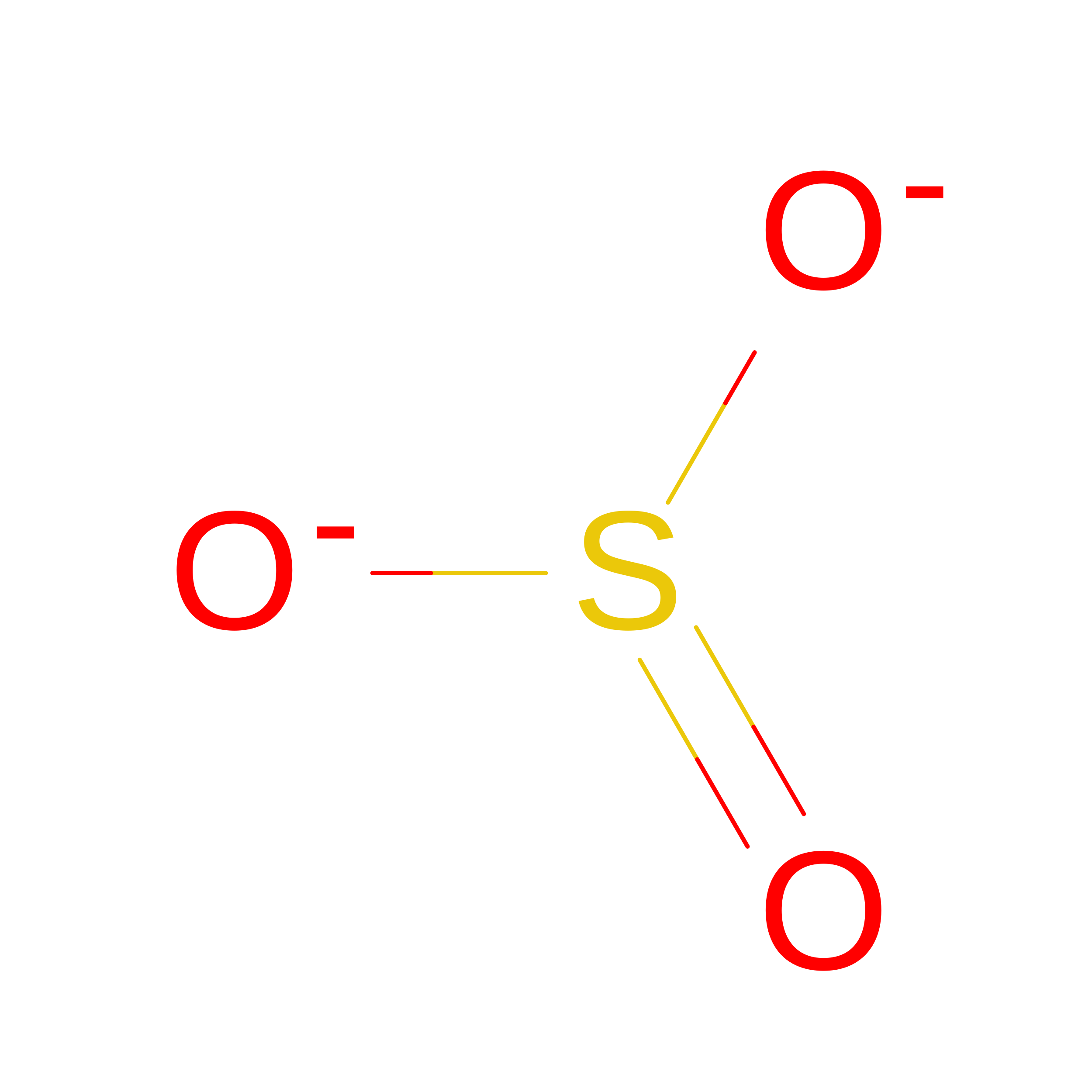
SULFATE ION
O4 S
QAOWNCQODCNURD-UHFFFAOYSA-L
SO3

Query on SO3


Download:Ideal Coordinates CCD File
G [auth A]
H [auth C]
I [auth C]
K [auth D]
L [auth D]
G [auth A],
H [auth C],
I [auth C],
K [auth D],
L [auth D],
M [auth E],
N [auth E]
SULFITE ION
O3 S
LSNNMFCWUKXFEE-UHFFFAOYSA-L
Modified Residues  1 Unique
IDChains TypeFormula2D DiagramParent
MSE
Query on MSE
A, B, C, D, E
A, B, C, D, E, F
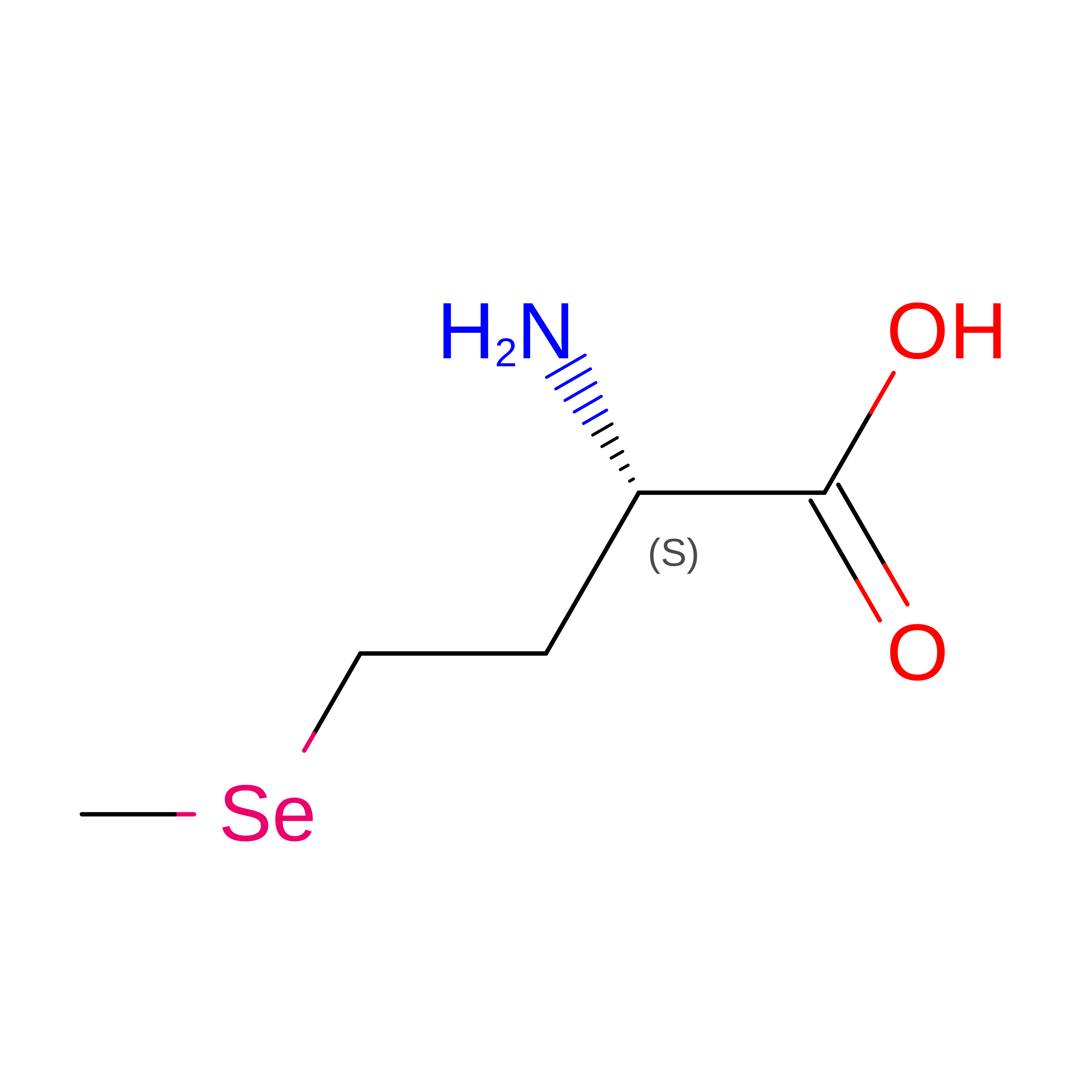
L-PEPTIDE LINKINGC5 H11 N O2 SeMET

Experimental Data & Validation

Experimental Data

  • Method: X-RAY DIFFRACTION
  • Resolution: 2.10 Å
  • R-Value Free:  0.269 (Depositor), 0.263 (DCC) 
  • R-Value Work:  0.229 (Depositor), 0.223 (DCC) 
  • R-Value Observed: 0.229 (Depositor) 
Space Group: C 1 2 1
Unit Cell:
Length ( Å )Angle ( ˚ )
a = 124.878α = 90
b = 47.207β = 119.56
c = 121.177γ = 90
Software Package:
Software NamePurpose
CNSrefinement
HKL-2000data reduction
SCALEPACKdata scaling
SOLVEphasing

Structure Validation

View Full Validation Report


Entry History 

Deposition Data

Revision History  (Full details and data files)

  • Version 1.0: 2005-01-09
    Type: Initial release
  • Version 1.1: 2008-04-30
    Changes: Version format compliance
  • Version 1.2: 2011-07-13
    Changes: Version format compliance
  • Version 1.3: 2011-11-16
    Changes: Atomic model
  • Version 1.4: 2024-11-20
    Changes: Data collection, Database references, Derived calculations, Structure summary