Download Mendeley
The Structure of (3R)-hydroxyacyl-acyl carrier protein dehydratase (FabZ) from Pseudomonas aeruginosa
Kimber, M.S., Martin, F., Lu, Y., Houston, S., Vedadi, M., Dharamsi, A., Fiebig, K.M., Schmid, M., Rock, C.O.(2004) J Biol Chem 279: 52593-52602
- PubMed: 15371447 Search on PubMed
- DOI: https://doi.org/10.1074/jbc.M408105200
- Primary Citation Related Structures:
1U1Z - PubMed Abstract:
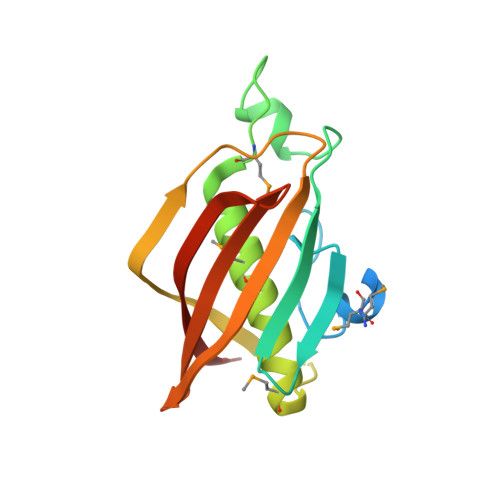
Type II fatty acid biosynthesis systems are essential for membrane formation in bacteria, making the constituent proteins of this pathway attractive targets for antibacterial drug discovery. The third step in the elongation cycle of the type II fatty acid biosynthesis is catalyzed by beta-hydroxyacyl-(acyl carrier protein) (ACP) dehydratase. There are two isoforms. FabZ, which catalyzes the dehydration of (3R)-hydroxyacyl-ACP to trans-2-acyl-ACP, is a universally expressed component of the bacterial type II system. FabA, the second isoform, as has more limited distribution in nature and, in addition to dehydration, also carries out the isomerization of trans-2- to cis-3-decenoyl-ACP as an essential step in unsaturated fatty acid biosynthesis. We report the structure of FabZ from the important human pathogen Pseudomonas aeruginosa at 2.5 A of resolution. PaFabZ is a hexamer (trimer of dimers) with the His/Glu catalytic dyad located within a deep, narrow tunnel formed at the dimer interface. Site-directed mutagenesis experiments showed that the obvious differences in the active site residues that distinguish the FabA and FabZ subfamilies of dehydratases do not account for the unique ability of FabA to catalyze isomerization. Because the catalytic machinery of the two enzymes is practically indistinguishable, the structural differences observed in the shape of the substrate binding channels of FabA and FabZ lead us to hypothesize that the different shapes of the tunnels control the conformation and positioning of the bound substrate, allowing FabA, but not FabZ, to catalyze the isomerization reaction.
- Affinium Pharmaceuticals, Toronto, Ontario M5J 1V6, Canada.
Organizational Affiliation: