1TV3 | pdb_00001tv3

Crystal structure of the N-methyl-hydroxylamine MtmB complex


Experimental Data Snapshot

  • Method: X-RAY DIFFRACTION
  • Resolution: 2.20 Å
  • R-Value Free: 
    0.168 (Depositor), 0.172 (DCC) 
  • R-Value Work: 
    0.146 (Depositor), 0.152 (DCC) 
  • R-Value Observed: 
    0.146 (Depositor) 

Starting Model: experimental
View more details

wwPDB Validation 3D Report Full Report

Validation slider image for 1TV3

Ligand Structure Quality Assessment 


This is version 1.4 of the entry. See complete history

Literature

Reactivity and chemical synthesis of L-pyrrolysine- the 22(nd) genetically encoded amino acid

Hao, B.Zhao, G.Kang, P.T.Soares, J.A.Ferguson, T.K.Gallucci, J.Krzycki, J.A.Chan, M.K.

(2004) Chem Biol 11: 1317-1324

  • DOI: https://doi.org/10.1016/j.chembiol.2004.07.011
  • Primary Citation Related Structures: 
    1TV2, 1TV3, 1TV4

  • PubMed Abstract: 

    L-pyrrolysine, the 22(nd) genetically encoded amino acid, was previously deduced to be (4R, 5R)-4-substituted-pyrroline-5-carboxylate attached to the epsilon-nitrogen of lysine based on the crystal structure of the M. barkeri monomethylamine methyltransferase (MtmB). To confirm L-pyrrolysine's identity, structures of MtmB have been determined following treatment with hydroxylamine, N-methylhydroxylamine, or dithionite. Analysis of these structures has provided additional support for the presence of the pyrroline ring and, together with previous mass spectroscopy data, has led us to assign the C(4)-substituent to a methyl group. Based on this assignment, synthetic L-pyrrolysine was prepared by chemical methods. Detailed study of this chemically synthesized L-pyrrolysine has allowed us to characterize its physical properties, to study its chemical stability, and to elucidate the role of its C(4) substituent. Future applications of this synthetic L-pyrrolysine include its in vivo incorporation into recombinant proteins.


  • Organizational Affiliation
    • Department of Biochemistry, The Ohio State University, Columbus, OH 43210, USA.

Macromolecule Content 

  • Total Structure Weight: 50.36 kDa 
  • Atom Count: 4,004 
  • Modeled Residue Count: 457 
  • Deposited Residue Count: 458 
  • Unique protein chains: 1

Macromolecules

Find similar proteins by:|  3D Structure
Entity ID: 1
MoleculeChains  Sequence LengthOrganismDetailsImage
Monomethylamine methyltransferase mtmB1458Methanosarcina barkeriMutation(s): 0 
EC: 2.1.1 (PDB Primary Data), 2.1.1.248 (UniProt)
UniProt
Find proteins for O30642 (Methanosarcina barkeri)
Explore O30642 
Go to UniProtKB:  O30642
Entity Groups
Sequence Clusters30% Identity50% Identity70% Identity90% Identity95% Identity100% Identity
UniProt GroupO30642
Sequence Annotations
Expand
Reference Sequence

Small Molecules

Ligands 1 Unique
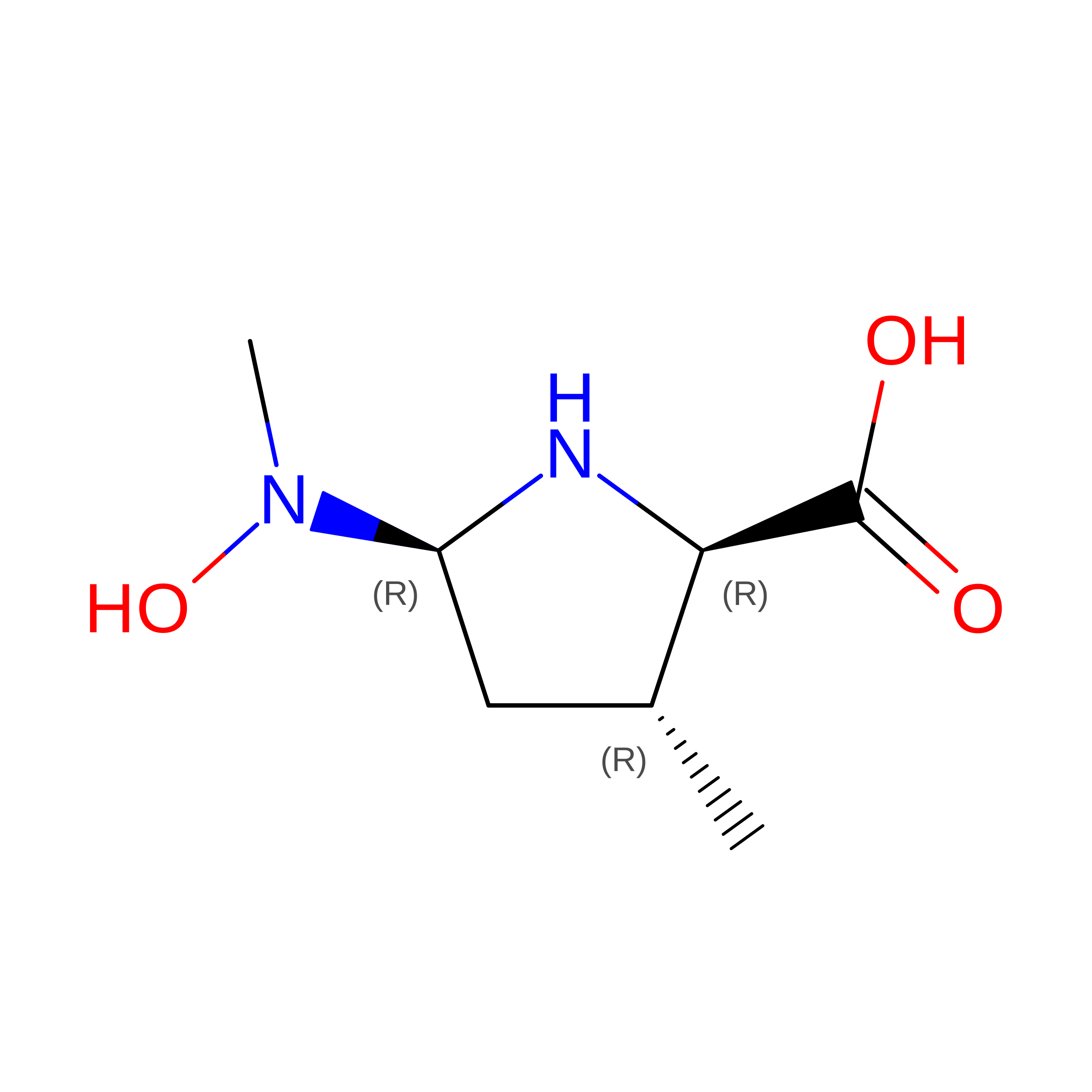
IDChains Name / Formula / InChI Key2D Diagram3D Interactions
BG4

Query on BG4


Download:Ideal Coordinates CCD File
B [auth A]5-(HYDROXY-METHYL-AMINO)-3-METHYL-PYRROLIDINE-2-CARBOXYLIC ACID
C7 H14 N2 O3
PGYJBAGGGAUHGV-HSUXUTPPSA-N

Experimental Data & Validation

Experimental Data

  • Method: X-RAY DIFFRACTION
  • Resolution: 2.20 Å
  • R-Value Free:  0.168 (Depositor), 0.172 (DCC) 
  • R-Value Work:  0.146 (Depositor), 0.152 (DCC) 
  • R-Value Observed: 0.146 (Depositor) 
Space Group: P 63 2 2
Unit Cell:
Length ( Å )Angle ( ˚ )
a = 157.987α = 90
b = 157.987β = 90
c = 136.914γ = 120
Software Package:
Software NamePurpose
CNSrefinement
DENZOdata reduction
SCALEPACKdata scaling
CNSphasing

Structure Validation

View Full Validation Report


Ligand Structure Quality Assessment 


Entry History 

Deposition Data

Revision History  (Full details and data files)

  • Version 1.0: 2004-10-19
    Type: Initial release
  • Version 1.1: 2007-10-16
    Changes: Version format compliance
  • Version 1.2: 2011-07-13
    Changes: Derived calculations, Version format compliance
  • Version 1.3: 2023-08-23
    Changes: Data collection, Database references, Derived calculations, Refinement description
  • Version 1.4: 2024-10-30
    Changes: Structure summary