1TU8 | pdb_00001tu8

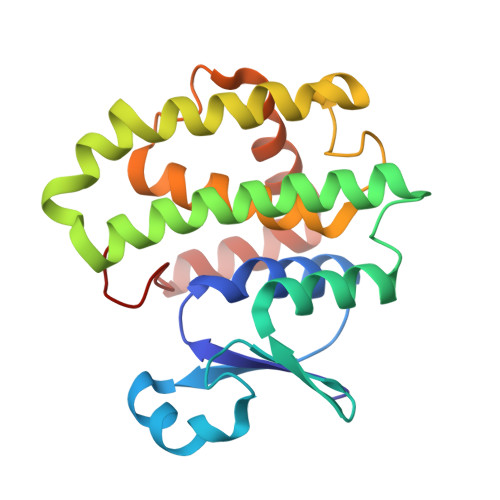
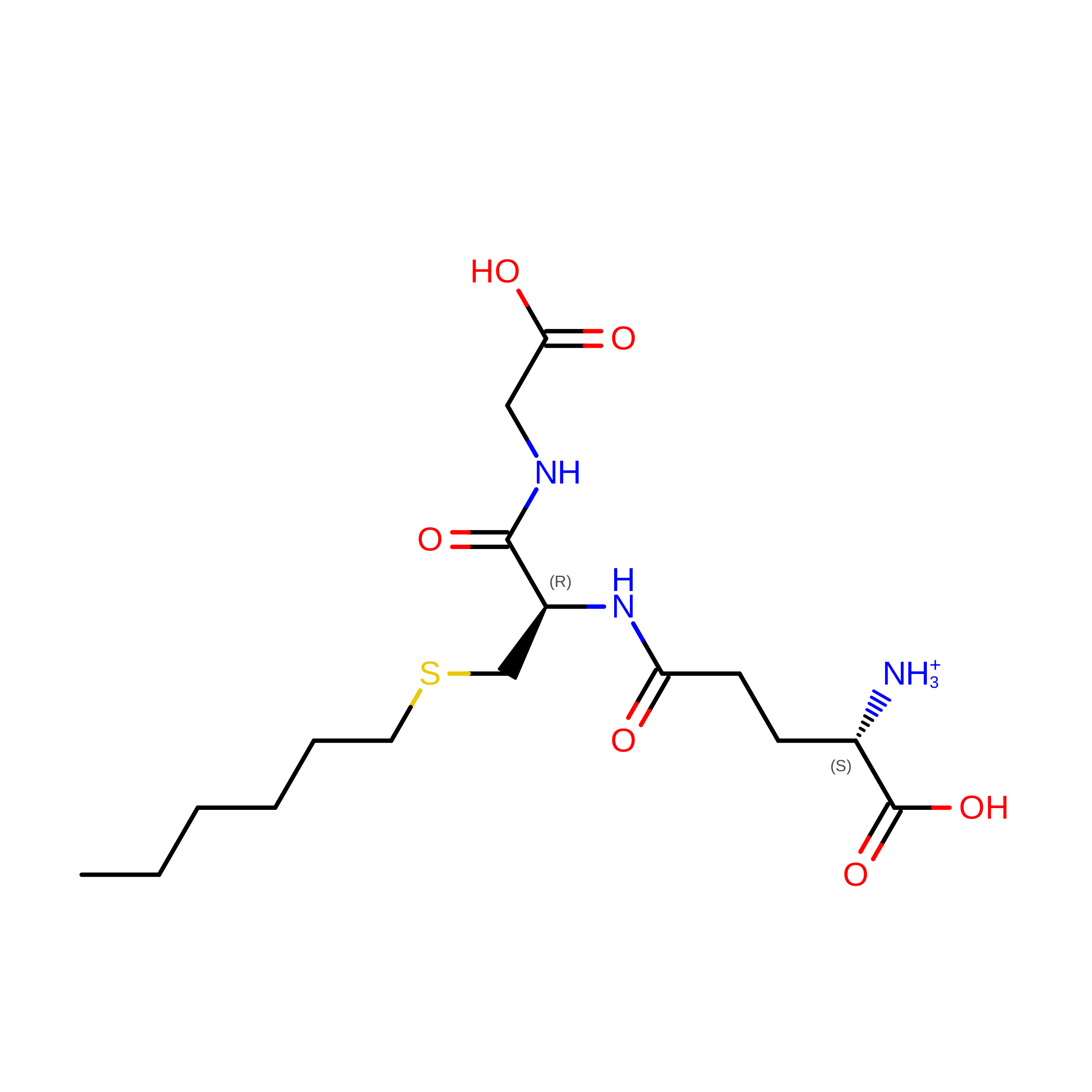
STructure of Onchoverca volvulus Pi-class Glutathione S-transferase with its kompetitive inhibitor s-hexyl-GSH


Experimental Data Snapshot

  • Method: X-RAY DIFFRACTION
  • Resolution: 1.80 Å
  • R-Value Free: 
    0.217 (Depositor), 0.249 (DCC) 
  • R-Value Work: 
    0.180 (Depositor) 
  • R-Value Observed: 
    0.182 (Depositor) 

wwPDB Validation 3D Report Full Report

Validation slider image for 1TU8

Ligand Structure Quality Assessment 


This is version 1.4 of the entry. See complete history

Literature

Structure of the Major Cytosolic Glutathione S-Transferase from the Parasitic Nematode Onchocerca volvulus

Perbandt, M.Hoppner, J.Betzel, C.Walter, R.D.Liebau, E.

(2005) J Biological Chem 280: 12630-12636

  • DOI: https://doi.org/10.1074/jbc.M413551200
  • Primary Citation Related Structures: 
    1TU7, 1TU8

  • PubMed Abstract: 

    Onchocerciasis is a debilitating parasitic disease caused by the filarial worm Onchocerca volvulus. Similar to other helminth parasites, O. volvulus is capable of evading the host's immune responses by a variety of defense mechanisms, including the detoxification activities of the glutathione S-transferases (GSTs). Additionally, in response to drug treatment, helminth GSTs are highly up-regulated, making them tempting targets both for chemotherapy and for vaccine development. We analyzed the three-dimensional x-ray structure of the major cytosolic GST from O. volvulus (Ov-GST2) in complex with its natural substrate glutathione and its competitive inhibitor S-hexylglutathione at 1.5 and 1.8 angstrom resolution, respectively. From the perspective of the biochemical classification, the Ov-GST2 seems to be related to pi-class GSTs. However, in comparison to other pi-class GSTs, in particular to the host's counterpart, the Ov-GST2 reveals significant and unusual differences in the sequence and overall structure. Major differences can be found in helix alpha-2, an important region for substrate recognition. Moreover, the binding site for the electrophilic co-substrate is spatially increased and more solvent-accessible. These structural alterations are responsible for different substrate specificities and will form the basis of parasite-specific structure-based drug design investigations.


  • Organizational Affiliation
    • Institute of Biochemistry and Foodchemistry, Department of Biochemistry and Molecularbiology, University of Hamburg, Martin Luther King Platz 6, 20146 Hamburg, Germany. Perbandt@chemie.uni-hamburg.de

Macromolecule Content 

  • Total Structure Weight: 98.75 kDa 
  • Atom Count: 7,682 
  • Modeled Residue Count: 832 
  • Deposited Residue Count: 832 
  • Unique protein chains: 1

Macromolecules

Find similar proteins by:|  3D Structure
Entity ID: 1
MoleculeChains  Sequence LengthOrganismDetailsImage
Glutathione S-transferase 2
A, B, C, D
208Onchocerca volvulusMutation(s): 0 
Gene Names: GST2
EC: 2.5.1.18
UniProt
Find proteins for P46427 (Onchocerca volvulus)
Explore P46427 
Go to UniProtKB:  P46427
Entity Groups
Sequence Clusters30% Identity50% Identity70% Identity90% Identity95% Identity100% Identity
UniProt GroupP46427
Sequence Annotations
Expand
Reference Sequence

Experimental Data & Validation

Experimental Data

  • Method: X-RAY DIFFRACTION
  • Resolution: 1.80 Å
  • R-Value Free:  0.217 (Depositor), 0.249 (DCC) 
  • R-Value Work:  0.180 (Depositor) 
  • R-Value Observed: 0.182 (Depositor) 
Space Group: P 1 21 1
Unit Cell:
Length ( Å )Angle ( ˚ )
a = 51.968α = 90
b = 81.999β = 91.23
c = 107.11γ = 90
Software Package:
Software NamePurpose
REFMACrefinement

Structure Validation

View Full Validation Report


Ligand Structure Quality Assessment 


Entry History 

Deposition Data

  • Released Date: 2005-01-11 
  • Deposition Author(s): Perbandt, M.

Revision History  (Full details and data files)

  • Version 1.0: 2005-01-11
    Type: Initial release
  • Version 1.1: 2008-04-30
    Changes: Version format compliance
  • Version 1.2: 2011-07-13
    Changes: Version format compliance
  • Version 1.3: 2018-10-03
    Changes: Advisory, Data collection
  • Version 1.4: 2024-03-13
    Changes: Advisory, Data collection, Database references, Derived calculations