1S53 | pdb_00001s53

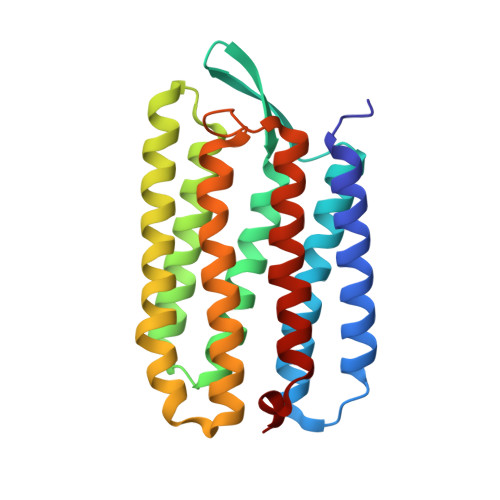
Thr46Ser Bacteriorhodopsin


Experimental Data Snapshot

  • Method: X-RAY DIFFRACTION
  • Resolution: 2.00 Å
  • R-Value Free: 
    0.266 (Depositor) 
  • R-Value Work: 
    0.214 (Depositor) 
  • R-Value Observed: 
    0.214 (Depositor) 

Starting Model: experimental
View more details

wwPDB Validation 3D Report Full Report

Validation slider image for 1S53

This is version 1.5 of the entry. See complete history

Literature

A C(alpha)-H.O Hydrogen Bond in a Membrane Protein Is Not Stabilizing

Yohannan, S.Faham, S.Yang, D.Grosfeld, D.Chamberlain, A.K.Bowie, J.U.

(2004) J Am Chem Soc 126: 2284-2285

  • DOI: https://doi.org/10.1021/ja0317574
  • Primary Citation Related Structures: 
    1S51, 1S52, 1S53, 1S54

  • PubMed Abstract: 

    Hydrogen bonds involving a carbon donor are very common in protein structures, and energy calculations suggest that Calpha-H...O hydrogen bonds could be about one-half the strength of traditional hydrogen bonds. It has therefore been proposed that these nontraditional hydrogen bonds could be a significant factor in stabilizing proteins, particularly membrane proteins as there is a low dielectric and no competition from water in the bilayer core. Nevertheless, this proposition has never been tested experimentally. Here, we report an experimental test of the significance of Calpha-H...O bonds for protein stability. Thr24 in bacteriorhodopsin, which makes an interhelical Calpha-H...O hydrogen bond to the Calpha of Ala51, was changed to Ala, Val, and Ser, and the thermodynamic stability of the mutants was measured. None of the mutants had significantly reduced stability. In fact, T24A was more stable than the wild-type protein by 0.6 kcal/mol. Crystal structures were determined for each of the mutants, and, while some structural changes were seen for T24S and T24V, T24A showed essentially no apparent structural alteration that could account for the increased stability. Thus, Thr24 appears to destabilize the protein rather than stabilize. Our results suggest that Calpha-H...O bonds are not a major contributor to protein stability.


  • Organizational Affiliation
    • Department of Chemistry and Biochemistry, UCLA-DOE Center for Genomics and Proteomics, Molecular Biology Institute, 655 Boyer Hall, University of California, Los Angeles, Los Angeles, California 90095-1570, USA.

Macromolecule Content 

  • Total Structure Weight: 50.26 kDa 
  • Atom Count: 3,667 
  • Modeled Residue Count: 454 
  • Deposited Residue Count: 454 
  • Unique protein chains: 1

Macromolecules

Find similar proteins by:|  3D Structure
Entity ID: 1
MoleculeChains  Sequence LengthOrganismDetailsImage
bacteriorhodopsin
A, B
227Halobacterium salinarumMutation(s): 1 
Membrane Entity: Yes 
UniProt
Find proteins for P02945 (Halobacterium salinarum (strain ATCC 700922 / JCM 11081 / NRC-1))
Explore P02945 
Go to UniProtKB:  P02945
Entity Groups
Sequence Clusters30% Identity50% Identity70% Identity90% Identity95% Identity100% Identity
UniProt GroupP02945
Sequence Annotations
Expand
Reference Sequence

Small Molecules

Experimental Data & Validation

Experimental Data

  • Method: X-RAY DIFFRACTION
  • Resolution: 2.00 Å
  • R-Value Free:  0.266 (Depositor) 
  • R-Value Work:  0.214 (Depositor) 
  • R-Value Observed: 0.214 (Depositor) 
Space Group: P 1 21 1
Unit Cell:
Length ( Å )Angle ( ˚ )
a = 44.667α = 90
b = 108.537β = 113.48
c = 55.943γ = 90
Software Package:
Software NamePurpose
DENZOdata reduction
SCALEPACKdata scaling
CNSrefinement
CNSphasing

Structure Validation

View Full Validation Report


Entry History 

Deposition Data

Revision History  (Full details and data files)

  • Version 1.0: 2004-03-02
    Type: Initial release
  • Version 1.1: 2008-04-29
    Changes: Version format compliance
  • Version 1.2: 2011-07-13
    Changes: Version format compliance
  • Version 1.3: 2021-10-27
    Changes: Database references, Derived calculations
  • Version 1.4: 2023-08-23
    Changes: Data collection, Refinement description
  • Version 1.5: 2024-11-06
    Changes: Structure summary