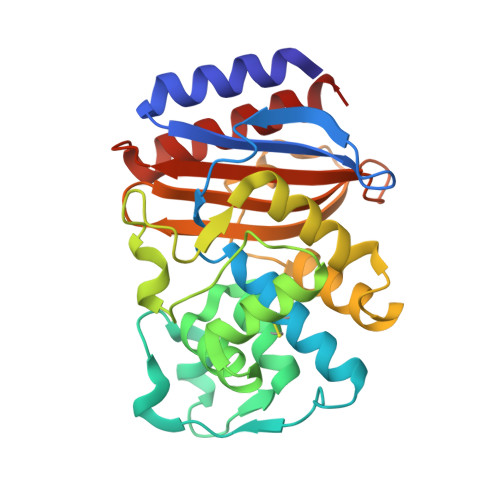
1S0W | pdb_00001s0w

1b Lactamse/ b Lactamase Inhibitor


Experimental Data Snapshot

  • Method: X-RAY DIFFRACTION
  • Resolution: 2.30 Å
  • R-Value Free: 
    0.261 (DCC) 
  • R-Value Work: 
    0.212 (Depositor), 0.214 (DCC) 
  • R-Value Observed: 
    0.261 (Depositor) 

Starting Model: experimental
View more details

wwPDB Validation 3D Report Full Report

Validation slider image for 1S0W

This is version 1.5 of the entry. See complete history

Literature

The modular architecture of protein-protein binding interfaces.

Reichmann, D.Rahat, O.Albeck, S.Meged, R.Dym, O.Schreiber, G.

(2005) Proc Natl Acad Sci U S A 102: 57-62

  • DOI: https://doi.org/10.1073/pnas.0407280102
  • Primary Citation Related Structures: 
    1S0W, 1XXM

  • PubMed Abstract: 

    Protein-protein interactions are essential for life. Yet, our understanding of the general principles governing binding is not complete. In the present study, we show that the interface between proteins is built in a modular fashion; each module is comprised of a number of closely interacting residues, with few interactions between the modules. The boundaries between modules are defined by clustering the contact map of the interface. We show that mutations in one module do not affect residues located in a neighboring module. As a result, the structural and energetic consequences of the deletion of entire modules are surprisingly small. To the contrary, within their module, mutations cause complex energetic and structural consequences. Experimentally, this phenomenon is shown on the interaction between TEM1-beta-lactamase and beta-lactamase inhibitor protein (BLIP) by using multiple-mutant analysis and x-ray crystallography. Replacing an entire module of five interface residues with Ala created a large cavity in the interface, with no effect on the detailed structure of the remaining interface. The modular architecture of binding sites, which resembles human engineering design, greatly simplifies the design of new protein interactions and provides a feasible view of how these interactions evolved.


  • Organizational Affiliation
    • Departments of Biological Chemistry and Structural Biology, Weizmann Institute of Science, Rehovot 76100, Israel.

Macromolecule Content 

  • Total Structure Weight: 92.92 kDa 
  • Atom Count: 6,905 
  • Modeled Residue Count: 856 
  • Deposited Residue Count: 856 
  • Unique protein chains: 2

Macromolecules

Find similar proteins by:|  3D Structure
Entity ID: 1
MoleculeChains  Sequence LengthOrganismDetailsImage
beta-lactamase TEMA,
C [auth B]
263Escherichia coliMutation(s): 0 
EC: 3.5.2.6
UniProt
Find proteins for P62593 (Escherichia coli)
Explore P62593 
Go to UniProtKB:  P62593
Entity Groups
Sequence Clusters30% Identity50% Identity70% Identity90% Identity95% Identity100% Identity
UniProt GroupP62593
Sequence Annotations
Expand
Reference Sequence
Find similar proteins by:|  3D Structure
Entity ID: 2
MoleculeChains  Sequence LengthOrganismDetailsImage
Beta-lactamase inhibitory proteinB [auth C],
D
165Streptomyces clavuligerusMutation(s): 1 
UniProt
Find proteins for P35804 (Streptomyces clavuligerus)
Explore P35804 
Go to UniProtKB:  P35804
Entity Groups
Sequence Clusters30% Identity50% Identity70% Identity90% Identity95% Identity100% Identity
UniProt GroupP35804
Sequence Annotations
Expand
Reference Sequence

Experimental Data & Validation

Experimental Data

  • Method: X-RAY DIFFRACTION
  • Resolution: 2.30 Å
  • R-Value Free:  0.261 (DCC) 
  • R-Value Work:  0.212 (Depositor), 0.214 (DCC) 
  • R-Value Observed: 0.261 (Depositor) 
Space Group: P 21 21 21
Unit Cell:
Length ( Å )Angle ( ˚ )
a = 45.785α = 90
b = 125.507β = 90
c = 158.763γ = 90
Software Package:
Software NamePurpose
DENZOdata reduction
SCALEPACKdata scaling
MOLREPphasing
CNSrefinement

Structure Validation

View Full Validation Report


Entry History 

Deposition Data

Revision History  (Full details and data files)

  • Version 1.0: 2004-02-10
    Type: Initial release
  • Version 1.1: 2008-04-29
    Changes: Version format compliance
  • Version 1.2: 2011-07-13
    Changes: Version format compliance
  • Version 1.3: 2021-10-27
    Changes: Database references, Derived calculations
  • Version 1.4: 2023-08-23
    Changes: Data collection, Refinement description
  • Version 1.5: 2024-11-20
    Changes: Structure summary