1Q6P | pdb_00001q6p

THE STRUCTURE OF PHOSPHOTYROSINE PHOSPHATASE 1B IN COMPLEX WITH COMPOUND 6


Experimental Data Snapshot

  • Method: X-RAY DIFFRACTION
  • Resolution: 2.30 Å
  • R-Value Free: 
    0.238 (Depositor), 0.203 (DCC) 
  • R-Value Work: 
    0.210 (Depositor) 

Starting Model: experimental
View more details

wwPDB Validation 3D Report Full Report

Validation slider image for 1Q6P

Ligand Structure Quality Assessment 


This is version 1.4 of the entry. See complete history

Literature

The Structural Basis for the Selectivity of Benzotriazole Inhibitors of Ptp1B

Scapin, G.Patel, S.B.Becker, J.W.Wang, Q.Desponts, C.Waddleton, D.Skorey, K.Cromlish, W.Bayly, C.Therien, M.Gauthier, J.Y.Li, C.S.Lau, C.K.Ramachandran, C.Kennedy, B.P.Asante-Appiah, E.

(2003) Biochemistry 42: 11451-11459

  • DOI: https://doi.org/10.1021/bi035098j
  • Primary Citation Related Structures: 
    1Q6J, 1Q6M, 1Q6N, 1Q6P, 1Q6S, 1Q6T

  • PubMed Abstract: 

    Protein tyrosine phosphatase 1B (PTP1B) has been implicated in the regulation of the insulin signaling pathway and represents an attractive target for the design of inhibitors in the treatment of type 2 diabetes and obesity. Inspection of the structure of PTP1B indicates that potent PTP1B inhibitors may be obtained by targeting a secondary aryl phosphate-binding site as well as the catalytic site. We report here the crystal structures of PTP1B in complex with first and second generation aryldifluoromethyl-phosphonic acid inhibitors. While all compounds bind in a previously unexploited binding pocket near the primary binding site, the second generation compounds also reach into the secondary binding site, and exhibit moderate selectivity for PTP1B over the closely related T-cell phosphatase. The molecular basis for the selectivity has been confirmed by single point mutation at position 52, where the two phosphatases differ by a phenylalanine-to-tyrosine switch. These compounds present a novel platform for the development of potent and selective PTP1B inhibitors.


  • Organizational Affiliation
    • Merck Research Laboratory, P. O. Box 2000, Rahway, New Jersey 07065, USA. giovanna_scapin@merck.com

Macromolecule Content 

  • Total Structure Weight: 73.86 kDa 
  • Atom Count: 4,974 
  • Modeled Residue Count: 574 
  • Deposited Residue Count: 620 
  • Unique protein chains: 1

Macromolecules

Find similar proteins by:|  3D Structure
Entity ID: 1
MoleculeChains  Sequence LengthOrganismDetailsImage
Protein-tyrosine phosphatase, non-receptor type 1
A, B
310Homo sapiensMutation(s): 0 
Gene Names: PTPN1 OR PTP1B
EC: 3.1.3.48
UniProt & NIH Common Fund Data Resources
Find proteins for P18031 (Homo sapiens)
Explore P18031 
Go to UniProtKB:  P18031
PHAROS:  P18031
GTEx:  ENSG00000196396 
Entity Groups
Sequence Clusters30% Identity50% Identity70% Identity90% Identity95% Identity100% Identity
UniProt GroupP18031
Sequence Annotations
Expand
Reference Sequence

Small Molecules

Ligands 2 Unique
IDChains Name / Formula / InChI Key2D Diagram3D Interactions
213

Query on 213


Download:Ideal Coordinates CCD File
D [auth A],
E [auth B]
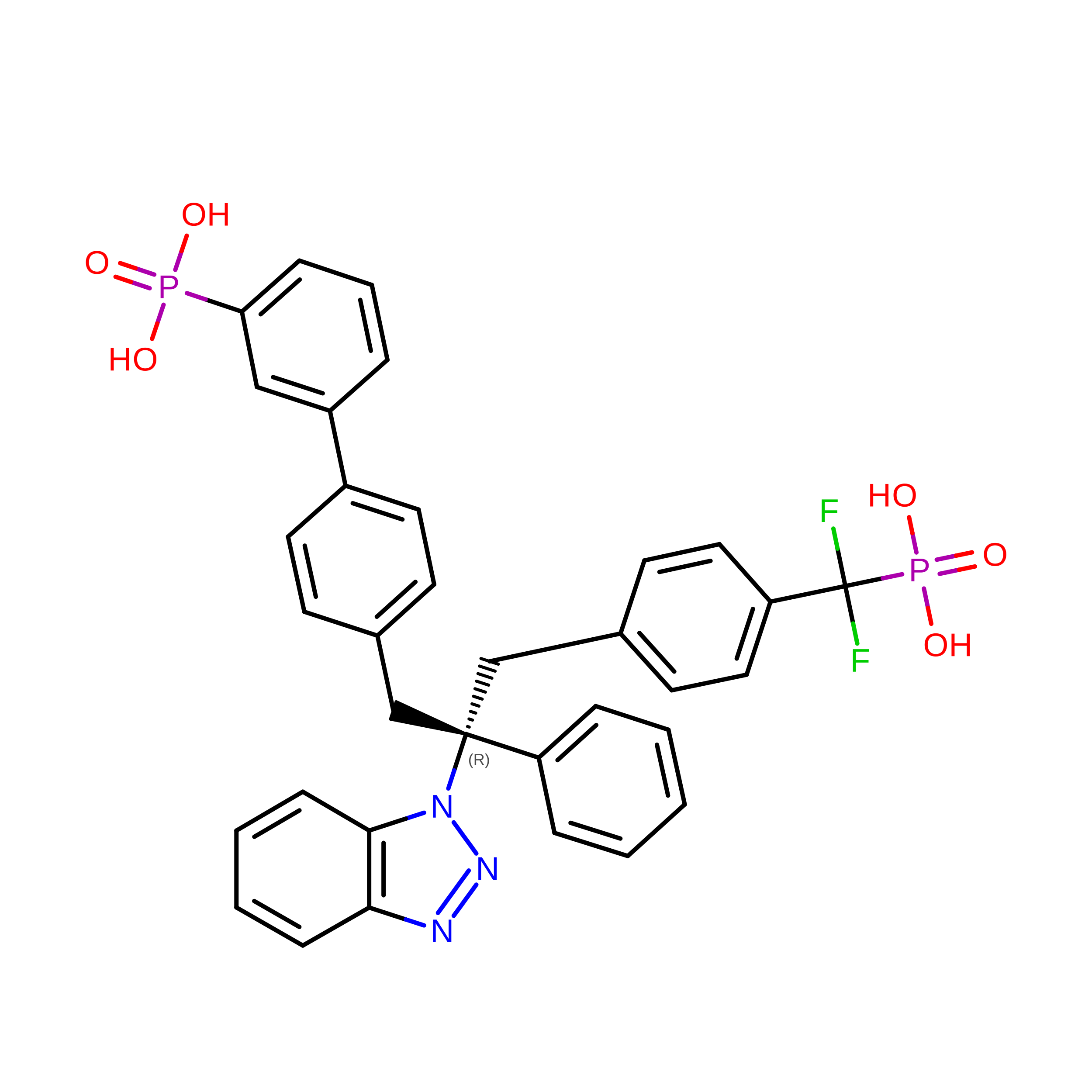
4'-((2S)-2-(1H-1,2,3-BENZOTRIAZOL-1-YL)-3-{4-[DIFLUORO(PHOSPHONO)METHYL]PHENYL}-2-PHENYLPROPYL)-1,1'-BIPHENYL-3-YLPHOSPHONIC ACID
C34 H29 F2 N3 O6 P2
DIRCLNUEXQQLRT-MGBGTMOVSA-N
CL

Query on CL


Download:Ideal Coordinates CCD File
C [auth A]CHLORIDE ION
Cl
VEXZGXHMUGYJMC-UHFFFAOYSA-M

Experimental Data & Validation

Experimental Data

  • Method: X-RAY DIFFRACTION
  • Resolution: 2.30 Å
  • R-Value Free:  0.238 (Depositor), 0.203 (DCC) 
  • R-Value Work:  0.210 (Depositor) 
Space Group: P 21 21 21
Unit Cell:
Length ( Å )Angle ( ˚ )
a = 87.945α = 90
b = 88.045β = 90
c = 139.228γ = 90
Software Package:
Software NamePurpose
X-GENdata scaling
X-GENdata reduction
CNXrefinement
CNXphasing

Structure Validation

View Full Validation Report


Ligand Structure Quality Assessment 


Entry History 

Revision History  (Full details and data files)

  • Version 1.0: 2003-09-30
    Type: Initial release
  • Version 1.1: 2008-04-29
    Changes: Version format compliance
  • Version 1.2: 2011-07-13
    Changes: Version format compliance
  • Version 1.3: 2017-10-11
    Changes: Refinement description
  • Version 1.4: 2023-08-16
    Changes: Data collection, Database references, Derived calculations, Refinement description