1NZ3 | pdb_00001nz3

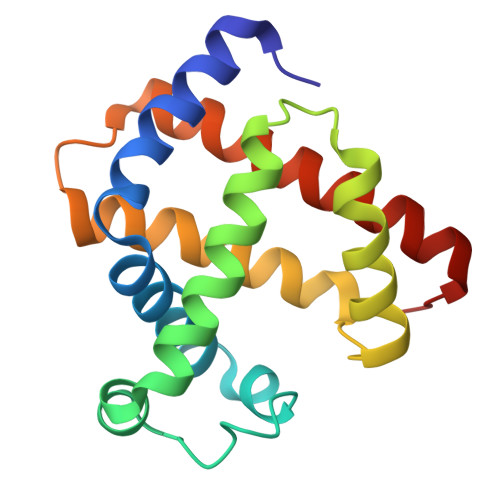
K45E-K63E Variant of Horse Heart Myoglobin


Experimental Data Snapshot

  • Method: X-RAY DIFFRACTION
  • Resolution: 1.60 Å
  • R-Value Observed: 
    0.181 (Depositor) 

Starting Model: experimental
View more details

wwPDB Validation 3D Report Full Report

Validation slider image for 1NZ3

This is version 1.6 of the entry. See complete history. 

Literature

Introduction and characterization of a functionally linked metal ion binding site at the exposed heme edge of myoglobin

Hunter, C.L., Maurus, R., Mauk, M.R., Lee, H., Raven, E.L., Tong, H., Nguyen, N., Smith, S., Brayer, G.D., Mauk, A.G.

(2003) Proc Natl Acad Sci U S A 100: 3647-3652

  • DOI: https://doi.org/10.1073/pnas.0636702100
  • Primary Citation Related Structures: 
    1NZ2, 1NZ3, 1NZ4, 1NZ5

  • PubMed Abstract: 

    A binding site for metal ions has been created on the surface of horse heart myoglobin (Mb) near the heme 6-propionate group by replacing K45 and K63 with glutamyl residues. One-dimensional (1)H NMR spectroscopy indicates that Mn(2+) binds in the vicinity of the heme 6-propionate as anticipated, and potentiometric titrations establish that the affinity of the new site for Mn(2+) is 1.28(4) x 10(4) M(-1) (pH 6.96, ionic strength I = 17.2 microM, 25 degrees C). In addition, these substitutions lower the reduction potential of the protein and increase the pK(a) for the water molecule coordinated to the heme iron of metmyoglobin. The peroxidase [2,2'-azinobis(3-ethylbenzthiazoline-6-sulfonic acid), ABTS, as substrate] and the Mn(2+)-peroxidase activity of the variant are both increased approximately 3-fold. In contrast to wild-type Mb, both the affinity for azide and the midpoint potential of the variant are significantly influenced by the addition of Mn(2+). The structure of the variant has been determined by x-ray crystallography to define the coordination environment of bound Mn(2+) and Cd(2+). Although slight differences are observed between the geometry of the binding of the two metal ions, both are hexacoordinate, and neither involves coordination by E63.


  • Organizational Affiliation: 
    • Department of Biochemistry and Molecular Biology and Protein Engineering Network of Centres of Excellence, University of British Columbia, Vancouver, BC, Canada V6T 1Z3.

Macromolecule Content 

  • Total Structure Weight: 17.6 kDa 
  • Atom Count: 1,285 
  • Modeled Residue Count: 153 
  • Deposited Residue Count: 153 
  • Unique protein chains: 1

Macromolecules

Find similar proteins by:|  3D Structure
Entity ID: 1
MoleculeChains  Sequence LengthOrganismDetailsImage
Myoglobin153Equus caballusMutation(s): 2 
Gene Names: MB
EC: 1.11.1 (UniProt), 1.7 (UniProt)
UniProt
Find proteins for P68082 (Equus caballus)
Explore P68082 
Go to UniProtKB:  P68082
Entity Groups
Sequence Clusters30% Identity50% Identity70% Identity90% Identity95% Identity100% Identity
UniProt GroupP68082
Sequence Annotations
Expand
Reference Sequence

Small Molecules

Ligands 1 Unique
IDChains Name / Formula / InChI Key2D Diagram3D Interactions
HEM

Query on HEM


Download:Ideal Coordinates CCD File
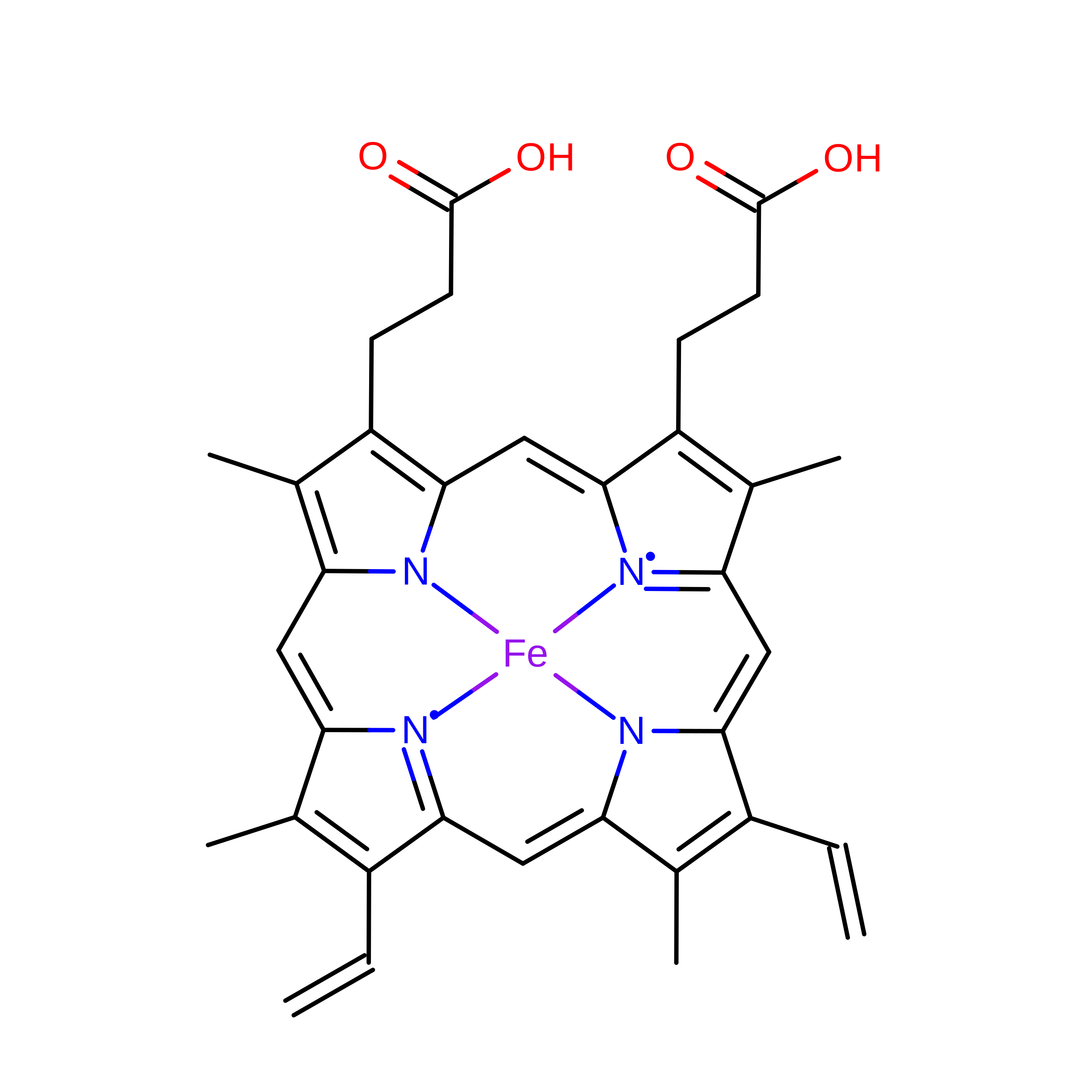
B [auth A]PROTOPORPHYRIN IX CONTAINING FE
C34 H32 Fe N4 O4
KABFMIBPWCXCRK-RGGAHWMASA-L

Experimental Data & Validation

Experimental Data

  • Method: X-RAY DIFFRACTION
  • Resolution: 1.60 Å
  • R-Value Observed: 0.181 (Depositor) 
Space Group: P 21 21 21
Unit Cell:
Length ( Å )Angle ( ˚ )
a = 29α = 90
b = 35.8β = 90
c = 125.8γ = 90
Software Package:
Software NamePurpose
X-PLORmodel building
PROLSQrefinement
X-PLORphasing

Structure Validation

View Full Validation Report


Entry History 

Deposition Data

Revision History  (Full details and data files)

  • Version 1.0: 2003-04-08
    Type: Initial release
  • Version 1.1: 2008-04-29
    Changes: Version format compliance
  • Version 1.2: 2011-07-13
    Changes: Version format compliance
  • Version 1.3: 2017-10-11
    Changes: Refinement description
  • Version 1.4: 2021-10-27
    Changes: Database references, Derived calculations
  • Version 1.5: 2023-08-16
    Changes: Data collection, Refinement description
  • Version 1.6: 2026-08-12
    Type: Remediation
    Reason: Metalloprotein remediation
    Changes: Derived calculations, Structure summary